


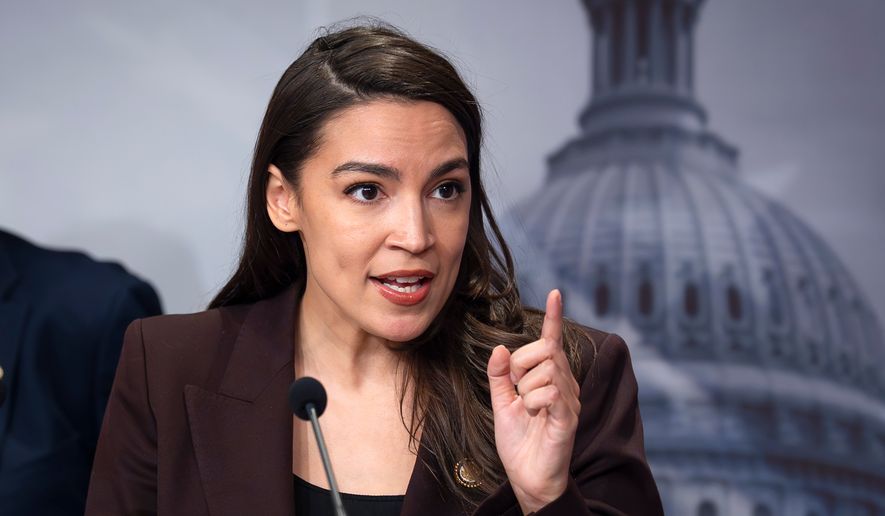

The speculation is getting louder about Rep. Alexandria Ocasio‑Cortez’s potential White House run.
When TMZ reported this week that she quietly split with her fiancé two years ago, the internet lit up — spurred by the timing of landed just days after she told followers she was freezing her eggs and planned to chronicle the process online.
The personal disclosures suggested she might be clearing space on her calendar and intensified the “she’s running” speculation across social media.
People were interested in these podcasts
It also arrived alongside a political win in Michigan, where she helped propel Abdul El‑Sayed to a narrow victory in the Democratic Senate primary, overcoming stiff opposition from the party establishment.
The victory gave Ms. Ocasio‑Cortez and the left wing the sort of win they have been looking for, one they can tout as proof the far-left message can travel beyond deep‑blue ZIP codes and into the battleground states that actually decide who lives at 1600 Pennsylvania Avenue.
Ms. Ocasio‑Cortez has done little to dampen speculation about her White House ambitions. She was asked about it on ABC’s “This Week,” which marked her first Sunday show appearance in over two years.
“I haven’t ruled out the possibility and I’m very humbled by the tremendous amount of support out there,” Ms. Ocasio‑Cortez said, adding that her attention is focused on the midterms.
She also kept open the possibility of challenging Senate Minority Leader Charles E. Schumer.
Polls show Ms. Ocasio-Cortez at the front of the pack of Democrats in a hypothetical 2028 nomination race.
Her approach has changed this election cycle.
Since shocking the political world with her 2018 victory over longtime Rep. Joe Crowley in New York City, she has regularly tossed her support behind like-minded far-left candidates. This year, she has been more selective.
She steered clear of hard‑fought races in New York City that could have soured relationships with Capitol Hill colleagues. Her endorsement list is also noticeably shorter — limited to a handful of candidates such as Mr. El‑Sayed in Michigan, Analilia Mejia in New Jersey, Junaid Ahmed in Illinois and David Orkin in New York’s Assembly.
She has a quieter presence than in past cycles, when she routinely jumped into contentious primaries and backed socialist-style insurgents against establishment Democrats.
That restraint reflects a broader political evolution that is also showing up in how she is distancing herself from some of the more radioactive ideas on the far left, including those pushed by Democratic Socialists of America, a group that has become a lightning rod inside Democratic politics.
As a member of the DSA chapter in New York, Ms. Ocasio-Cortez has fallen in line behind the group’s opposition to U.S. military aid to Israel, marking a change from the past when she was OK with supporting some defensive systems, including the Iron Dome.
At the same time, she has been far more selective about how closely she associates with DSA’s most radical positions.
Pressed on the DSA platform, which calls for defunding the Defense Department, abolishing the police and prison system and eliminating the U.S. Senate, she declined to embrace it. “No, but I think that this is a free country,” she said, adding that people “are free to do what you like” in organizing around such positions.
On calls to abolish prisons and police, Ms. Ocasio-Cortez said: “I have a local city councilman that has this saying, ’Woke 1 was crazy.’”
What matters, she said, is “what a candidate is saying” in the present, not positions staked out years earlier.
In the case of Ms. Ocasio‑Cortez, she still champions Medicare for All, is a vocal critic of federal immigration enforcement and wants to abolish ICE.

Please read our comment policy before commenting.