



OPINION:
America cannot rebuild its manufacturing base on top of an inefficient freight network.
Policymakers are investing heavily in reshoring production, strengthening domestic supply chains and expanding American manufacturing. But producing more goods at home is only half the equation. Manufacturers must also be able to move raw materials and finished products across the country quickly, reliably and at a competitive cost.
Today’s fragmented freight network often works against that goal. Many cross-country shipments must change hands between railroads at interchange points, where railcars can sit idle for hours or even days. Each handoff adds delay, uncertainty and expense — costs that ripple through production schedules, inventories and ultimately, consumer prices.
People were interested in these podcasts
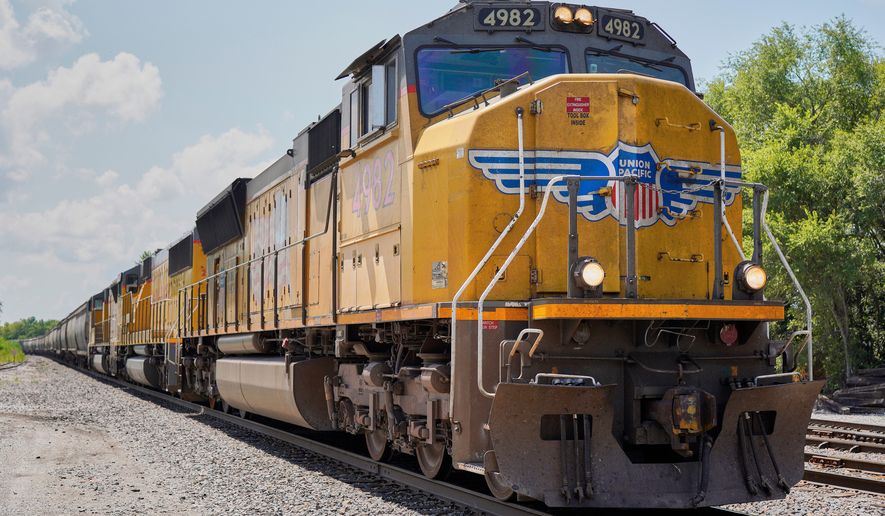
That is the context for the proposed Union Pacific–Norfolk Southern merger, announced nearly a year ago. After finding the initial application incomplete, the Surface Transportation Board accepted a revised application in May and is now reviewing supplemental information filed on July 27.
The transaction would connect largely complementary eastern and western networks, allowing thousands of freight routes to operate on a single line rather than requiring an interchange.
Rail carries the automobiles, chemicals, steel, lumber and industrial inputs on which American manufacturing depends. The STB’s review therefore involves more than whether two railroads should combine. It also requires asking whether the existing freight network can support the manufacturing economy that policymakers are trying to rebuild.
A central concern in any major merger is whether greater efficiency comes at the expense of competition. Rival railroads have an obvious incentive to resist a transaction that could make a competitor stronger, but their substantive concerns still deserve scrutiny.
Critics argue that the merger could reduce shipper options, concentrate too much traffic in one railroad and produce higher rates or service disruptions during integration. Those are legitimate issues for the STB to examine — and they are issues that Union Pacific and Norfolk Southern have increasingly addressed through enforceable commitments.
On July 22, Canadian National reached an agreement with Union Pacific and withdrew its opposition to the merger. Under that agreement, Canadian National would receive access to facilities where the transaction might otherwise reduce the number of Class I railroads serving customers.
This would also acquire Norfolk Southern’s interests in terminal railroads serving Kansas City and St. Louis and receive additional operating rights in parts of the Midwest. This agreement expands that competitor’s access to strategically important markets.
Five days later, Union Pacific and Norfolk Southern submitted additional customer protections. Their revised commitments nearly double the traffic eligible for the Committed Gateway Pricing program, from approximately 134,000 to 258,000 annual carloads, and extend the program to bulk unit-train customers such as grain shippers.
The program is intended to preserve pricing through existing gateways so that customers can continue using competing railroads rather than being forced onto the combined system.
The companies also report that fewer than 40 facilities out of more than 20,000 — less than 0.2% — would experience any reduction in access to Class I railroads. At those locations, they have committed to preserving access to another Class I carrier wherever legally and operationally possible.
A new Targeted Access Program would provide customers with temporary access to another railroad if service deteriorates during integration, while an expedited dispute process would allow the STB to intervene if promised benefits do not materialize.
From an economic standpoint, these are meaningful safeguards. They directly target the two principal risks created by a major rail merger: the loss of competitive access and the possibility that service deteriorates while the networks are combined.
But the STB must weigh the merger with these protections against the economic costs of preserving today’s fragmented network. Connecting these largely complementary systems would convert approximately 10,000 routes to single-line service and create another 88,000 potential single-line lanes, eliminating costly interchanges that tie up working capital — especially when annual inventory carrying costs average roughly 25% of a product’s value.
With estimated annual savings of $3.5 billion, maintaining the status quo carries its own substantial cost.
The potential benefits become more important as manufacturing returns to North America. Companies are reshoring production, expanding domestic facilities and building shorter, more resilient supply chains. As domestic production grows, the portion of the supply chain operating within the United States also grows.
That makes the efficiency of the country’s internal freight network increasingly important to American competitiveness.
The STB must determine whether the proposed safeguards adequately protect competition while also accounting for the economic costs of leaving the current network unchanged.
Washington cannot call for a manufacturing comeback while treating the network that moves American goods as an afterthought. American manufacturing needs a freight system capable of matching its ambitions.
• Danielle Zanzalari, PhD, is an assistant professor of economics at Seton Hall University. She frequently researches on financial regulation, public finance and an array of economic efficiency issues.

Please read our comment policy before commenting.