



OPINION:
The Labor Department under President Trump has aimed to root out widespread waste and abuse in insurance, our nation’s most important workplace safety net. But it should also focus on another egregious fraud: the skimming by some states off the gig economy.
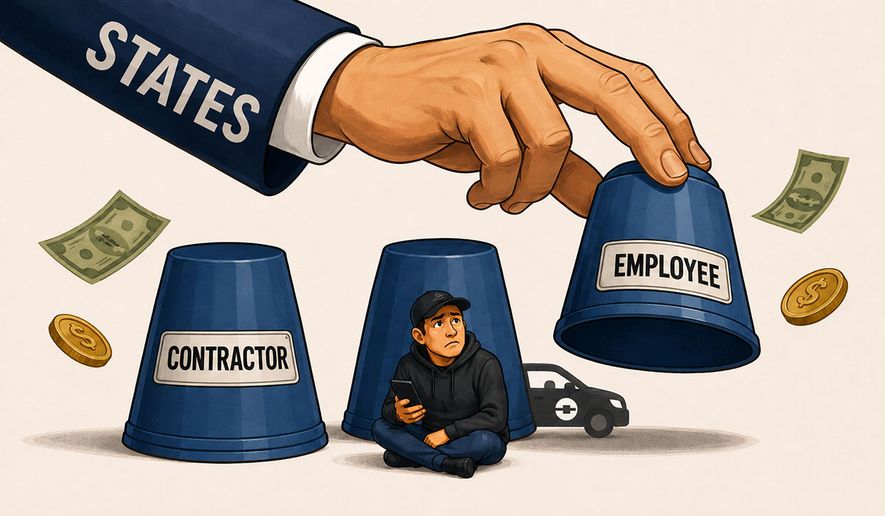
These states extracted millions of dollars in federal relief money by treating gig workers as non-employees during the pandemic, but they are now calling those same workers employees in an effort to extract unemployment payments from gig platforms.
The result of this hypocrisy is a double payout — and an indirect tax on the people who use platform services.
People were interested in these podcasts
On June 17, as part of the administration’s historic effort to take on fraud, Acting U.S. Labor Secretary Keith Sonderling demanded immediate action from the governors of every state and territory to combat waste, fraud and abuse.
The same day, the department announced the recovery of more than $512 million in fraudulent CARES Act unemployment payments, bringing recoveries from Maryland alone to more than $1 billion.
These efforts are a welcome development. COVID-19 relief fraud was a criminal assault on unemployment insurance that undermined the stability of the system.
The unemployment insurance system is a federal-state partnership: It works only when both partners are good stewards of taxpayer money. The administration is right to expect states to do their part, but despite the administration’s recent efforts, huge pockets of fraud remain—one of the largest being states that are milking the so-called gig economy.
The most concrete example is New Jersey. In 2020, it allowed thousands of gig workers to apply for benefits under the Pandemic Unemployment Assistance (PUA) fund. That fund was set up for self-employed people, including gig workers, who weren’t covered by the normal unemployment system.
By acknowledging that gig workers are self-employed, New Jersey was able to siphon millions of federal relief dollars into its coffers. Fast forward to 2022, when the relief money had dried up, and New Jersey took the opposite position. It demanded that Uber and a subsidiary pay $100 million into its unemployment trust fund after the state’s labor department asserted that nearly 300,000 drivers had been misclassified as independent contractors.
In other words, the state flipped its position to extract more money.
Other states are also testing the boundaries. Massachusetts sued Uber and Lyft on the theory that their drivers were employees under state wage law. The companies eventually paid a total $175 million to settle the case.
A 2024 state auditor report separately examined whether “transportation network companies” like Uber and Lyft were avoiding obligations to unemployment and other public programs by classifying drivers as independent contractors.
This trend should concern the U.S. Labor Department, which is responsible for state compliance with the unemployment insurance regime created when Congress enacted the Federal Unemployment Tax Act (FUTA).
The issue isn’t whether states should combat genuine misclassification of employees. The abuse of the system arises when states insist on having their cake and eating it too. They’re happy to treat gig workers as contractors when there are federal dollars on the table. But when those dollars run out, they take the opposite position and say, ’Never mind, gig workers are really employees.’
The result is double taxation and higher costs for the average consumer.
This kind of fraud also distorts the unemployment system more broadly. Once states attach unemployment taxes to contracting rather than employment, there is no limiting principle. Why should states stop with big gig-economy companies like Uber and DoorDash? Freelance writers, consultants, software developers, photographers, musicians and other independent professionals could come next.
And where there are dollars to be found, you can bet that cash-hungry states will eventually come after them.
The Trump administration understands that fraud threatens unemployment insurance by draining funds. State mission creep poses a different danger. It changes what the program is.
If the evolving economy demands it, Congress could create some form of income protection program for independent workers. Until it does, states shouldn’t misuse FUTA’s machinery to enact that policy themselves.
• Thomas Beck served as an adviser to both Trump presidential transitions and spent more than a decade leading labor and employee relations for the nation’s largest healthcare system. Prior to that, he served as Chairman of the Federal Labor Relations Authority and practiced labor law at global law firm Jones Day.

Please read our comment policy before commenting.