



A version of this story appeared in the daily Threat Status newsletter from The Washington Times. Click here to receive Threat Status delivered directly to your inbox each weekday.
ISTANBUL —The Trump administration’s push to open Libyan oil as a Gulf-supply alternative during the war with Iran is on the rocks after an assassination, a central banker’s move to quit and a week of drone strikes and explosions that ran into Sunday.
A blast over the weekend at an electrical substation at the Zawiya oil complex cut power to Tripoli, Zawiya, Sabratha, Surman and Gharyan, according to Libya’s General Electricity Co., and officials were investigating whether the incident is tied to a series of armed drone attacks.
The drone strikes in recent days have targeted energy infrastructure in western Libya, which the internationally recognized government in Tripoli controls. The eastern half of the country is controlled by a Benghazi-based warlord, Gen. Khalifa Haftar.
People were interested in these podcasts
The same power plant hit Sunday was struck four days earlier by an explosive drone, cutting power and prompting General Electricity to suspend work and withdraw its technical teams from the nearby plant Chevron and ExxonMobil are counting on as they enter the Libyan market.

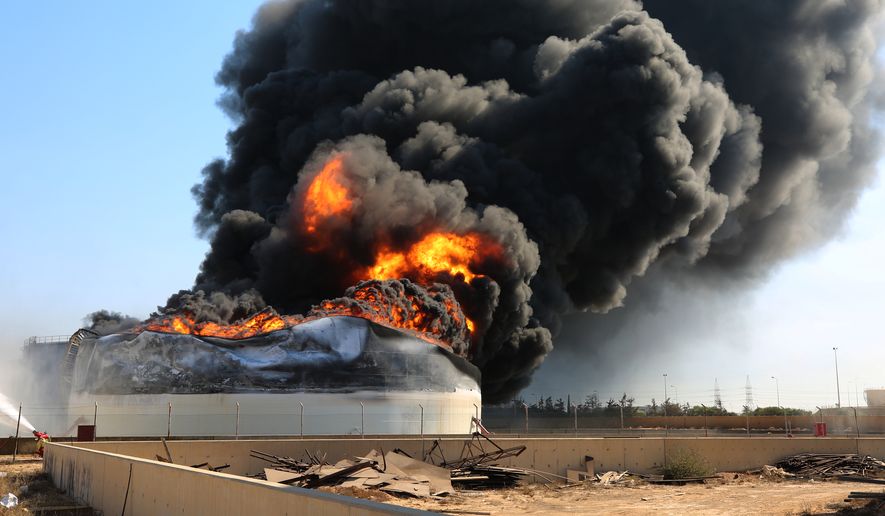
Over the last week, at least six drone strikes have hit a refinery, an electric plant, substations and storage tanks near the coastal city of Zawiya, about 30 miles west of Tripoli.
The attacks came on the heels of an Aug. 10 car bombing in Benghazi that killed one of Gen. Haftar’s top intelligence officers.
A day earlier, the governor of the Central Bank of Libya, which answers to leaders in both halves of the split nation, submitted a letter of resignation that both Benghazi and Tripoli rejected.
In less than two weeks, Libya’s energy infrastructure, security apparatus and main east-west economic institution all came under pressure — the same three pillars Massad Boulos, President Trump’s senior adviser for Arab and African affairs, set out in Washington in April as the basis for reuniting Libya and opening more of its oil to American companies.
Iran’s closure of the Strait of Hormuz has choked a route that normally carries roughly a fifth of the world’s oil and liquefied natural gas. Libya is part of Washington’s answer to Tehran.
Mr. Boulos said in April that Libya would reach 1.6 million barrels of oil a day in the short term and 2 million to 3 million by the end of the decade.
Chevron’s return to Libya was the biggest American oil move in decades.
The company won a Sirte Basin contract earlier this year, followed by ExxonMobil signing an agreement covering four offshore blocks. Libya holds 41% of Africa’s proved oil reserves, more than any other country on the continent.
Libya pumped 1.44 million barrels a day in June, its highest since 2013 but still short of the 1.6 million produced before the 2011 uprising that eventually split the country. The Zawiya refinery near Tripoli processes 120,000 barrels a day carried roughly 450 miles from the Sharara field, operated by Spain’s Repsol with France’s TotalEnergies, Austria’s OMV, Norway’s Equinor and Libya’s National Oil Corp.
But the instability in Libya threatens American interests in the wider region, said Wolfgang Pusztai, an Austrian security analyst who served as defense attache in Libya and chairs the National Council on U.S.-Libya Relations advisory council.
Washington’s aims, he told The Washington Times, are to stabilize the country, counter Russia’s military presence in Africa, increase Libyan oil production, control migration to Europe and counter Chinese influence over southern Libyan minerals. “The Boulos initiative is more an opportunity to further U.S. interests from where they stand now,” he said.
Mr. Boulos condemned the refinery attacks and the killing in a post on social media on Wednesday, calling for investigations and urging Libyan stakeholders to “redouble their efforts to overcome divisions.”
“We cannot deal with the three events as three separate incidents, nor can we jump to the conclusion that a single plot lies behind them,” said Hany El-Aasar, executive director of Egypt’s National Center for Studies. What matters, he told The Times, is that Libya’s security, energy and economic institutions came under pressure at the same moment Washington was trying to bind them together.
“In terms of the perpetrators, the three hits are not connected,” said Omar Khattaly, a Libyan American consultant who formerly ran the real estate fund of Libya’s sovereign wealth fund and visited Tripoli in late July. “But they are connected through the current weak structure of the Libyan state. This is all about money, power and control.”
Split country
Libya has been divided since 2014. Prime Minister Abdulhamid Dbeibah runs the west, the Government of National Unity in Tripoli. Gen. Haftar, an 82-year-old dual American Libyan citizen who lived for two decades in Virginia, commands the east and much of the south through the Libyan National Army.
Neither man has faced an election. Turkey supports Mr. Dbeibah with troops and drones. Egypt, the United Arab Emirates and Russia have backed Gen. Haftar. Russia’s Africa Corps still holds positions in the eastern desert and Chinese companies compete for mineral concessions in the south.
The current division dates to the 2011 NATO intervention that toppled Moammar Gadhafi. Then-President Obama, whose administration joined France and Britain in leading the air campaign, later called the failure to plan for post-Gadhafi Libya his worst foreign-policy mistake. Fifteen years on, the Trump administration is attempting to assemble a bargain from the pieces the intervention left behind.
The arrangement under discussion would preserve Mr. Dbeibah’s influence in Tripoli through a central role for his nephew while elevating Gen. Haftar’s 35-year-old son Saddam Haftar to lead a new national executive council. Washington would offer American oil investment and press for the release of frozen Libyan assets. Elections would come later, if at all.
The clearest evidence the approach can work came April 11, when the rival eastern and western legislative chambers approved a unified national budget of 190 billion Libyan dinars, roughly $30 billion — the first since 2013.
Under attack
The Zawiya strikes began at 3:45 a.m. Aug. 8, when an explosive-laden drone punctured a fuel-storage tank.
Attacks followed daily. The National Oil Corp. warned it could halt refinery operations if the attacks continued.
The Petroleum Facilities Guard said initial findings pointed to first-person-view drones launched from inside Libya.
Some analysts say the central conflict pits two militias that both answer, on paper, to the Tripoli government — the First Support Division under the interior ministry and the rival 103rd Battalion under the defense department. Mohamed Bahroun, leader of the First Support Division, denied responsibility for the drone strikes and called them “an act of terrorism.”
Central Bank of Libya Governor Naji Issa’s resignation, dated Aug. 9, went to both the eastern House of Representatives and the western High Council of State. Both chambers refused to accept it, and Mr. Issa remained at his post through the weekend. He was the first Libyan central banker approved across the political divide, and the central bank he runs is one of the few national institutions both sides accept.
It distributes oil revenue between east and west, and its governor sits at the center of the revenue-sharing arrangement holding the American initiative together. Libyan analysts linked his move to quit to disputes over the U.S.-mediated unified spending agreement and pressure from a weakening dinar. Mr. Issa said only that his reasons were too sensitive to state.
Mr. Boulos had singled out Mr. Issa for praise in his April speech, calling it commendable that “representatives from both sides set aside their differences for the good of the country, and especially Central Bank of Libya Governor Naji Issa.”
A bomb attached to his car killed Maj. Gen. Fawzi al-Mansouri after evening prayers in Benghazi’s Hawari district. He commanded military intelligence for Gen. Haftar’s forces. Saddam Haftar would have inherited him as a central figure in the eastern security apparatus. No group has claimed responsibility.
“Selecting a president from the east and a prime minister from the west to establish a unified government is a reasonable approach,” Mr. Pusztai said. “But I doubt that the reported candidates — Saddam Haftar for president and Abdulhamid Dbeibah for prime minister — will be widely accepted.”
Negotiating a re-union
Six weeks ago, Saddam Haftar met Secretary of State Marco Rubio in Washington to discuss Libyan-led reunification. Four days earlier, Abdulsalam al-Zoubi, the Tripoli government’s deputy defense minister, met Mr. Boulos and senior State Department officials.
Misrata, western Libya’s most powerful city outside the capital and the force that stopped Gen. Haftar’s advance on Tripoli in 2019, has rejected the framework. Sheikh Mohamed al-Rajoubi, chairman of the city’s Council of Notables and Elders, told Al Jazeera Arabic that the council had received no written proposal from Mr. Boulos despite months of consultations.
Turkish Foreign Minister Hakan Fidan arrived on Egypt’s Mediterranean coast Wednesday after stops in both halves of Libya. He met Mr. Dbeibah in Tripoli a day earlier, then traveled to Benghazi for meetings with Saddam Haftar and his father. Egypt, Turkey, Saudi Arabia and Pakistan also consult as the Regional Four, whose foreign ministers met in Cairo in June alongside talks with Mr. Boulos. Days before Mr. Fidan’s Libya trip, Saudi Arabia, Turkey and Pakistan signed a trilateral defense pact in Mecca.
Each R4 member brings something Washington needs. Turkey holds military dominance over western Libya through drones and naval assets, in a deployment its parliament extended through early 2028. Egypt underwrites eastern security through the apparatus Maj. Gen. Mansouri helped run. Saudi Arabia holds the financing. Pakistan has signed a $4 billion arms agreement with Gen. Haftar’s forces.
The Egypt-Turkey rapprochement is the bright spot in Washington’s Libya calculation. Cairo and Ankara spent 2019 arming opposite sides of a Libyan civil war and severed diplomatic relations for a decade. Their coordination on the Boulos framework — Fidan meeting Egyptian Foreign Minister Badr Abdelatty at El Alamein after his shuttle to Tripoli and Benghazi — signals that neither capital plans to countermove against the other’s Libyan clients. Without that mutual restraint, the American initiative would collapse back into proxy war. The United Arab Emirates, which backed Gen. Haftar for a decade, has not publicly commented on the Zawiya strikes.
“Egyptian-American agreement on the Libyan file is a strategic necessity for both sides,” Mr. El-Aasar said. Washington does not want Libya contested by Russia, whose preoccupation with Ukraine the U.S. may want to exploit.
The Trump administration has increasingly favored power-sharing deals built around actors who already hold territory. Similar frameworks shaped U.S. policy in Gaza, Syria and early Kurdish diplomacy. Libya was to be the first success story, because its oil offered an immediate payoff at exactly the moment the Iran war was closing others. Four months after Mr. Boulos laid out his three tracks in Washington, all three are under strain.
“On the ground, Libyans see Boulos as a broker seeking financial benefits from possible future oil contracts,” Mr. Khattaly said, “and would rather see more direct involvement from the U.S. secretary of state and the State Department.”

Please read our comment policy before commenting.