



NEWS AND ANALYSIS:
A continent and ocean away from the pageantry and theatrics of the U.S.-China summit last week, the commander of the Pacific Command revealed details on his effort to deter and, if needed, win a war against China.
Adm. Samuel Paparo, the fighter pilot commander, says he is aligning with ancient Chinese military strategy of defeating enemies without firing a shot.
“I’m almost quoting Sun Tzu when I say winning without fighting is the acme of skill,” the four-star admiral told Time magazine in quoting “The Art of War.” “Mission success for me is not to fight and win a war; it’s to provide a deterrent capability so that we never go to war in the first place.”
People were interested in these podcasts
Central to the admiral’s strategy are plans drawn from Ukraine’s war against Russia in using new battlefield techniques such as drone swarms to target Chinese forces in any future invasion of Taiwan, the major U.S.-China flash point in the Pacific theater.
Adm. Paparo calls the strategy a “hellscape” powered by masses of armed drones attacking Chinese amphibious forces crossing the 100-mile-wide Taiwan Strait separating the island from the mainland.
“We’ve seen that assault warfare, whether that is an amphibious assault, an airborne assault, has become a much more costly human endeavor,” he said. “In the ways that Ukraine is about a 600-mile-by-30-mile hellscape of drone warfare, I seek to put those principles at work to deter an armed invasion.”
The objective for U.S. forces is to apply 21st-century military technology to the battlefield. “We need not gain air or maritime superiority of a space; we need only deny its use to aggressors,” he said.
Pacific Command’s current strategy is deterrence by denial, he said.
“It’s a way of expressing that we’re not seeking the overthrow of the Communist Party,” he said. “It’s just that you should know that where America’s direct vital interests are involved, there’s a high probability of denying your aggression.”
If deterrence fails and war with China breaks out, “I am confident in our ability to prevail,” Adm. Paparo said. “What I am working toward is the margin by which we do, and that margin expresses itself in lives, capability, money, and time. I want to drive that bill down to zero.”
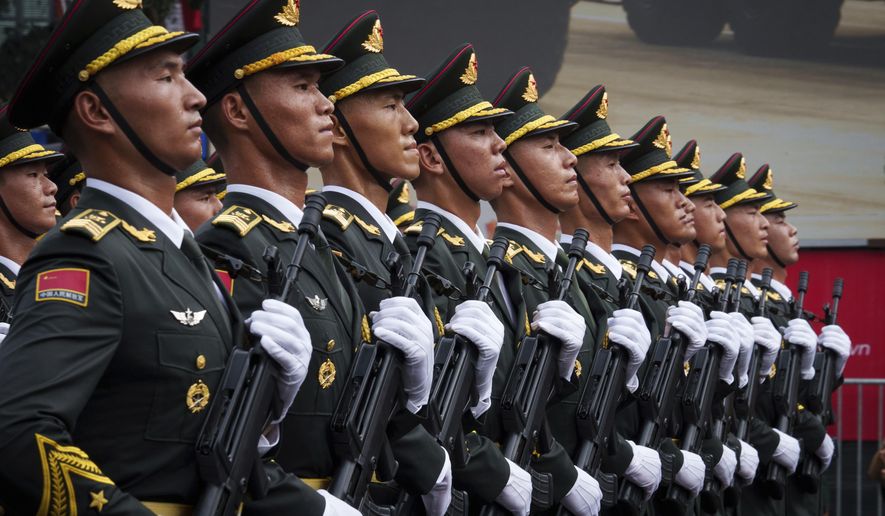
On China’s large-scale, rapid buildup of military power, the commander said the People’s Liberation Army is engaged in an historic expansion that is “an exponential increase in military power, and more specifically, in power projection capability.”
Some 25 years ago the PLA deployed about 37 warships. Today China has 12 times that number — about 444 warships.
Reflecting what appears to be a war footing, Adm. Paparo said over the past 18 months, the PLA navy deployed two cruisers, eight destroyers, eight frigates, one aircraft carrier, 11 submarines, four amphibious ships and four long-range combat logistics ships.
Chinese space weapons, missiles and a rapidly expanding nuclear force are a particular concern. “They’re moving toward world reach,” he said.
Japanese defense minister repeats call for nuclear arms debate
Japanese Defense Minister Shinjiro Koizumi this week again urged his government to urgently debate acquiring nuclear weapons amid growing nuclear threats from China.
The minister said during a three-hour television interview that Tokyo also should consider acquiring nuclear-powered submarines to bolster its limited but modernizing self-defense forces.
“Japan is being watched by the international community. It is watching what kind of security strategy Japan develops,” he said on the satellite news outlet BS Fuji.
“Regarding the issue of nuclear weapons [and Japan’s Three Non-Nuclear Principles], and presumably the issue of nuclear-powered submarines, I think these are things that previously were difficult to discuss. My position is that we should discuss them without taboos and without excluding options,” Mr. Koizumi said.
It was the second time the defense minister called for a debate on nuclear weapons. He made similar comments in July.
The defense minister also said the debate in the one time constitutionally pacifist nation should be held without restrictions or without making decisions in advance and insisting the discussion of building nuclear weapons is unacceptable for Japan “is somewhat at odds with my sense of urgency.”
The widely reported comments prompted Mr. Koizumi to issue a statement a day later explaining that he did not mean Japan had decided to acquire nuclear weapons or nuclear submarines.
In the Monday broadcast interview Mr. Koizumi noted the expanding nuclear arms threat from China and he rejected Beijing’s propaganda claim that Japanese military modernization is a “new militarism.”
Japan does not possess nuclear weapons or strategic bombers while China has deployed substantial numbers of both, he said.
Japan boasts a highly developed nuclear power infrastructure and analysts estimate that if a decision were made to build nuclear arms, Tokyo could do so within six months to three years.
In Beijing, a Foreign Ministry spokesman condemned the defense minister’s remarks and urged Tokyo to abide by its obligations under the Nuclear Non-Proliferation Treaty.
“Japan is a non-nuclear-weapon state party to the Non-Proliferation Treaty and therefore has a bounden duty under international law to not receive, manufacture, acquire or transfer nuclear weapons. There is no room for negotiation,” Ministry spokesman Guo Jiakun told reporters.
Critics note China’s urging adherence to NPT guidelines is hypocritical based on past Chinese technology and material transfers to nuclear arms programs in Pakistan, Iran, North Korea and Libya in violation of NPT obligations.
Official Japanese statements on debating nuclear weapons is viewed by analysts as part of Tokyo’s effort to counter Chinese cognitive warfare against Japan.
Raising the prospect of the nuclear debate in strategic messaging is aimed at disrupting Beijing’s psychological dominance and challenges regional deterrence assumptions.
“Beijing has dramatically ramped up its belligerence toward Japan since Prime Minister Takaichi entered office in October 2025,” stated a report by the Jamestown Foundation.
Japan is developing countermeasures but needs better strategic messaging to blunt the aggressive cognitive warfare from Beijing, the report said.
President Trump discussed Japan’s worries about China during a phone call with Japanese Prime Minister Sanae Takaichi hours after his summit with Chinese President Xi Jinping. The discussion included security related to China, Ms. Takaichi told reporters.
Carrier deployment to close gap near China
The Navy is closing an aircraft carrier gap caused by the lack of a deployed strike group near China with the dispatch of USS Theodore Roosevelt from San Diego on Sunday.
“The Theodore Roosevelt carrier strike group is underway conducting routine operations in the U.S. 3rd Fleet area of operations,” a Navy Pacific Fleet spokesman told Inside the Ring.
The 3rd Fleet is part of the Pacific Fleet and its area includes waters from western Alaska through the central Pacific west of Hawaii.
The fleet leads naval forces in the region and provides realistic, relevant training for the Navy in conducting “the full spectrum of military operations — from combat operations to humanitarian assistance and disaster response,” the spokesman said.
The fleet is working with allies and partners to advance freedom of navigation and overflight, rule of law, and other principles supporting regional security.
It could not be learned if the Roosevelt will replace the USS George Washington in the Pacific or sail to the Middle East and allow that carrier to return to its home region.
Navy policy prohibits discussing future operations or warship movement to protect operations security, the spokesman said.
The warship was first seen on video leaving San Diego harbor by ship spotters with no official announcement by the Navy.
The Roosevelt is said to be heading to the Middle East to replace the Washington carrier strike group that was moved from the western Pacific to relieve the long-deployed USS Abraham Lincoln carrier.
The Washington is the Navy’s sole forward-deployed carrier, based in Japan, and its Aug. 19 deployment to Iran left the region without a strike group.
That carrier moved to the Middle East after the Lincoln spent more than eight months in the region without a port call and amid reports of morale problems on board.
Military analysts say American carriers, each equipped with a large number of warplanes and about 5,000 sailors, are major U.S. strategic power projection platforms and critical for deterring adversaries. The lack of a carrier near China created a temporary increased risk.
“The lack of deployed carriers in the Pacific is not a security threat today. However, it does mean that the U.S. has fewer tools available if a crisis or conflict occurs,” Mark Cancian, with the Center for Strategic and International Studies, told Stars and Stripes in August.
The Lincoln is currently on its way to the home port of San Diego and sailing east in the central Pacific.
The Roosevelt strike group could either be a ready force for responding in the Asia-Pacific region while on its way to waters near Iran or eventually sail on to the Middle East and allow the Washington to return to Pacific waters.
Since the outbreak of hostilities with Iran, the Navy has deployed two carrier strike groups to the Middle East, along with an amphibious ready group and a dozen other warships.
President Trump on Wednesday again raised the specter of resuming large-scale military action against Iran in pressuring Tehran into reaching a deal to end the conflict.
Mr. Trump said the war would be won very quickly “one way or the other.”
“They’ll either be one way, or the other. Does anyone know what that means?” he said.
The comment likely refers to the president’s remarks at the United Nations General Assembly last week when he threatened to “annihilate the Islamic Republic” unless an agreement ending the conflict is reached.
• Contact Bill Gertz on X @BillGertz.
Contact the author

Please read our comment policy before commenting.