



OPINION:
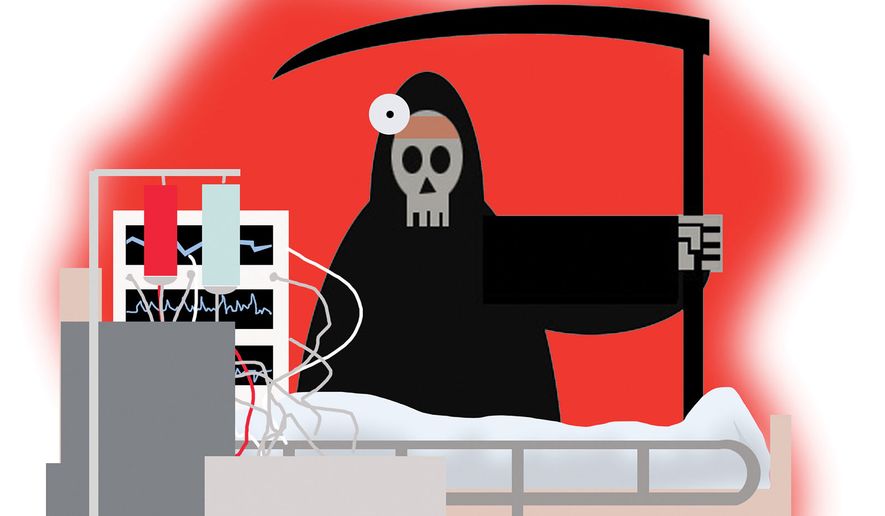
Always care, never kill. This philosophy guides many Catholic hospice workers in New York. But as of this month, the integrity of religious hospice care may be compromised by a pernicious practice spreading nationwide: assisted suicide.
Religious healthcare providers consider assisted suicide a violation of human dignity. The Catholic Church forbids assisted suicide and other forms of “mercy killing,” and these healthcare workers shouldn’t be forced to participate in practices that oppose their deeply held religious beliefs.
Yet the Medical Aid in Dying Act might do exactly that.
People were interested in these podcasts
The bill, which took effect on August 5, authorizes physicians to write prescriptions for lethal drugs for terminally ill adults. These drugs are self-administered by the patient to cause death.
Physicians are also required to “provide information and counseling” under the Palliative Care Information Act, which obliges physicians to offer terminally ill patients information about end-of-life options. Those options now include elective death.
A coalition of more than 10 Catholic groups has filed a lawsuit arguing that New York’s statute violates their right to free exercise of religion.
But this bill and others like it threaten not only religious liberty, but the religious and moral principles necessary to secure the “blessings of liberty” for us and our progeny: intrinsic human value. Or, in more familiar terms, that “all men are created equal, endowed by God with certain unalienable rights.”
All human life is valuable and, therefore, worth living. The Sisters of Hawthorne faithfully apply this principle to care for the elderly. Says Marie Edward, superior general of the Dominican Sisters of Hawthorne: “For over 125 years, we have ministered to the poor who are dying of cancer as if they were Christ Himself. Our calling is to offer comfort, prayer, and loving medical care to those in their final days — not death.”
The sisters operate a home with 42 beds for cancer patients with terminal diagnoses. It’s clear that, in their view, it can never include suicide. It is rooted in an unconditional compassion for the dying, “lovingly giving them food and drink, tending their wounds, lightening the burden of sickness where possible and, above all, ensuring they are never alone.” They remain at the bedside of the sick to “bear witness to their unique and unrepeatable value.”
This is love in its truest form: Unyielding devotion even when it cannot be reciprocated. But it is now being replaced by the “mercy” of death. In fact, one of the leading national advocacy groups for assisted suicide, Death with Dignity, consistently speaks of assisted suicide as “peaceful, humane, and dignified.”
Groups like Death with Dignity may dress their arguments up in flowery human-rights language, but that doesn’t change their substance: grounding human value in our ability rather than our nature.
This view has implications at the beginning of life as much as at its end. Massachusetts just passed a law removing its 24-week gestational limit on abortion. While the old limit included exceptions for the mother’s “physical and mental health” and “grave fetal diagnosis,” several women were unable to get late-term abortions for their severely disabled babies — prompting activists to campaign for the limit to be removed.
Nicole Martin’s story was central to the movement to liberalize abortion in the state. At 31 weeks pregnant, doctors discovered that her son’s brain had stopped growing. They told her he “would never talk, walk or eat on his own.”
The doctors couldn’t pursue abortion because they couldn’t determine whether the diagnosis met the statutory exception of a “grave fetal diagnosis.” So Ms. Martin and her husband flew to Washington — where there is no gestational limit — for an abortion.
The baby’s name was Daniel. He would have lived a life of limited ability, similar in kind to the limitations of cerebral palsy or profound intellectual disability.
Yet it is impermissible to kill such individuals, even if we feel inconvenienced by watching them suffer or forget that many of us will become like Daniel at some point in our lives: incapable of talking, walking or eating on our own.
Our society faces a choice in how it treats its Daniels. Progressives answer with death, categorizing the weak, needy, and vulnerable in a manner reminiscent of a Nazi-era slogan: “life unworthy of life.”
We must choose a different path, the path of the Sisters of Hawthorne: bearing witness to the “unique and unrepeatable” value of every human being. Only by embracing their courageous and unrelenting view of human value can we reject the dangerous slippery slope of assisted suicide.
• Liana Graham is a researcher in domestic policy at The Heritage Foundation, and Dawson Knaul was a member of Heritage’s Young Leaders Program.

Please read our comment policy before commenting.