



OPINION:
As an American business leader working around the globe, I have seen the cycles of conflict and strife that have destroyed so many families in the Middle East. I also know because I am one of them.
My son, Itay Chen, was the youngest U.S. citizen abducted and kidnapped by Hamas on Oct. 7, 2023. His kidnappers withheld information about his status — whether he was alive or not — for 760 days, inflicting inhumane psychological terrorism on my family.
Itay was finally returned as the last U.S. hostage and his remains brought home for burial in November 2025.
People were interested in these podcasts
Inevitably, in time, the conflict with Iran will end, economies will sputter to life, and the combatants will uneasily await the next explosion.
How can President Trump possibly stop this unending cycle, which will bring more pain to new families in the region?
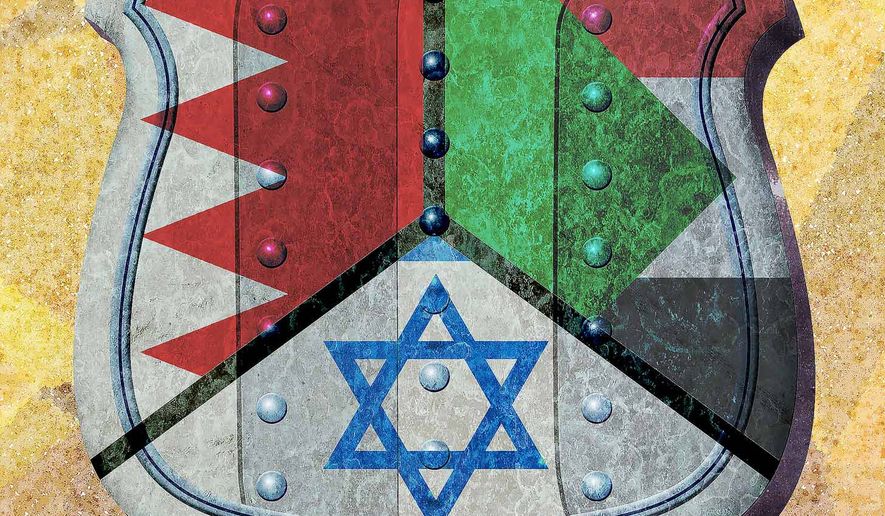
I believe that Mr. Trump has created a unique opportunity to permanently shape a new Middle East. He can offer the people of the region something better than war. The Abraham Accords are a living framework for political and economic integration and prosperity that can endure for centuries.
It is worth remembering how unlikely the accords seemed in 2020, when the United Arab Emirates and Bahrain became the first Arab states in a generation to normalize relations with Israel without conditioning progress on a comprehensive peace with the Palestinians.
Five years later, this unlikely agreement is the only durable architecture of security and commerce the region has produced this century. UAE-Israel trade alone topped $1.4 billion last year. Defense-technology cooperation between Washington and its accords partners is now moving through Congress as bipartisan legislation.
The India-Middle East-Europe Economic Corridor (IMEC) — a trade route linking India, the Gulf and Europe through Israel — is a direct response to Beijing’s Belt and Road ambitions. And it exists on paper because the accords partners were willing to sit at the same table.
Mr. Trump understood better than most of us that the accords could yield more than alliances between governments. As a dealmaker, he understood that the accords are a foundation for normalized relations that enable trade routes, joint ventures and shared security cooperation.
The accords have survived their first major test, even as the Iran conflict continues. Amid true instability, they remain the most viable diplomatic and economic framework for the future.
Mr. Trump and the congressional leaders working to keep the Iran war from tearing the region apart have real political capital to spend with the Gulf States. And they should spend it on expanding the Abraham Accords, which will benefit not just the Middle East but also the U.S. economy and the American people.
Israel’s leadership coalition is opposing progress and the expansion of the Abraham Accords. Prime Minister Benjamin Netanyahu’s coalition partners have rejected accords-related economic deals that will benefit Israelis and Americans.
And every month the Board of Peace plan in Gaza is rejected, it is a month when the Hamas leaders regain their grip on Gaza and the region creates alternative national security frameworks, such as the pact between Saudi Arabia, Turkey and Pakistan.
Mr. Netanyahu and his conservative political coalition owe Mr. Trump — who has protected Israel’s interests through this crisis — a more concrete plan for how they will positively contribute to the fulfillment of the Abraham Accords.
Beyond Israel, now is the time for maximum American pressure on the leaders of the region. Washington should apply the same combination of private insistence and public expectation-setting to Jerusalem, Riyadh, Ankara and Doha that it is applying to Tehran.
A partner who blocks the president is not a bystander, but an obstacle.
The Middle East remains unsettled; pretending otherwise would be foolish. But an unsettled region with a working framework for turning adversaries into trading partners is a fundamentally different (and far more hopeful) situation than the one Washington faced a year ago.
The Abraham Accords did not happen by accident, and they will not expand by accident. I lost my son to regional violence and instability; the accords are the only existing framework to move out of war with a path to peace and prosperity.
If we embrace the U.S. commander-in-chief’s vision of political and economic integration, President Trump will not only cement his presidency; he will also deliver something worthy of a Nobel Peace Prize.
• Ruby is the father of Itay Chen, a 19-year-old Israeli-American who was killed by Hamas terrorists on Oct. 7, 2023. Itay was held by Hamas until November 2025, when he was returned for burial.

Please read our comment policy before commenting.