



OPINION:
Faith makes life sparkle, and life without it is grim. This has been understood since biblical times, as Hebrews 11:1 attests: “Now faith is the substance of things hoped for, the evidence of things not seen.”
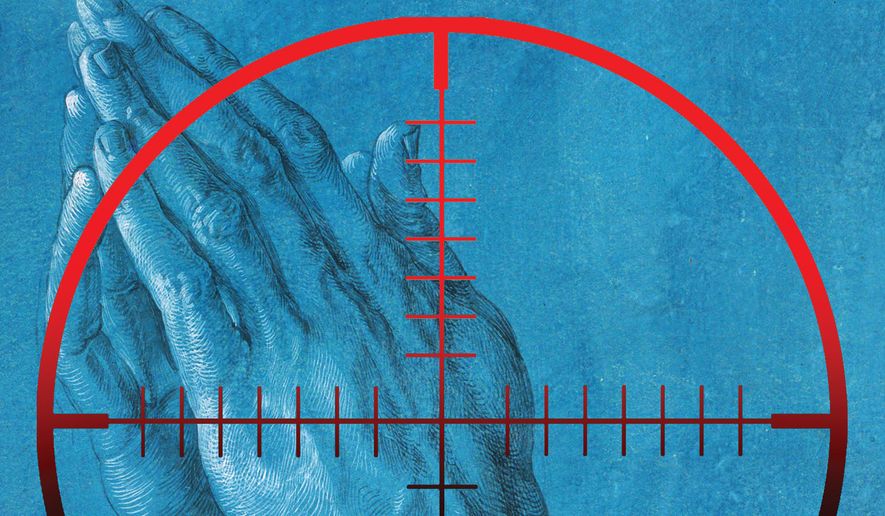
Religion, as the wellspring of both faith and hope, is, though, under assault in the modern era. The consequence of placing belief in the crossfire can only be a forlorn world.
The disheartening trend in the treatment of religion is found in a study released in June by the Pew Research Center. Among the key findings: The number of nations exhibiting high or very high levels of social hostility toward religion surged for the fourth year in a row in 2023, the most recent year covered by the center’s annual survey.
People were interested in these podcasts
In the aftermath of the Oct. 7, 2023, Hamas attacks on Israel that year, 55 nations of 198 surveyed displayed elevated levels of social hostility – up from 40 in 2020 and the most since the Arab Spring uprisings of 2012.
Countries that led the survey’s social hostility index tracking religious harassment and violence were Nigeria, India, Israel, Syria, Bangladesh and Pakistan.
An accompanying study of government-imposed restrictions on religion found a similar but less pronounced trend. Nations showing high or very high levels tallied 57 in 2020, rising slightly to 58 by 2023. China, Iran, Afghanistan, Indonesia, Syria and Uzbekistan were tagged as countries with the worst records of government restrictions on religion.
Other subcategories of government hostility have multiplied almost without ceasing. Pew found that government harassment of religious groups grew from 112 nations in 2007 to 185 by 2023, and government interference in worship services rose from 118 to 175 countries during the same period.
Consequently, fresh cases of hostility toward religion are likely to flare from the pages of Pew’s forthcoming annual surveys. This year, for example, Japan has broken with its custom of tolerance by taking the unprecedented step of dissolving a long-standing religious organization with tens of thousands of adherents.
In March, Japan’s Supreme Court ruled that the Family Federation for World Peace and Unification had “committed acts in violation of laws and regulations that significantly harm public welfare” with its fundraising practices. Subsequently, the Japanese government has seized assets worth an estimated $500 million from the federation’s many local branches, whose late founder, the Rev. Sun Myung Moon, also founded this publication.
South Korea is now threatening to follow a similar trajectory. President Lee Jae Myung’s government is prosecuting the founder’s 83-year-old wife, Dr. Hak Ja Han, for violation of the Political Funds Act – bribery, in essence – a charge she has steadfastly denied.
A verdict is due Aug. 31. In the meantime, Mr. Lee is reviewing the legality of a dissolution order like Japan’s.
Americans who pride themselves on religious freedom enshrined in the U.S. Constitution mustn’t be too quick to point an accusatory finger at their global neighbors. In 2022, the Biden administration’s FBI weighed opening an investigation of Richmond, Virginia’s “traditionalist Catholics” as potential violent extremists.
Exposure of the scheme to equate certain liturgical practices — including the classical Latin mass — with terrorism resulted in a national outcry, but only a muted FBI apology.
While Washington officialdom is hardly beyond reproach on the subject of religious hostility, Americans have their own biases to ponder. According to the FBI’s 2025 hate-crime report, religion is listed as second only to race/ethnicity/ancestry as the cause for criminal acts of bias.
This year, New York has seen a 9.4% spike in citywide hate crimes, despite its reputation as America’s most cosmopolitan city. Disturbingly, incidents targeting Jews make up 56.9% of the incidents, according to the New York police report, although Jews make up only 10% of the city’s population.
We must not forget that religion is itself a source of deadly prejudice, which government can train on its enemies. Such is the ongoing story of the Middle East, with the Islamic Republic of Iran headlining the current chapter. For the regime’s ruling theocrats, Islam’s aspirational model of a religious caliphate overspreading the region is maddeningly undercut by the proximal existence of the Jewish state as a competing – and more prosperous – entity.
Faith that prefers death to anything short of victory over its rivals smothers life’s sparkle for believers and nonbelievers alike.
But despite religion’s shortcomings, placing faith in the crossfire of government and social hostility is unjustified. It is religion, after all, that has imparted the Golden Rule, which simply says: “Do to others as you would have them do to you.” In that rule lies the hope of humanity.
• Frank Perley is a former senior editor and editorial writer for Opinion at The Washington Times.

Please read our comment policy before commenting.