



A version of this story appeared in the daily Threat Status newsletter from The Washington Times. Click here to receive Threat Status delivered directly to your inbox each weekday.
OPINION:
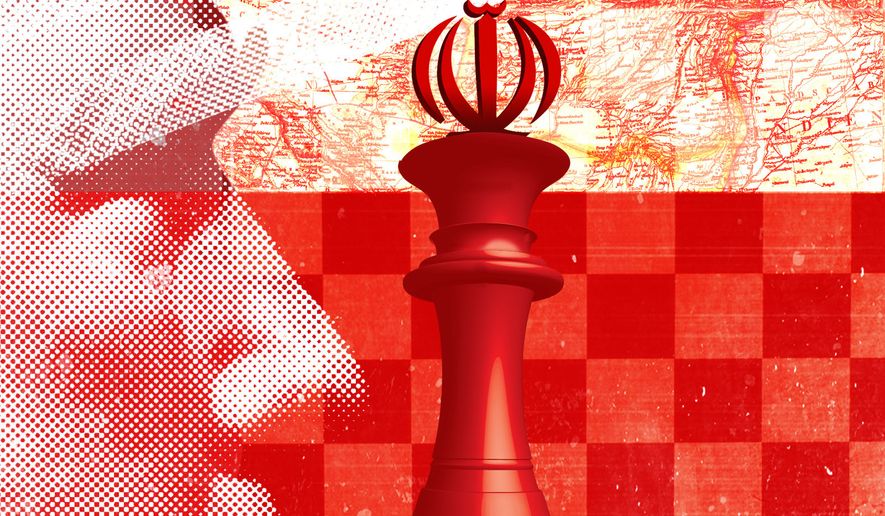
President Trump is drawing the United States into a military quagmire in Iran, despite his campaign promise to end so-called forever wars.
The standoff results from launching a war and then abandoning it halfway through in favor of diplomacy: negotiating with a radical Islamic regime whose deep ideological hatreds render its leaders incapable of honoring any agreement with its avowed premier foe.
The best way for Mr. Trump to extricate the United States from the war is to unleash American and Israeli air, naval and missile power once again, with added elements of intense covert action and intelligence power to complete the mission called Operation Epic Fury launched in February.
People were interested in these podcasts
The announced goal should be to force the unconditional surrender that Mr. Trump initially demanded, or so weaken the nation of 93 million that it joins the list of U.S. enemy states in the region.
Iran deserves to become a failed state for its 40 years of attacks on America and its people.
On social media, the president recently told Iran, “Deal or Total Surrender.”
Instead, the president must show absolute resolve and offer Tehran a choice between total surrender or total annihilation of the regime and all that sustains it in power.
Targets for destruction would include sectors of Iran’s military industry and the remaining leadership, military troops and forces, especially the Islamic Revolutionary Guards Corps.
Civilian infrastructure must not be excluded. Key parts of Iran’s oil industry and infrastructure, once destroyed, would severely limit support for terrorist proxies such as Hezbollah, Hamas and the Houthis.
Remaining ballistic-missile, UAV, air defense, naval, nuclear, and military-industrial capabilities also would be revisited by Central Command forces.
The political end state of imposing a failed state is hard to predict, but at a minimum, the world would see an Iran so weakened that a power vacuum would be created and a successor regime would take power, leaving the state no longer a regional threat.
It is important to understand clearly that the Islamic Republic of Iran has directly or indirectly killed hundreds, perhaps thousands, of Americans through terrorism and proxy warfare since the regime took power in 1979. It deserves to join Libya, Iraq, Syria and others in the region as a failed or severely weakened state.
As a news correspondent for The Washington Times for more than 40 years, I rarely write opinion pieces. The problems facing the United States in Iran compelled me to comment.
The late CIA counterintelligence chief James Jesus Angleton once told me in the 1980s that effective counterterrorism operations must be built on relentless retaliation: Every act of terrorism must be met with a powerful response, and terrorist attacks must never go unchallenged.
Mr. Trump has promised Iran an economic “D-Day” amid stalled negotiations with the regime. However, the IRGC has withstood nearly five decades of U.S. sanctions plus four months of an American-imposed naval blockade, where no commercial ships or tankers can enter or depart Iranian ports and coastal areas.
Iran has been one of the most economically penalized countries in the world, yet its leadership has always been able to survive.
In response to the threat, Iranian Foreign Minister Abbas Araghchi posted on social media: “We have seen this movie before. Same bull. Different bullies.”
Financial warfare will have its impact, no doubt, but to create a truly failed state that loses legitimacy within the region and is never able to rebuild, kinetic warfare will be needed.
Tomorrow’s column will look at the history of failed states in the Middle East and the lessons China is learning in the president’s current Iran strategy.
• Bill Gertz is a national security correspondent for The Washington Times.
Follow the author


Please read our comment policy before commenting.