



A version of this story appeared in the daily Threat Status newsletter from The Washington Times. Click here to receive Threat Status delivered directly to your inbox each weekday.
OPINION:
America has an important tradition of applying the maxim of “relentless retaliation” in our counterterrorism operations, and it needs to follow through with this policy in the case of Iran.
One clear example pertained to Libyan dictator Moammar Gadhafi, who dispatched intelligence agents to conceal a bomb inside a radio cassette player placed in the cargo hold of Pan Am Flight 103. The plane exploded over Scotland four days before Christmas 1988, killing 270 people, 190 of them Americans.
Twenty-three years later, Gadhafi’s life ended when he was captured by rebels who sodomized him with a bayonet before killing him.
People were interested in these podcasts
Libya has been on a downward spiral as a result and has yet to recover from the ouster of the Gadhafi regime in 2011.
Iraq was the second enemy state to earn that status by targeting the United States and its allies. After Saddam Hussein’s regime was linked to a foiled 1993 plot to assassinate President George H.W. Bush, President George W. Bush ultimately launched the U.S. invasion that ousted the dictator in 2003.
Iraq was placed on the state sponsor of terrorism list in 1979, briefly removed in 1982 and added again in 1990 after Iraq invaded Kuwait.
Its support for terrorism included hosting and financing the Abu Nidal Organization, one of the most lethal terrorist groups of the 1970s and 1980s. The regime also sheltered Abu Abbas’ Palestine Liberation Front, which carried out the 1985 hijacking of the cruise ship Achille Lauro and killed American Leon Klinghoffer.
Beginning in 2002, Saddam paid the families of Palestinian suicide bombers as incentives for attacks and provided Palestinian terrorist factions with offices, training and funding in Baghdad.
Ending Iraq’s support for terrorism was one rationale for the 2003 war, though Operation Iraqi Freedom also relied on faulty intelligence about a secret weapons-of-mass-destruction program.
Saddam’s capture and eventual execution for crimes against humanity ultimately left Iraq vulnerable to Islamic terrorist groups, notably the ultra-violent Islamic State group.
America’s 20-year misadventure in Iraq ended when then-Brig. Gen. Dan Caine, deputy commander of a special operations task force in Iraq, defeated most of the Islamic State group.
Gen. Caine told President Trump in 2018 that, given eased rules of engagement, he could defeat the Islamic State group in one week, not years, as other advisers claimed. He did exactly that, a feat that later led to his being pulled from retirement, promoted to full general and named chairman of the Joint Chiefs of Staff in 2025.
Next came Syria, designated a state sponsor of international terrorism in 1979 and, until the designation’s lifting, the longest continuously designated member of that list.
Syria, under the Assads, backed the Lebanon-based Hezbollah by allowing Iranian arms and explosives to transit through the country.
Damascus also hosted the political headquarters of Hamas for years and played a role in the 1983 bombings in Beirut, including the U.S. Marine barracks attack that killed 241 Americans and wounded many more.
The U.S. was not directly involved in the fall of Syria’s Bashar Assad in December 2024. U.S. forces in Syria were there to conduct limited strikes against remaining Islamic State group elements. The regime’s collapse was mainly a result of Mr. Assad’s weakened patrons: Russia, exhausted by the war in Ukraine, and Iran and Hezbollah, battered by Israeli military and intelligence strikes.
The new Syrian government quickly won support from the Trump administration, which backs the government led by Ahmad al-Sharaa, a former commander of the rebel group Hay’at Tahrir al-Sham that ousted Mr. Assad. Washington is seeking to normalize ties with Damascus, though Syria remains a weakened, war-torn state.
Today, despite vast oil reserves, both Libya and Iraq remain failed states, plagued by corruption, a weak rule of law and outside interference.
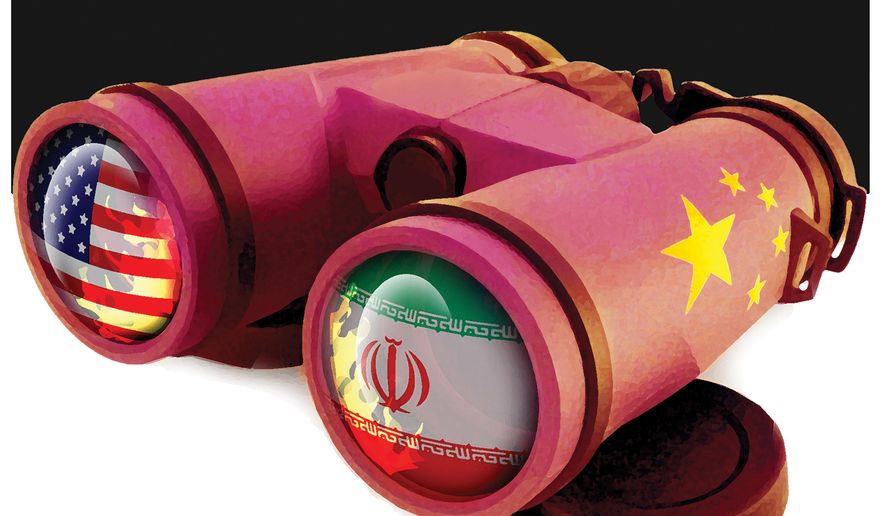
The Chinese Communist Party is watching all this closely and learning from Mr. Trump’s lack of resolve.
Meanwhile, Beijing has identified Libya, Iraq and Syria as victims of what Beijing calls “color revolutions,” a strategy the ruling party claims the U.S. uses to engineer regime change through covert operations rather than direct military intervention.
The Chinese Foreign Ministry has named Libya, Iraq, Syria, Yemen, Ukraine, Venezuela and Belarus as targets of American-backed color revolutions. An official 2023 white paper, “US Hegemony and Its Perils,” traces the pattern to the Arab Spring of the 2010s, which it says unleashed “chaos and disaster” on many countries.
Chinese propaganda now describes Libya as a divided, civil-war-plagued state that never became the modern, democratic nation promised by Western intervention.
The real reason behind the CCP’s anti-color revolution narrative is defensive — a way to politically attack the U.S., Beijing’s main rival for global power and influence and the chief obstacle to China’s strategic goal of global dominance.
Of even greater importance to China’s communist rulers is the fear that a color revolution will prompt the Chinese people to act against the despised, corrupt communist system and seek its ouster.
So what is to be done? Why not embrace and exploit the false notion of a global U.S. conspiracy to oust enemy regimes in the Middle East and elsewhere through nonmilitary means?
Mr. Trump should tell Gen. Dan “Razin’” Caine to once again carry out a scorched-earth bombing campaign to end the Iran war in weeks, not years, and rid the world of its hated regime.
The rationale is clear. It would be better to so damage the Iranian regime that it becomes another failed state in a region rife with Islamic terrorism than to allow Tehran to survive and rebuild toward its ultimate goal: nuclear and perhaps chemical and biological weapons that could someday be used against the United States and its allies in the region.
• Bill Gertz is a longtime national security correspondent for The Washington Times.
Follow the author


Please read our comment policy before commenting.