



Social media users are claiming that Canada could plunge the U.S. into darkness if the trade war between the once-friendly neighbors escalates further.
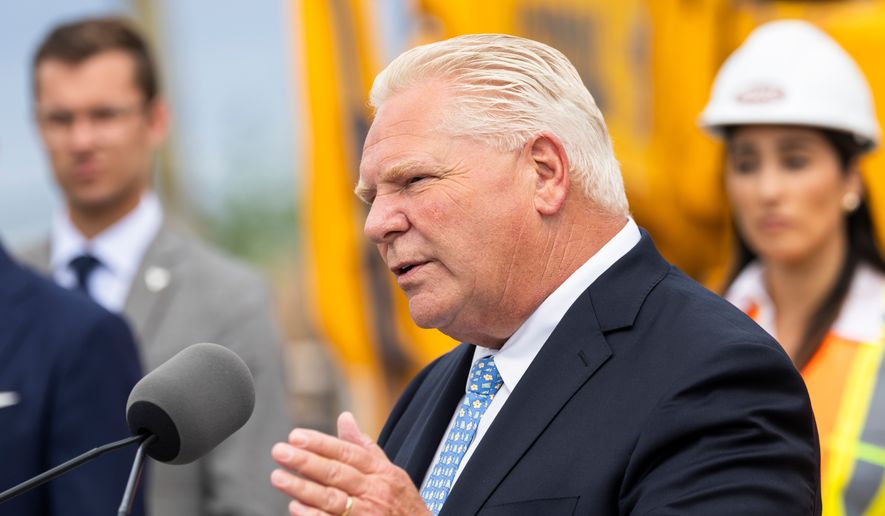
Speculation spread after Ontario Premier Doug Ford said in an interview with The Associated Press on Monday that “everything is on the table” if the dispute worsens, including cutting off electricity from his province. Canada imposed about $20 billion worth of retaliatory tariffs on American goods on Tuesday, with no action taken to limit electricity.
Regardless, experts say that U.S. residents will not suddenly find themselves without power if Canadian officials follow through with any form of Ford’s threat.
People were interested in these podcasts
Here’s a closer look at the facts.
CLAIM: Canada can shut off electricity in the U.S. and cause massive blackouts.
THE FACTS: This is misleading. Canada, which provides electricity to some states, could stop the supply, according to experts, but it could not cause massive blackouts with the flick of a switch. The U.S. has enough other sources of electricity to make up for the gap, and economic impacts are more likely than a lack of power.
“We would see it in the market, we would see it in the prices, but we would not be bereft of electricity,” said Barbara Kates-Garnick, a professor of practice in energy policy at Tufts University’s Fletcher School.
Canada exported $3.3 billion worth of electricity to the U.S. in 2025, according to the Canada Energy Regulator, a government agency. It imported $1.4 billion worth of electricity from its southern neighbor the same year. That’s 32.7 terawatt hours and 22.1 terawatt hours, respectively. The U.S. generated 4.43 thousand terawatt hours of electricity in 2025, according to the Energy Information Administration.
The U.S. imports electricity from Canada in part because it is cheaper than generating more supply domestically. If Canada stopped electricity exports to the U.S., generation would instead rely on sources that could be more expensive, thereby driving up electricity costs. However, a sufficient amount could still be produced to power the country.
“They’re mostly a supplier, they do not control the actual availability of energy in our homes,” Saleh ElHattab, founder and CEO of the energy management company Gravity, said of Canada. “It’s a market that has tons of suppliers. People who just have more expensive sources of energy will get bids that they usually don’t get access to.”
In an unlikely scenario, massive blackouts could occur if there is extreme weather that leads to far more electricity usage than anticipated. But regular people wouldn’t immediately lose power.
Jonathan Steirer, interim director of Case Western Reserve University’s Great Lakes Energy Institute, explained that what’s more plausible is that high-usage customers such as data centers or universities would receive curtailment orders requiring them to take themselves off the power grid and use alternate electricity sources such as backup generators. Many such entities already opt into demand response programs to receive incentives for voluntarily decreasing electrical consumption at peak times.
If such actions were not enough, rolling blackouts could be ordered. Still, if the situation were properly managed, customers would be notified before they lose power.
“On a business-as-usual day, if they were to just turn off the metaphorical switch, most of the impacts would be economic,” Steirer said.
___
Find AP Fact Checks here: https://apnews.com/APFactCheck.

Please read our comment policy before commenting.