



OPINION:
For more than four decades, the regime in Tehran has fueled terrorism, destabilized the Middle East through proxy militias, pursued nuclear weapons capability and brutally oppressed its own people.
Successive American administrations tried diplomacy, sanctions and accommodation. None has fundamentally altered Tehran’s behavior.
By confronting the Islamic Revolutionary Guard Corps and refusing to accept the regime’s long-held assumption that it can threaten American interests without consequence, President Trump has changed the strategic landscape.
People were interested in these podcasts
Still, military action alone does not guarantee lasting political victory. The recent weakening of the regime has created a historic strategic opportunity.
Continuing the maximum pressure campaign, the United States should embrace a political strategy that empowers the Iranian people, denying the regime time to regroup.
That political strategy begins with one simple principle: Lasting democratic change in Iran cannot be imposed from outside. It must be achieved by the Iranian people themselves.
America’s role is not to choose Iran’s future. We have had our fill of nation-building. America’s role is to stand with those inside Iran who are risking everything for freedom and to ensure that U.S. policy strengthens — not overlooks — them.
The recent increase in executions, arrests and repression should be understood for what it is: not a demonstration of confidence, but evidence of fear. History shows that authoritarian regimes often become most brutal when they believe that their grip on power is weakening.
The regime itself understands where the greatest threat lies.
For decades, Tehran has devoted extraordinary resources to suppressing organized democratic opposition while investing heavily in propaganda aimed at discrediting that opposition abroad. Policymakers should ask a simple question: Why would the regime expend so much effort against an organized democratic movement if it did not regard it as an existential threat?
The answer to that question should shape how Washington assesses the prospects for democratic change in Iran.
The debate should not be about personalities; it should be about strategy. Some continue to hope that political change can emerge around well-known individuals outside Iran or through external pressure alone, but sustainable democratic transitions are not built on personalities or military action alone.
They require organization, a clear political vision, networks capable of mobilizing support and a strategy rooted in the people living under the dictatorship.
External pressure remains an important instrument of policy, but history suggests that it is most effective when it reinforces credible, organized democratic forces inside the country rather than attempting to substitute for them.
Measured against that standard, the National Council of Resistance of Iran merits careful consideration by American policymakers.
For nearly 50 years, the National Council of Resistance of Iran has advanced a democratic vision based on free elections, separation of religion and state, equality between women and men, judicial independence, protection of ethnic and religious minorities, peaceful coexistence and a non-nuclear republic.
These principles are embodied in NCRI President Maryam Rajavi’s Ten-Point Plan, a practical road map for democratic transition rather than merely a political slogan.
Its relevance is not merely theoretical. The movement has endured decades of executions, imprisonment, demonization and assassination attempts while maintaining organized networks inside Iran.
Over the years, the NCRI has engaged with lawmakers, former senior government officials, military leaders, legal scholars and human rights advocates across the U.S. and Europe. Support has come from Republicans and Democrats, conservatives and liberals, reflecting a shared recognition that the Iranian people deserve a democratic alternative to religious dictatorship.
The issue before Washington is not whether democratic alternatives exist. It is a question of whether American policy will recognize and engage those who have demonstrated organizational resilience, a coherent democratic program and a long-term commitment to helping the Iranian people determine their own future.
Mr. Trump has already created the strategic opening. The administration now has an opportunity to help secure the political outcome by standing with the Iranian people — and not with the regime that oppresses them.
That means maintaining maximum pressure on the regime while placing human rights at the center of America’s Iran policy. It means publicly condemning the regime’s accelerating executions, engaging organized democratic Iranian voices, denying legitimacy to both clerical dictatorship and monarchical restoration, expanding support for the free flow of information into Iran and making clear that no agreement with Tehran should come at the expense of the Iranian people’s democratic aspirations.
If America aligns its strategy with the courage, sacrifice and democratic aspirations of the Iranian people, it can do more than weaken a dangerous regime. It can help create the conditions for one of the most consequential democratic transformations of the 21st century.
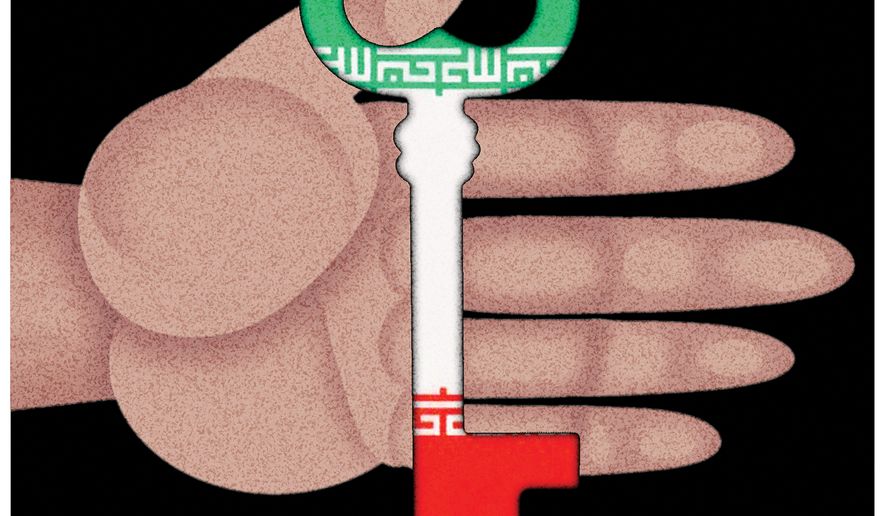
Mr. Trump opened the door. The test now is whether the rest of the world will help the Iranian people walk through it.
• Carla Sands is a former U.S. ambassador to Denmark (2017-2021) and a former member of President Trump’s Economic Advisory Council.

Please read our comment policy before commenting.