



OPINION:
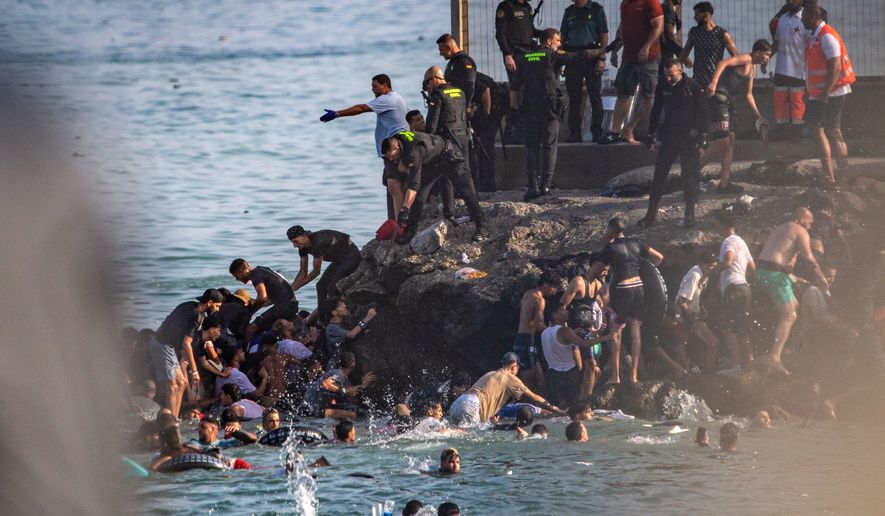
In roughly 24 hours, the Spanish Interior Ministry estimated that about 50,000 migrants crossed illegally from Morocco into the autonomous city of Ceuta by land and sea. Ceuta’s mayor-president placed the number even higher. By late Friday afternoon, El Pais reported that 57 bodies had been recovered from the waters near the Spanish territory. Prime Minister Pedro Sanchez called the breach “a violation of Spain’s territorial integrity.”
Approximately 37,500 of those who crossed had returned to Morocco by Friday afternoon, but their departure does not erase what happened. Tens of thousands entered Spanish territory before the government could stop them. Ceuta shows how quickly a border can collapse when deterrence disappears and illegal entry carries no immediate consequence.
The Spanish city sits on the North African coast and, together with Melilla, forms the European Union’s only land border with Africa. Its crisis may seem distant from the United States, but the warning is unmistakable. A sovereign nation decides who enters, who remains and who must leave. When a crowd can override those decisions through sheer numbers, the government is not managing migration. It is losing control of its territory.
Ceuta exposes the consequences of dangerous liberal policies that have treated enforcement as a greater moral offense than illegal entry. The same politicians who find endless urgency for pronouns, gender identity and every fashionable cultural grievance have spent years weakening deterrence and portraying removal as cruelty. When roughly 50,000 people crossed in a day, those priorities collided with reality.
Once illegal aliens are inside, the balance shifts. Activists demand broader claims, courts slow removal and politicians resist enforcement, while citizens absorb the cost. What should have been stopped at the border became years of litigation, public expense and political paralysis. Every failure to enforce the law tells the next crowd that overwhelming the system works and that lawlessness will be rewarded.
Spanish authorities believe smugglers exploited a recent Supreme Court ruling that limited summary returns for migrants intercepted at sea. The ruling did not legalize illegal entry or eliminate Spain’s authority to remove those without a lawful claim, but it created the appearance of an opening. The precise trigger remains disputed, yet the result is undeniable: Criminal networks and tens of thousands of would-be entrants believed the border could be breached.
Ceuta had already demonstrated that migration could become a weapon of political pressure. In 2021, Morocco relaxed its border controls amid a diplomatic dispute with Spain, allowing thousands to enter the country. The breach Friday was exponentially larger and proved how vulnerable a country becomes when control of its border depends on another government’s cooperation.
America cannot dismiss this as Europe’s problem. The consequences of a breached border do not remain in Texas, Arizona or California. Every community is a border town because an illegal alien released into the interior can travel anywhere in the country. Violent criminals who disregard the national border do not suddenly respect state lines, county boundaries or local laws. Sanctuary jurisdictions deepen the danger when they obstruct federal immigration enforcement or release removable offenders before Immigration and Customs Enforcement can take custody.
That failure has names and faces. Jose Ibarra entered the United States illegally in 2022 and was allowed to remain while his immigration case proceeded. Two years later, he murdered 22-year-old nursing student Laken Riley while she was running near the University of Georgia campus. Victor Martinez-Hernandez was returned across the southern border three times before entering again. He later raped and murdered Rachel Morin, a Maryland mother of five, on a public trail. Both men were sentenced to life without parole.
Neither crime occurred near the southern border, but both families suffered the consequences of its failure. Laken Riley’s loved ones and Rachel Morin’s children joined the Angel Families who carry pain that could have been prevented. A secure border cannot prevent every crime, but it can prevent crimes committed by people who never should have been in the country.
President Trump has shown that border chaos is a political choice, not an inevitability. The Border Patrol recorded 9,848 apprehensions along the southwestern border in June, 94% below the Biden administration’s monthly average, and completed a 14th consecutive month without releasing migrants apprehended at the border into the American interior. Those results followed the restoration of deterrence, detention and consequences.
Ceuta nevertheless shows why one successful administration is not enough. A future president can revive mass release, weaken removal and again place the demands of immigration activists ahead of the safety of American citizens. Congress must make Mr. Trump’s gains permanent by restricting parole abuse, accelerating asylum decisions and funding detention and removal. It must also enforce final removal orders and prevent another administration from nullifying immigration law through bureaucratic discretion.
• Colton Overcash is the founder of Vertex Strategies, a government relations and strategic advisory firm based in Charlotte, North Carolina, with a presence in Washington. He previously held two presidential appointments at the U.S. Department of Homeland Security, where he advised senior leadership on immigration and border security issues during the Trump administration.

Please read our comment policy before commenting.