



The District has logged plenty of miles bringing world-class events to the city, but turning its diagonal, narrow streets into a racetrack presented a new challenge ahead of this month’s Freedom 250 Grand Prix.
Aug. 23’s race celebrating the country’s 250th anniversary will see a field of 25 IndyCar drivers making contested passes on Constitution Avenue, reaching speeds of 180 mph on the Pennsylvania Avenue straightaway and crossing the finish line on Third Street right in view of the U.S. Capitol.
But long before the 1.7-mile track zigzagging along the National Mall was built, the idea surfaced when Penske Corp. President Bud Denker spitballed concepts with Fox Sports CEO Eric Shanks.
“We were grabbing a beer in Indianapolis, and we said, ‘What can we do to celebrate our country’s 250th anniversary next year?’ And then we said, ‘How about having an IndyCar race on the nation’s capital’s streets?’” Mr. Denker, who is also the Freedom 250 Grand Prix’s CEO, told The Washington Times. “No one took it seriously, I think, but myself.”
Mr. Denker soon learned there was no fast track to hosting a race in the District, especially on federal property.
His original course design that had drivers going around the Capitol and roaring past the Supreme Court would require congressional approval.
Mr. Denker eventually discovered that his pitch — no public money would go into funding the event, free tickets for anyone who wanted to attend, and paying for any repairs caused by the race — made it palatable to both sides of the aisle.
But it took time. The gregarious executive needed several months last year to win over lawmakers with an extra nudge to secure their support. And after 81 meetings over 93 days, he still didn’t have enough votes.
Ready to cancel his plans for the Grand Prix in January, Mr. Denker called Transportation Secretary Sean Duffy to share the deflating news.
Mr. Duffy, a major proponent of the event, urged Mr. Denker to instead design a track off Capitol grounds. If he could do that, President Trump would sign an executive order to bring it to life.
Mr. Denker said he was intimidated by the prospect, since it took him two years to map out the IndyCar circuit in Detroit. But the altered course revealed itself to him as he began pacing around downtown Washington.
“By God’s will, I saw a racetrack in two hours,” he said, adding that the wide, well-paved lanes of Pennsylvania Avenue satisfied the crucial race-day needs of a pit lane and staging grounds for each team.
Within a week, Mr. Denker was joining the president in the Oval Office on Jan. 30 to watch him sign the executive order.
A circuit where drivers will weave between the Smithsonian’s Natural History Museum and the National Archives, zoom by the Air and Space Museum, and catch views of the Washington Monument will give a major East Coast city the IndyCar experience — something the organization hadn’t done in more than a decade.
Mr. Denker said he wasn’t sure how to gauge interest in the Grand Prix with that dearth of recent races in this part of the country. He got his answer when more than 280,000 people signed up for the free tickets in the first nine days they were offered.
From streets to racetrack
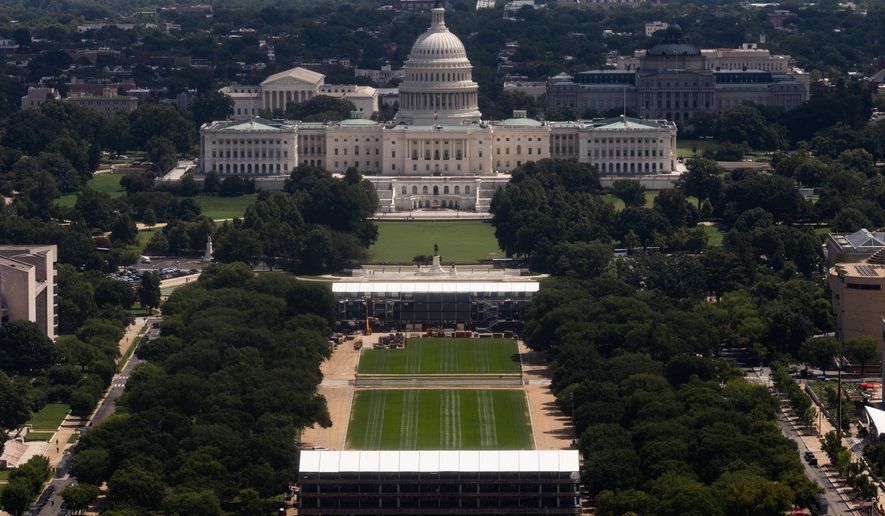
The National Mall’s transformation into a racetrack is well underway.
Heavy concrete barricades and fencing are lining Seventh Street to serve as a buffer between spectators and racers, and temporary grandstands and suites for fans are being erected along key sections of the course.
Four pedestrian bridges taking fans over the racetrack and onto the Mall’s grass will be constructed in the coming weeks.
Race officials said all roadway modifications must be undone by Sept. 3 and the grandstands disassembled by Sept. 15.
As for security, authorities said to expect airport-style precautions with attendees going through magnetometers and needing to bring a clear bag to be allowed in.
The race will be a no-drone zone, and officers from Metropolitan Police, the U.S. Park Police and the Secret Service will be on the ground.
“There will be lots of seen and unseen countermeasures deployed throughout the city to make sure that this goes off without a hitch, and everyone, race fans and public alike, have a great event through the weekend,” Deputy Director of the Secret Service Matthew C. Quinn said at a recent press briefing.
The security posture will not be as intense as it was for Washington’s Fourth of July celebrations, but that could change if Mr. Trump decides to watch the extravaganza. Mr. Denker said he hopes the president shows up to wave the green flag to start the race.
One thing Mr. Denker has kept under wraps is the 55-pound behemoth of a trophy for the winner.
He said if the victorious driver can hoist the one-of-a-kind prize after racing 147 laps — because a 1.7-mile course navigated 147 times equals 250 miles — he noted it would be a true feat of strength.
Despite D.C. Mayor Muriel Bowser’s eagerness to make the race an annual event, Mr. Denker said he wants to get through this year’s Grand Prix before he looks ahead. He added that the rarity of the race is beginning to sink in with the drivers.
“I’ve had probably six or seven of them come here for various events, and when they drive down Pennsylvania Avenue and they see the nation’s capital, it’s this wow moment,” he said just weeks away from the Aug. 22 practice day. “And to think that they’re only one of [the 25 drivers] who ever had that chance, I keep reminding them of that and they keep reminding themselves of that.”

Please read our comment policy before commenting.