



The Senate is preparing to work overtime to clear a pile of legislation and nominations and find a way to satisfy GOP angst over the stalled SAVE America Act.
Proponents of the voter ID and election integrity bill largely admit the SAVE America Act will not pass the Senate before the chamber adjourns for its summer recess, but they want to show progress toward that goal.
“I’d like to get as much done as we could, but I think we’re going to be limited a little bit,” Sen. Tommy Tuberville, Alabama Republican, told The Washington Times.
Senate Republicans have spent the week discussing various options for holding at least one vote related to the SAVE America Act before leaving for the recess, but no final decision has been made on the best approach.
“All I can tell you is, the folks back home want us to fight,” said Sen. Roger Marshall, Kansas Republican. “The folks back home want voter ID. They want proof of citizenship. And I’m going to do whatever I can to make sure that happens.”
Other Republicans are growing frustrated at the time spent pushing various iterations of a bill they argue has no path to becoming law.
“We’ve got SAVE Act, Son of SAVE Act, SAVE Act goes to Hollywood — a lot of sequels,” North Carolina Sen. Thom Tillis said in exasperation.
The decision-making on the latest sequel has been delayed due to a pile-up of other legislative business Republicans want to address before adjourning for the rest of the summer.
Still on the agenda: a stopgap appropriations bill to keep the government funded past the midterm election; a Russia and Iran sanctions package, measures regulating college sports and cryptocurrency, and confirming more of President Trump’s nominees, including Todd Blanche for attorney general.
Thursday would have been the Senate’s final day in session if the to-do list had not grown so long, or if all 100 senators provided consent to speed up the lengthy Senate voting process.
Such a deal could still come together in the coming days, but several Republicans are not prepared to leave Washington without renewed action on the SAVE America Act.
The preferred plan is to adopt a budget resolution kick-starting the filibuster-proof reconciliation process that could be used to provide funding to states to implement election requirements for voters to show proof of citizenship to register and photo ID to cast a ballot.
That path currently lacks support from the 50 Senate Republicans it would take to adopt a budget and is increasingly unlikely to happen, but any senator can force a vote. Some are reserving that option.
One of the challenges is the budget reconciliation process allows a “vote-a-rama” of unlimited amendments that Democrats can use to hammer vulnerable Republicans ahead of the midterm elections.
“Nobody likes a vote-a-rama. So what can we do if we’re not going to do that?” Florida GOP Sen. Rick Scott said.
One option under discussion, he said, is voting on the House-passed Stop Insider Trading Act. In addition to banning members of Congress from trading stocks, the bill would require voters to show photo ID when casting ballots in federal elections.
The marrying of the two politically popular issues could create a tougher vote for Democrats than any of the previous Senate attempts to advance portions of the SAVE America Act.
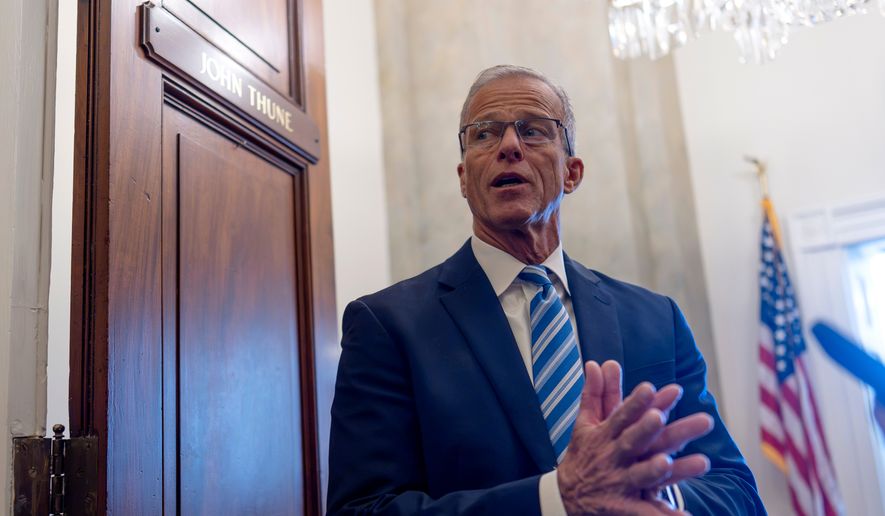
Senate Majority Leader John Thune put the Stop Insider Trading Act on the Senate calendar, along with a standalone voter ID bill.
“We’re going to vote on them at some point,” the South Dakota Republican said, adding it is “to be determined” whether those votes occur before the recess.
Sen. Todd Young, Indiana Republican, said he is interested in passing the SAVE America Act, not just a show vote. But he is also not adamant the Senate remain in Washington “if there’s no path forward or no plan for success.”
“I respect my constituents enough not to humor them or to offer false hope,” he said. “But I still think there’s ample opportunity to come up with a plan and try and persuade any holdout colleagues, and so that’s my objective.”
Mr. Tillis said his GOP colleagues up for reelection in at-risk states “should be dictating the priorities” between now and November.
Ohio Sen. Jon Husted is the only vulnerable Republican who has said he would stay in Washington to press for the SAVE America Act.
Contact the author


Please read our comment policy before commenting.