


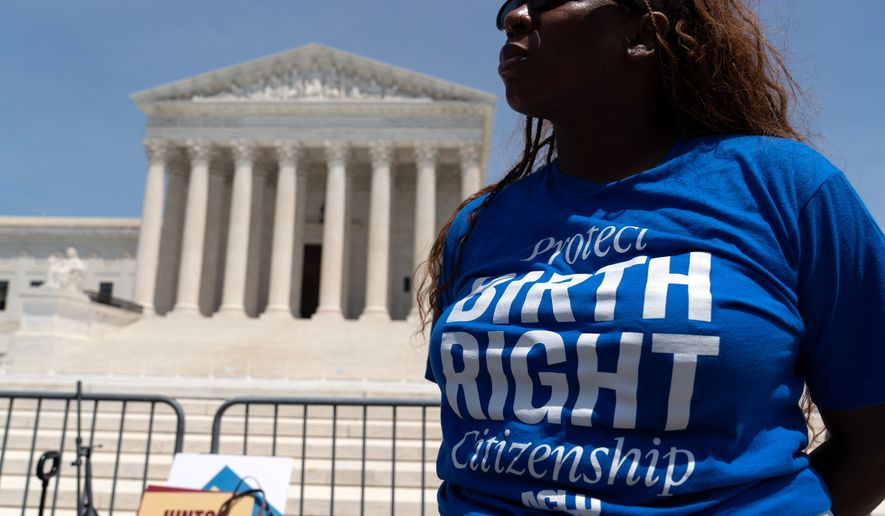

President Trump signed an executive order Thursday banning the practice of “birth tourism” and ordering his administration to try to root out firms that assist pregnant women in entering the U.S. just to earn citizenship for their children.
He also signed another order directing his administration not to recognize the children of birth tourism as citizens. That order also denies birthright citizenship to children whose parents work for a foreign government or whose parents are part of a terrorist organization.
The White House said it is trying to use some of the wiggle room left by the Supreme Court in its ruling in June, when it struck down Mr. Trump’s previous birthright citizenship restrictions as unconstitutional.
“We’re making adjustments,” Mr. Trump said in the Oval Office.
Mr. Trump’s earlier effort tried to deny automatic citizenship to children born to illegal immigrants and temporary visitors.
The Supreme Court shot him down, saying both of those categories are protected by the Constitution’s 14th Amendment, which grants citizenship to all children born on U.S. soil who fall under the jurisdiction of the government.
The justices said there are only a few exceptions to that general rule.
One exception is children of foreign diplomats because their parents aren’t under the jurisdiction of the U.S. Another exception is children born to an occupying army.
Mr. Trump, in his new order, expanded the pool of diplomats and foreign government employees whose children can be denied citizenship. And he equated foreign terrorists to an occupying army to deny their newborns automatic citizenship.
The order also denied citizenship to children of parents “engaged in a commercial transaction to purchase or access birthright citizenship … or engaged in fraudulent activity to obtain citizenship.” And it covers cases when a foreign parent engages a U.S. surrogate mother.
Senate Democratic leader Charles E. Schumer of New York called the president’s new attempts “blatantly illegal.”
“Trump has just set himself up for yet another loss in the courts. Democrats will challenge this order, and we will win,” he said.
The orders do nothing to affect children born to illegal immigrants and temporary visitors who are already in the U.S.
The Pew Research Center said that in 2023 some 245,000 children were born to immigrant mothers who are in the U.S. illegally.
Pew said birth tourism — children born to women who came on legal visas specifically to deliver — accounted for just 9,000 cases.
Despite those low numbers, the practice has galled Republicans who say it’s an abuse of the American immigration system.
While some women enter the U.S. on their own to give birth, particularly across the southern border, others pay tens of thousands of dollars to companies that exist specifically to facilitate birth tourism.
One case, which the Justice Department prosecuted, involved what authorities described as a “maternity house” in Rancho Cucamonga, California. USA Happy Baby Inc. rented apartments to pregnant Chinese women who would give birth, then return to China a month or two later.
The operators coached the women on how to avoid scrutiny in their travel visa applications by claiming they were engaged in tourism and would only be in the U.S. for days or weeks — not the months they really intended to stay.
They were also coached to hide their pregnancies from border officers by wearing loose clothing and to understate how far along they were if the pregnancy was noticed. They were told to select customs lines operated by older White officers, who were thought to give less scrutiny to the women.
Happy Baby charged up to $100,000 for VIP clients.
White House Deputy Chief of Staff Stephen Miller said the new order bans birth tourism altogether.
“No one in the world is any more allowed to obtain a visa for this fraudulent purpose,” he said, standing alongside Mr. Trump.
The trick will be to try to spot those cases where women are coming for the purpose of giving birth.
The first Trump administration issued guidance to immigration officers to look for such cases and try to deny them, but the Pew numbers show thousands still managed to enter.
After the Supreme Court’s ruling, acting Attorney General Todd Blanche ordered his department to investigate and attempt to prosecute any birth tourism outfits it can identify.
The new orders are not retroactive, a White House official said.
Mr. Trump called his new executive orders a “big deal” and continued to criticize the justices for their ruling.
“A very, very unfortunate decision,” he said.
He said the 14th Amendment, which includes the grant of birthright citizenship, was intended to help newly freed slaves and should not have applied to immigrants.
Chief Justice John G. Roberts Jr. disagreed, saying the concept of citizenship tied to place of birth dates back to English common law.
• Kerry Picket contributed to this article.
Contact the author

Please read our comment policy before commenting.