


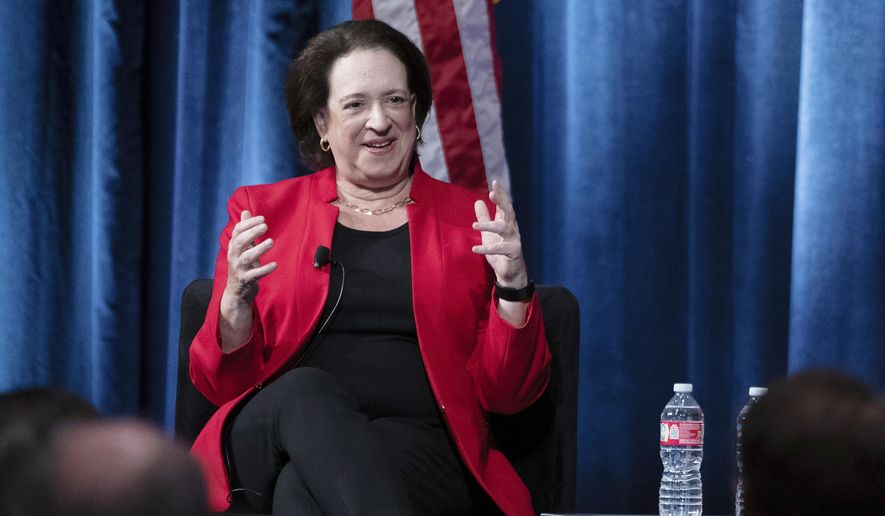

Nearly two dozen conservative groups asked the Senate Judiciary Committee on Monday to look into why Supreme Court Justice Elena Kagan has not recused herself from an upcoming case involving “climate lawfare.”
In a five-page letter, the groups note that Justice Kagan wrote the foreword to the “Fourth Edition of the Reference Manual on Scientific Evidence.” The manual, published by the National Academy of Sciences in December, includes a chapter titled “Climate Science” that details the effects of greenhouse-gas emitters and climate change.
The chapter advised “climate lawfare” plaintiffs on how to persuade “skeptical” judges to consider state and local climate disputes, according to the groups’ letter to the Senate committee.
People were interested in these podcasts
The term “climate lawfare” was coined after state and local governments targeted big oil companies in high-profile court cases in an attempt to hold them liable for damages related to climate change.
The manual chapter at issue was later withdrawn due to criticism about bias.
But Justice Kagan’s foreword noted: “In the coming years, judges will confront lawsuits relating, for example, to artificial intelligence, climate science, and epidemiology … Enter this manual.”
“Case in and case out, the instruction that the manual offers in scientific principles and methods can improve the quality of judicial decision making,” the justice wrote.
The conservative groups say the foreword is problematic because the justices will hear arguments in Suncor Energy Inc. v. County Commissioners of Boulder County next term, which begins in October. The high court will decide if federal law prevents states from holding oil companies accountable for interstate greenhouse gas emissions and global climate change.
The conservative organizations want the Senate Judiciary Committee to evaluate whether Justice Kagan violated federal law under 28 USC 455, which details reasons a justice, judge or magistrate should be disqualified from weighing a legal battle.
They say she has prejudged the issue and should not participate in considering the Suncor Energy case.
They also are raising the issue of the court’s self-adopted recusal and ethics rules in 2023, in which the justices moved to apply the federal law to themselves. The high court previously did not have formal recusal measures.
Still, critics note there is no formal body that enforces the ethics code and recusals on the justices.
“Justice Elena Kagan’s inconsistent recusal history undermines confidence in the impartiality of the Supreme Court,” said Carrie Severino, president of JCN (formerly the Justice Crisis Network), one of the conservative groups.
“Her latest failure to recuse herself comes after she wrote the introduction to the National Academies’ reference manual, effectively giving a judicial endorsement to its biased climate science chapter, which was written with the cooperation of climate lawfare litigators,” Ms. Severino said.
“Justice Kagan’s participation in the Suncor case is indefensible given her public endorsement of climate lawfare plaintiffs’ theories,” she added. “If Justice Kagan will not take it upon herself to follow the law, the Senate Judiciary Committee must step in.”
Spokespersons for the high court and the Senate Judiciary Committee did not immediately respond to a request for comment.
Contact the author


Please read our comment policy before commenting.