



OPINION:
Maine’s Senate race just handed Democrats a brutal lesson in what happens when a party’s establishment and its grassroots stop speaking the same language.
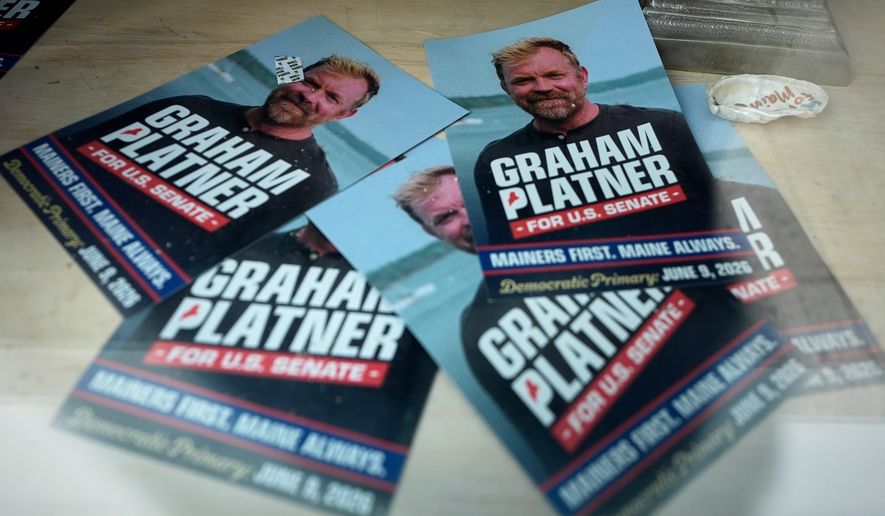
Democratic nominee Graham Platner spent months building one of the most energized, small-dollar operations in the country, the kind of organic fundraising machine every campaign wants and very few can actually build.
Then, in the span of a single news cycle, the entire Democratic apparatus in Washington walked away from him.
People were interested in these podcasts
I have spent my career building digital programs for Republican campaigns, including Donald Trump’s early digital operation and state representative campaigns, and I can tell you that what happened in Maine is a case study in how not to punish someone who has galvanized grassroots donors.
Small-dollar donors are not ATMs. They are believers. They give $5, $10, $25 at a time because they feel like they are part of something bigger than themselves, something the consultant class in Washington does not control, cannot buy and hardly understands.
It is fragile — and powerful when it is real.
Mr. Platner’s massive, small-dollar apparatus raised more than $16 million, according to Federal Election Commission filings, with nearly 60% coming from contributions of less than $200.
Mr. Platner’s grassroots operation was in the image of an outsider: a blue-collar oyster farmer who survived a string of controversies that would have sunk any other conventional recruit. His supporters gave to him anyway, because he was unpolished and independent, something a candidate blessed by Senate Minority Leader Charles E. Schumer could never even dream of.
Here is the problem for Democrats heading into November: You cannot manufacture that grassroots energy on command, nor can you easily transfer it to a replacement candidate picked by party insiders.
Their choice, whoever it is, will inherit a Democratic nomination without inheriting the sense of insurgent authenticity that made Mr. Platner’s campaign catch fire in the first place.
Former Maine House Speaker Hannah Pingree, the Democratic nominee for governor in Maine, said it herself when she called for Mr. Platner to step aside: The energy behind him does not have to disappear, but it needs a new candidate to carry it.
That is easy to say. It is far harder to execute, and every digital strategist knows why.
Donor lists do not transfer loyalty. Email open rates do not transfer trust. A grassroots movement built around one person’s outsider story cannot simply be handed to someone else and expected to perform at the same level. The Democratic Senatorial Campaign Committee cannot clone Mr. Platner to get donors to show up at its fancy dinners for other candidates who are hardly as exciting.
Republicans should watch this closely — not with glee, but with caution. The lesson here is not really about Mr. Platner. It is about what happens when a candidate’s grassroots support becomes bigger than the party establishment’s trust in him, and leadership alone decides when to cut him loose, regardless of what grassroots donors who built that energy think.
Democrats can replace Mr. Platner’s name on the ballot. What they cannot replace is the energy it took to build that grassroots operation in the first place.
In a race this close, that could be the entire election.
• Mike Hahn is president of digital at Frontline Strategies. He was the executive vice president of Digital Strategy at National Public Affairs, the deputy digital director at the National Republican Senatorial Committee and an alum of the Trump 2016 and 2020 campaigns, where he served as the director of social media.

Please read our comment policy before commenting.