



OPINION:
Keynesian economics has become an increasingly attractive answer for politicians seeking simple solutions to hard problems.
Yet, like many other quick fixes, these policies simply do not work.
The core progressive philosophy is to achieve socioeconomic “equality” through big-government intervention. Hiking taxes, raising the minimum wage and eliminating right-to-work laws are prominent examples of this leftward shift in economic policy.
Yet these progressive follies risk harming Americans by stalling the economy and pushing people and businesses to relocate to states with fewer restrictions and more freedom.
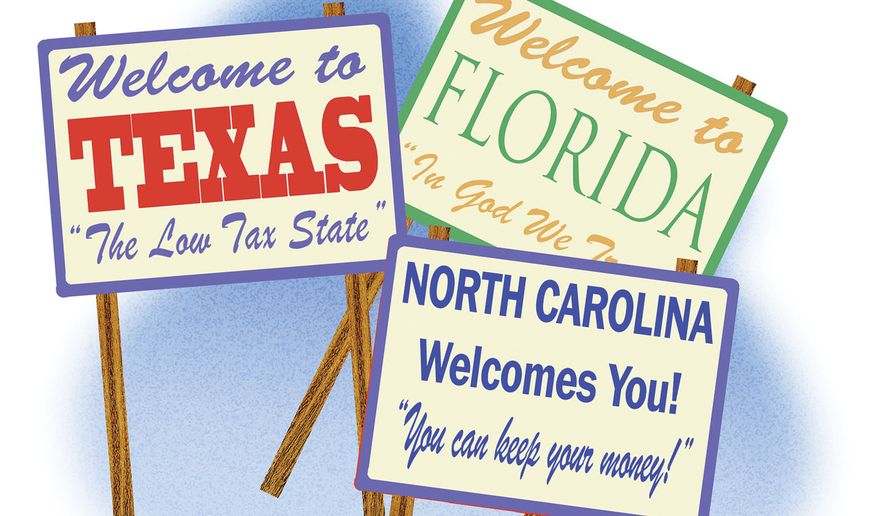
As business owners face higher corporate taxes, for example, they are forced to raise prices, lay off workers and/or relocate to remain competitive. States with high tax rates, such as California, New York and Illinois, are losing talent to low-tax states such as Texas, Florida and North Carolina.
Blue states are bleeding people and hundreds of millions of dollars in lost business activity and investment.
Leftists such as former Vice President Kamala Harris support raising the corporate tax rate from 21% to 28%, a move that would devastate businesses. The Tax Foundation projects that a 7-percentage-point increase would shrink GDP by 0.6% (roughly $160 billion), wages by 0.5% and employment by 125,000 jobs.
Despite claims that tax hikes will raise government revenue, the Laffer curve suggests the opposite is more likely.
Since 1980, 22 Western countries have cut corporate tax rates, and government revenue from corporations has increased from 2.2% to 3.0% of gross domestic product.
Wealth taxes have also risen in popularity despite evidence that alienating the most productive and mobile cohort of the population leads to capital flight. For example, when Norway increased its wealth tax from 0.85% to 1.1%, the country experienced an exodus of both population and wealth. Economists predicted the tax would generate $146 million, but it resulted in a net loss of $448 million in government revenue, according to the Norwegian government’s own data.
American politicians supporting wealth taxes are motivating high-earning individuals to move across state lines, as IRS data shows people are migrating from blue states to red ones.
Another pillar of leftist politics is raising the minimum wage. Sen. Bernard Sanders, Vermont independent, and Rep. Alexandria Ocasio-Cortez, New York Democrat, support increasing the federal minimum wage to $17 and $25, respectively.
Firms facing higher labor expenses are forced to hike prices, cut hours or staff, automate or relocate to more favorable business environments. This misguided policy ignores the simple fact that wage controls do not lead to income raises for all workers. A few government-picked winners may receive a wage increase, but losers may have their hours cut or end up with no job at all.
The Heritage Foundation finds that instituting a $15-per-hour minimum wage led to a 1% reduction in overall employment in San Francisco, 2% in Seattle, and 3% in Los Angeles. The first to be affected are inexperienced, unskilled workers — often the younger generation — who hold low-wage jobs.
As residents become unemployed or priced out by inflation, they migrate to more favorable economic environments in red states.
Labor policy is another popular avenue for progressive economic interventionism. Right-to-work laws are supported by 26 states (primarily red) and prohibit workers from being forced to join or pay dues to a union. The Protecting the Right to Organize Act would effectively end right-to-work laws in every state where they exist.
Despite many troubling provisions, the PRO Act is proposed by left-of-center policymakers in every new Congress under the pretense that it strengthens worker power through government protection.
States with right-to-work laws had 19% higher population growth from 1940 to 2010, according to the Manhattan Institute report. Right-to-work states had lower childhood poverty rates, higher upward mobility for the bottom 50% of income earners and higher employment rates.
Evidence supports it: Americans want to live in states where labor laws embrace competition and worker choice, and jurisdictions with right-to-work laws deliver substantial economic benefits.
Progressive models encourage resident flight, high costs and slower economic growth, and they ultimately risk harming American prosperity. Progressive policymakers who support legislation that ignores supply and demand, the Laffer curve and basic economic incentives will undoubtedly raise prices, lower wages and reduce job opportunities for the very families they claim to want to help.
Put simply, affordability and migration patterns can be linked to government intervention. Prioritizing broad-based growth through deregulation, tax restraint, elimination of price and wage controls and pursuit of workforce development has a strong track record for attracting residents, businesses and investment — ultimately raising living standards.
Lawmakers should consider where people are moving and then tailor their policies accordingly.
• Nicole Huyer is a senior research associate in The Heritage Foundation’s Thomas A. Roe Institute for Economic Policy Studies. Michael Bicksel is a member of Heritage’s Young Leaders Program.

Please read our comment policy before commenting.