



OPINION:
Great pitchers usually arrive in Washington with some fanfare.
Stephen Strasburg joined the Nationals as the most heralded amateur pitcher of his time; the only collegiate player selected to the 2008 U.S. Olympic team.
Max Scherzer came with one Cy Young already on his resume, a two-time All-Star with a $210 million contract.
People were interested in these podcasts
Gio Gonzalez was an All-Star who had won 31 games in his previous two years and was traded for four minor leaguers, including two pitching prospects.
Jordan Zimmermann was the Nationals’ second-round draft choice who Baseball America rated as the organization’s top prospect.
But Foster Griffin? We knew more about Ebirah, Horror of the Deep — the most obscure monster to ever appear in a Godzilla movie — than we did about Griffin when he signed with the Nationals in December after three seasons in the Land of the Rising Sun.
We certainly know about him now.
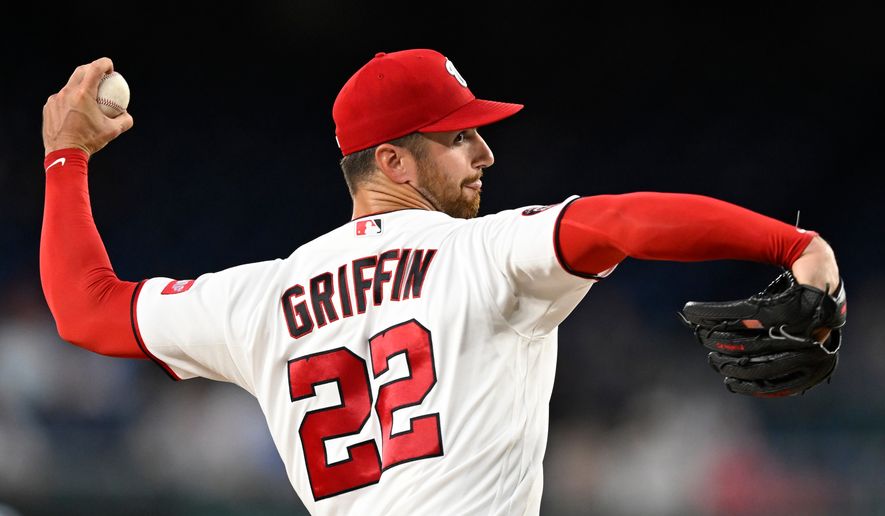
Griffin is having a record-setting season on the mound for Washington — a Strasburg-Scherzer-Gonzalez-Zimmermann-type year, with an 11-2 record and a 2.69 ERA (he lost three or four more wins due to bullpen collapses) on a team that has surprised everyone by pounding opponents with the best offense in baseball. They get a day off when Griffin pitches. He does the pounding.
He gave up just one run in seven innings in a 5-2 victory Sunday over the Athletics. That has become his modus operandi. Griffin set the Nationals’ record for the most consecutive starts (eight) with one run allowed or less. He tied the franchise record, dating back to Montreal, with Hall of Famer Pedro Martinez.
Griffin, a former No 1 draft choice by Kansas City who will turn 31 on Monday, is doing this surrounded by pitchers who, for the most part, often walk to the mound carrying a gasoline can.
And what is particularly amusing is he is doing this with old-school pitching location, command and selection and a fastball that barely breaks 90 mph.
He was named to the National League All-Star team as a replacement for Milwaukee’s Braxton Ashcraft and showed everyone what we’ve seen in Washington, coming in the game in relief and retiring three straight American League batters — striking out Yandy Diaz and Dillon Dingler — on 10 pitches.
Enjoy it while you can — Griffin may be gone come the Aug. 3 trading deadline.
This is one of the complications facing the Washington front office as that deadline approaches — deal, stand pat, or take more cards.
I believe if the Nationals are still within wild card striking distance come that deadline — they were 51-51 going into Wednesday’s game against Colorado — they need to hold on to their trade value players and even add some bullpen help if possible.
They may fall short come the end of the season, but if the Nationals are truly about player development, it is important to those young players in the clubhouse to play meaningful games in August and September. It is important for the front office to show a commitment to the clubhouse, or else risk the air going out of the balloon the rest of the season.
It is certainly important for the Lerner ownership — after years of neglect and embarrassment — to give fans a reason to come to the ballpark today, tomorrow and the next day and not three years from now. This fan base won’t just bounce back if some grand plan of rebuilding materializes years from now.
Trading value like C.J. Abrams, James Wood and others would certainly help contribute to that grand plan. But there should be no urgency to do so. Wood won’t be a free agent until the end of the 2030 season, which means he won’t reach that Juan Soto point in his deal — two years left under control, still making him a desirable target and possibly bringing in a big haul — until the end of the 2028 season. If Scott Boras continues to represent Wood, the agent is going to take his talents to the free agency market, whatever that may look like in the future.
Abrams, who is not a Boras client, this winter will still have two more seasons under team control until he becomes a free agent at the end of the 2028 season. That’s an attractive prize for trading partners in the offseason.
Griffin, though, is more complicated. He is on a one-year contract — a rental for other teams, which may diminish his trade value. But he could be a very important rental to the right contender.
The complication for Washington is that if they don’t trade Griffin, they might watch him walk at the end of the season with nothing to show for it.
President of baseball operations Paul Toboni could try to sign Griffin to a long-term deal — perhaps three years. But the looming work stoppage this winter makes long-term contracts difficult to negotiate. Management risks making a deal that will look foolish if they somehow prevail and get a salary cap in a new labor agreement — though unlikely.
Players have to wonder if money in hand now may be better than the uncertainty of what salaries would look like on the other side of the upcoming war.
It would be funny if the new slide rule analytics regime makes its first big investment in a pitcher who doesn’t care how fast you throw ball four either.
• You can hear Thom Loverro on “The Kevin Sheehan Show” podcast.
Follow the author

Please read our comment policy before commenting.