



Democrats this week are debating the order of the 2028 presidential state primary calendar, which will determine how much influence the party factions have in choosing the eventual nominee.
The Democratic National Committee’s Rules and Bylaws Committee is working to decide which states will hold the earliest primaries and caucuses in 2028. If the committee produces a calendar, the full DNC body would need to give final approval.
A decision by the committee could come Friday.
People were interested in these podcasts
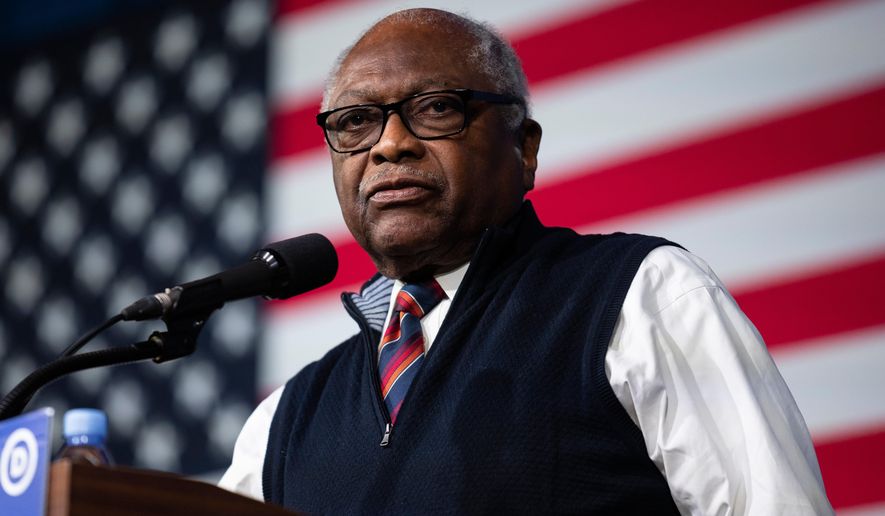
Rep. James S. Clyburn, South Carolina Democrat, is fighting to keep his state first, as it was in 2024.
The state’s Democratic Party has a high percentage of Black voters, and gave then-former Vice President Joseph R. Biden his first primary victory as a presidential candidate in 2020.
“We have demonstrated in our state that we know how to successfully vet candidates and how to make candidates successful in the general election,” said Mr. Clyburn, adding the state has voter “demographics” that prepare candidates for competing on the national level.
The South Carolina Democratic Party has amplified statements from the Rev. Al Sharpton who said removing the state’s first-in-the-nation spot would be an insult to Black voters.
“This isn’t about one state’s ego,” Mr. Sharpton said in a statement released by the South Carolina party. “It’s a test of whether the Democratic Party actually means it when it says Black voters are the backbone of this coalition, or whether that’s just something we say during election years and quietly walk back once the votes are counted.”
Some Democrats are also fighting for Nevada, the other front-runner, to be the first state. Nevada has an almost 30% Hispanic population, with a Black population share under the national average.
“Nevada is a battleground and a bellwether, a purple state that prepares leaders to compete on the national stage, small enough to campaign door-to-door … where long-shots get a real shot,” Nevada Democratic leaders say in a video promoting the state.
At a May DNC Rules and Bylaws meeting, Rep. Steven Horsford, Nevada Democrat, said the state is diverse and pointed to its growing Black and Asian populations.
Nevada’s caucuses favored Sen. Bernard Sanders, Vermont independent who caucuses with Democrats, over Mr. Biden by a more than 26-point margin in 2020, indicating the state could lean toward a socialist candidate in 2028. The state now has a primary system.
House Minority Leader Hakeem Jeffries, New York Democrat, told The Washington Times that he agrees with Mr. Clyburn’s defense of South Carolina’s early spot.
“I support Jim Clyburn’s view that South Carolina should clearly play a preeminent role, as it has done now for several presidential cycles, in terms of the early nominating process,” Mr. Jeffries said.
He said the Supreme Court’s recent decision in Louisiana v. Callais, altering the interpretation of the Voting Rights Act, has created additional pressure to counter what he sees as “Jim Crow-like tactics in the Deep South trying to undermine the ability of African Americans to select the candidates of their choice.”
Southern states such as Louisiana and Alabama have followed the Supreme Court’s decision by redrawing predominantly Black congressional districts in favor of Republicans.
Rep. George Latimer, New York Democrat, said he thinks the DNC should stick to the tradition of having a small state kick off the process, because lower-profile candidates have difficulty competing in larger battlegrounds.
“I’m a traditionalist,” he said. “I grew up in an era where it was Iowa and New Hampshire. And as a New Yorker, I don’t think that screws New York. I think it gives the candidate who doesn’t start out with national name recognition or national money a chance to prove themselves in a grassroots way.”
He said if Iowa or New Hampshire aren’t the pick, then Nevada or South Carolina should be, because in a larger state such as Michigan, “you’re basically saying … we’re going to limit this down to just those people that start out with big money and big name recognition.”

Please read our comment policy before commenting.