



A version of this story appeared in the daily Threat Status newsletter from The Washington Times. Click here to receive Threat Status delivered directly to your inbox each weekday.
OPINION:
After the NATO summit in Ankara, Turkey, earlier this month, I caught up with former U.S. Ambassador to NATO Kurt Volker, who pronounced the high-level meetings “a great success because NATO got back to doing what it was supposed to be doing.”
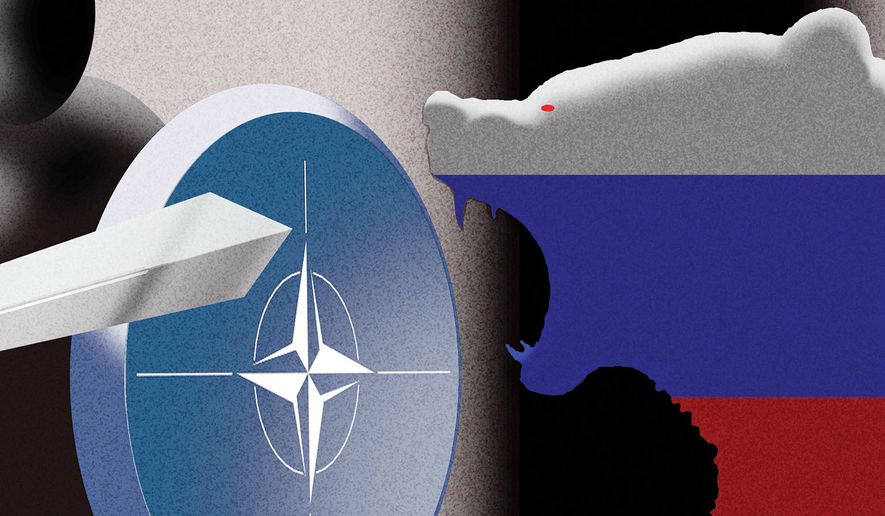
For Mr. Volker, that means NATO is rightly focused on deterring threats to Europe and North America from Russia.
From its creation in 1949, in the wake of the most horrific war the world had ever witnessed, to the collapse of the Soviet Union, NATO — in its first iteration — enabled an extraordinary period of safety, security and prosperity. It never had to fire a shot.
People were interested in these podcasts
NATO 2.0 began after the Cold War, with a new focus on crisis management, especially in the former Yugoslavia, as well as expeditionary military operations in Afghanistan after the alliance invoked Article 5, its collective defense clause, for the first and only time.
Russian ruler Vladimir Putin, who famously argued that the collapse of the Soviet Union was the worst geopolitical disaster of the 20th century, sparked NATO’s rejuvenation and return to its core mission.
European NATO members, especially, should have seen the ominous warnings when Mr. Putin invaded Georgia in 2008 and illegally annexed Crimea in 2014. They should also have seen it in Moscow’s transformation of defector Alexander Litvinenko into a polonium-210 human dirty bomb in downtown London in 2006, and in Russia’s 2018 use of a Novichok nerve agent against former intelligence officer Sergei Skripal.
Yet it was Ukrainian President Volodymyr Zelenskyy and his fellow citizens who awakened Europe from its post-Cold War slumber by courageously defending their nation against the Kremlin’s barbaric February 2022 invasion.
NATO welcomed Finland and Sweden as members and increased defense spending as a percentage of gross domestic product. NATO is now committed to building the robust interoperable defense required to reestablish the deterrence obliterated by Mr. Putin and the most destructive land war on European soil since World War II.
NATO 3.0 looks a lot like NATO 1.0 because the threat picture on the European continent today so closely resembles the period immediately after World War II, when the Red Army threatened to march on Western Europe.
NATO’s goal has always been to deter hostile expansion on the European continent and to ensure collective security for its members. Seventy-seven years later, NATO continues to be “bound together by common values of democracy, individual liberty, human rights and the rule of law.”
Ukraine is very much at the point of attack, defending the rest of Europe from the enemy at its gates. Ukraine has no formal opportunity to join NATO under Article 10’s open-door policy until after Russia is defeated, but until then, Ukraine will be NATO’s most important and valuable partner.
Consider the recent announcement that multiple European countries, including Ukraine, Denmark, France, Germany, Italy and Britain, will build a shared ballistic missile capability for Europe based on Ukraine’s experience in defending its cities against Russia’s indiscriminate missile attacks.
Mr. Zelenskyy said the goal is to mass-produce a low-cost anti-ballistic missile system for Europe that could be exported to other nations.
The U.S. should continue to lead NATO, even as Europe assumes a heavier security burden in its own backyard.
U.S. bases in NATO member countries not only give us skin in the game as a tripwire defense but also enable us to project power in our theaters around the world, including the Middle East and Africa.
The U.S. should be the favored supplier of technology and arms while benefiting from lessons learned, particularly in the drone warfare revolution occurring on the battlefields in Ukraine.
In a 1984 NATO proclamation, President Reagan called on Congress and the American people to express “our support for a bond which has served us so well over the years and which will continue to be essential to our welfare in the future to maintain peace through their collective strength and determination.”
The rule of law, freedom and democracy are force multipliers for business, as reflected in the trillions of dollars in trade between the U.S. and Europe.
That is why Mr. Volker is right to commend NATO for getting back to its central mission of deterring Vladimir Putin’s menacing war machine.
• Daniel N. Hoffman is a retired clandestine services officer and former chief of station with the Central Intelligence Agency. His combined 30 years of government service included high-level overseas and domestic positions at the CIA. He has been a Fox News contributor since May 2018. He can be reached at danielhoffman@yahoo.com. All statements of fact, opinion or analysis expressed are those of the author and do not reflect the official positions or endorsement of the CIA or any other U.S. government agency.
Follow the author


Please read our comment policy before commenting.