



A version of this story appeared in the daily Threat Status newsletter from The Washington Times. Click here to receive Threat Status delivered directly to your inbox each weekday.
SEOUL, South Korea — Japan is set to launch a new counterintelligence agency, the National Intelligence Bureau, and hold the first meeting of its new National Intelligence Council on July 31.
The decisions were approved by the Cabinet Friday, Japanese media reported from Tokyo, citing growing intelligence threats. The initiatives were enabled by legislation passed in May; more is expected to be forthcoming.
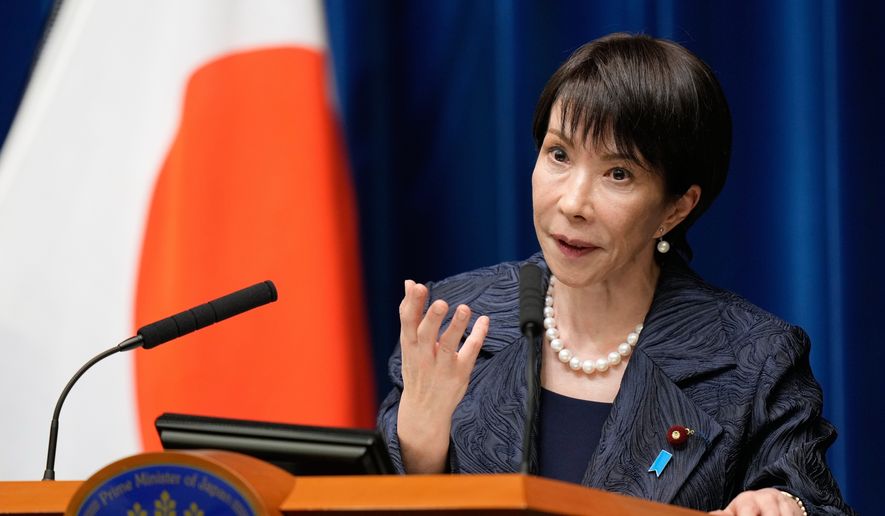
Prime Minister Sanae Takaichi will chair the inaugural meeting of the 10-member NIC. Kazuya Hara, director of Cabinet intelligence and a former senior police official, will lead the new NIB.
People were interested in these podcasts
The moves to upgrade intel collection, analysis and sharing may be overdue. British defense think tank the Royal United Services Institute in June dubbed Japan a “spy paradise” for its lax counterintelligence and related laws.
Japan’s bureaucratic neo-ninjas
The NIB is an expansion of an existing body, the Cabinet Intelligence and Research Office. Its core function will be to act as a control tower over Japan’s existing network of spooks.
According to a July 26 editorial in Kyodo News, Japan’s agencies lack appropriate numbers of analysts and, due to a culture notoriously embedded in the nation’s bureaucracies, do not share intelligence beyond their own silos.
Those agencies are: The Cabinet Intelligence and Research Office, which forms the skeleton of the new NIB; the Self Defense Force’s Defense Intelligence Headquarters, which specializes in signals intelligence; the Justice Ministry’s Public Security Intelligence Agency, which monitors domestic extremists and extremist groups; and the Foreign Ministry’s Intelligence and Analysis Service that evaluates global developments and threats.
In a June report, “Re-Establishing Japan’s Intelligence Capability — ‘Spy Paradise’ lost?” RUSI stated that Japan’s overseas intelligence gathering has been too conservative and said military attaches in embassies worldwide are not fully enabled in their role.
Even so, Japanese foreign intelligence has pulled off at least one major coup.
Insertion of human intelligence assets into the elite ranks of North Korea — let alone into the corridors of its ruling family — is incredibly difficult. Yet, Tokyo managed it.
From 2001 to 2008, Kenji Fujimoto, a sushi chef, served in the household of the late dictator Kim Jong-il, a noted gourmand. Though Mr. Fujimoto was undoubtedly a professional chef, and subsequently wrote a book and spoke to media about his experiences in the Kim household, a person familiar with South Korean intelligence told this newspaper that he clandestinely reported to Tokyo spies.
This kind of work, taking place in Japan’s own backyard, could make Tokyo spies highly valuable to their colleagues in more distant democracies.
“Japan’s proximity to China, Russia and [North Korea] places it in an advantageous position,” RUSI wrote. “Setting up new institutions and appointing more staff increases opportunities for professional relationships that bring … ‘quasi allies’ together.”
At home, it is widely believed that Japan is vulnerable to foreign agents.
“The current system has too many vulnerabilities,” RUSI wrote. “Japan’s 2014 ‘Act on the Protection of Specially Designated Secrets,’ only applies to information that has been actively designated as secret by a government agency. It does not criminalize acting as a clandestine agent for a foreign power or accepting payment from a foreign intelligence service.”
Ms. Takaichi, who took office in October 2025, has taken an uncompromising stance toward security — clear in her attitude toward China. Now, she is turning her attention to intelligence, overseas spies in Japan may come under pressure.
One of the NIB’s first planned initiatives is to register agents of foreign governments who are engaged in lobbying in Japan. That kind of system — as used in Washington — has not, so far, existed in Japan.
Recent reports make clear the importance of such a system.
The Ukraine War has prompted Ukrainian and Russian procurers to travel overseas, scouring the electronics markets of manufacturing nations, including China, India, Japan, South Korea and Taiwan, for the dual-use components that keep their high-tech military-industrial complexes ticking over.
Ukrainian purchases have easy routes home via Eastern Europe, but Russia is heavily sanctioned. As a result, trade data shows that Russian buys are being funneled home across porous borders in states including not just China, but also Turkey, the United Arab Emirates and several of the Central Asian ‘Stans.
In an investigative story that cited unnamed Western intelligence officials and was widely quoted in Japanese media, The New York Times reported on July 7 that after Russian intelligence assets were expelled from embassies across the Western world, many relocated to Japan.
Russia operates a clandestine, procurement-dedicated organization, the 20th Directorate, The Times reported.
In Japan, operating under the cover of Russian airline Aeroflot, the directorate’s Maksim Vladimirovich Filchenkov, an officer in Moscow’s military intelligence, or GRU, has been so successful that 90% of Russian drones downed in Ukraine contain Japanese components.
The Times also revealed that the Russian efforts were known to Ukrainian agencies, prompting Kyiv to send eight official letters to Japan’s Foreign Ministry informing it of the directorate’s activities — to no effect.
Mr. Filchenkov’s media unmasking, however, appears to have had an impact. On Thursday, he reportedly exited Japan.
Contact the author


Please read our comment policy before commenting.