



SANTO DOMINGO, Dominican Republic — The only zoo in the Dominican Republic is providing a safe haven for confiscated illegal and smuggled animals as a government crackdown aimed at protecting exotic species gathers pace.
Tucked inside a green oasis in the middle of the capital, Santo Domingo, are crocodiles, flamingos, and even tigers that officials have confiscated from people accused of illegally keeping them. The numbers are growing and threaten to overload the country’s lone zoo.
“It’s a burden,” said Alfonso Ferreira, deputy director of the city’s National Zoological Park. “People have a predisposition to owning wild animals.”
Dominican authorities seized 188 animals last year, compared with 30 in 2023, as the government tries to tackle the illegal ownership of certain species. It has also launched educational campaigns to raise awareness about their plight.
So far this year, officials have confiscated more than 8,900 species, although a majority of those were crickets and young fish to feed animals including seahorses.
Commonly, flamingos are the most rescued animals, said Nelson García Marcano, head of the Caribbean nation’s Department of Wildlife Regulation and Control.
Flamingos, which are protected, are often illegally taken from their natural habitat and sold to hotels, which use them as garden ornaments, he said. It’s a trend that individual homeowners have started to follow.
“People like to copy what they find attractive and beautiful,” said Garcia Marcano, who decried the practice, noting people sometimes amputate a bird’s wings. “It’s a migratory animal,” he said. “It’s an animal that should be free.”
Nursing animals back to health
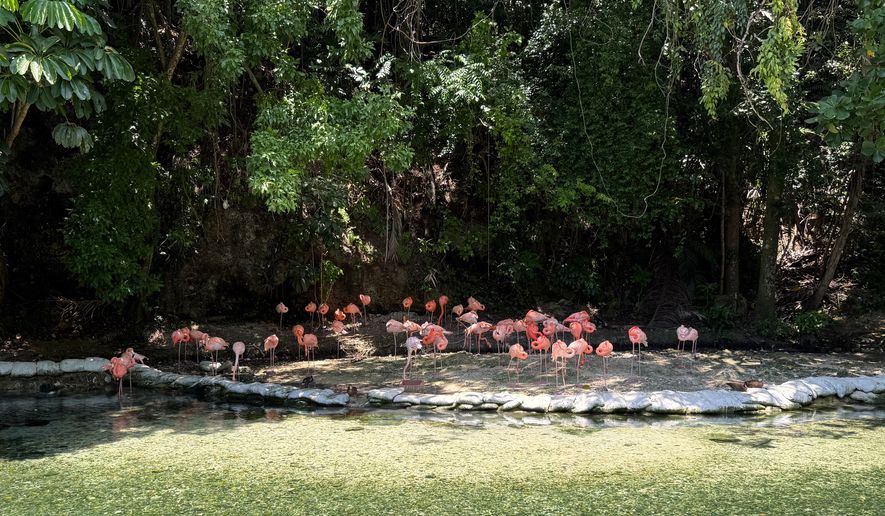
On a recent hot morning, The Associated Press visited a flock of rescued flamingos that sought shade in a private section inside the zoo.
They had recently been confiscated by authorities, and it showed. Their typically bright coral feathers were white, as if they had been bleached. Ferreira explained that their captors usually feed them white bread instead of the algae and tiny crustaceans their bodies require.
To reduce the number of flamingos featured at hotels across the Dominican Republic, García Marcano said they have suggested that staff embrace species including the purple gallinule, a crane-like bird with iridescent feathers.
At the zoo, the rescued flamingos receive carrots and bird feed and are rehabilitated for several months before some are released back into their natural habitat.
Nearby, several crocodiles sat without blinking in individual cages filled with greenish water. They, too, had been snatched from their natural habitat and kept as pets.
Encompassing 125 hectares (309 acres), the zoo is big enough that a small train ferries visitors to exhibits, but resources are stretched. Territorial animals such as crocodiles must be isolated, which requires more cages and in turn, more funding.
Veterinarians run multiple tests on the rescued animals to determine their health. Many will require a strict diet because their owners would often have fed them the wrong food, weakening an animal’s immune system and causing physical deterioration.
“Before, we only received parakeets and parrots,” said veterinarian Tatiana Carreño Pinto. “Now we have a much wider range of species arriving at the park.”
‘It’s like cat and mouse’
The zoo also is preparing to take in exotic animals confiscated in neighboring Puerto Rico as part of a deal reached last year, including caimans that have been seized from suspected drug traffickers.
Puerto Rico, a U.S. territory, is struggling with an overload of exotic species, with nearly 100 animals seized over the July 4 weekend alone. They included 80 boa constrictors, eight native boas, four reticulated pythons, three caimans, and four troupials - Venezuela’s state bird.
An official with the Rangers Corps of Puerto Rico’s Department of Natural and Environmental Resources did not respond to multiple requests for comment.
In the Dominican Republic, officials continue to try to save species that once roamed free.
A project was launched last year to save an endemic parrot, which is under threat and commonly kept as a pet. The government has erected large billboards warning against the trade in the parrots. García Marcano said officials are receiving a growing number of calls about this practice as people spot them along roads while traveling.
The zoo, once again, steps in to help feed and rehabilitate the seized parrots.
“Operations have been carried out, arrests have been made,” García Marcano said. “It’s like cat and mouse. You have to maintain constant vigilance.”

Please read our comment policy before commenting.