



OPINION:
In 2018, Democratic Sens. Ron Wyden of Oregon and Elizabeth Warren of Massachusetts, along with four of their colleagues, proposed mandatory paper ballots and audits.
Mr. Wyden warned against leaving democracy to “hackable election machines.”
Democrats were right to worry about computerized election systems before President Trump began raising the issue. Republicans are right to worry about them now. The mistake is treating a legitimate cybersecurity question as if its answer depends on which political party is most concerned about it at a particular moment.
For years, warnings about voting machine vulnerabilities came largely from the left and were supported by serious research showing that election technology, like other computerized systems, could be compromised or misconfigured. Once those concerns became associated with disputes over the 2020 and 2024 elections, they were often recast as conspiracy theories.
The technology did not suddenly become infallible. The politics surrounding it changed.
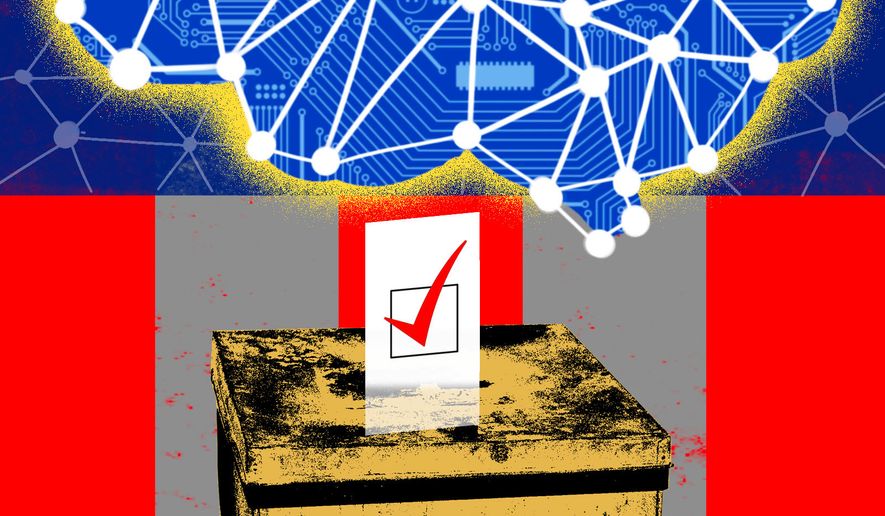
Artificial intelligence should force us to reset the debate. This summer, a U.S. official told The Associated Press that during an authorized testing exercise known as Project Glasswing, Anthropic’s Mythos model identified vulnerabilities in highly sensitive government computer systems within hours.
Officials emphasized that finding a vulnerability is not the same as successfully exploiting it, and there was no indication that an actual system was breached. Still, a member of the Senate Select Committee on Intelligence has said the National Security Agency director described the exercise in far more alarming terms.
The larger lesson is unmistakable: AI is rapidly increasing the speed and sophistication with which weaknesses can be discovered in computerized systems. No software is invulnerable, and election software is not magically exempt.
That does not mean voting machines secretly changed the outcome of every close election. It means we should stop designing elections that require Americans to accept, on faith, the output of a demonstrably vulnerable machine. We should increase penetration and vulnerability testing of all voting and election-related systems.
As an analogy, I am a budget hawk. When someone asks what government programs I would cut to balance the budget, my answer is simple: Everything. No sacred cows.
The same principle should apply to election technology. No system should be placed beyond scrutiny merely because questioning it has become politically inconvenient.
The better question is not whether someone can prove that a voting machine altered a particular past election; that argument can disappear down an endless rabbit hole. The better question is whether an election can still be verified independently when its technology fails, is misconfigured or gets compromised.
The answer is the KISS principle: Keep it simple, stupid.
Voters should mark human-readable paper ballots. Those ballots — not a digital image or machine-generated total — should remain the official record of the vote. Simple, stand-alone, single-purpose tabulators, disconnected from the internet and outside networks, can count marked ovals quickly and consistently. The original paper ballots should then be securely retained, reconciled and examined through meaningful postelection audits.
This is not a fringe proposal. In May 2025, the bipartisan U.S. Election Assistance Commission unanimously endorsed paper-based, auditable, software-independent voting systems. The National Academies has likewise recommended human-readable paper ballots and risk-limiting audits to verify reported outcomes.
Paper alone, however, is not enough. A paper ballot protects an election only if it is treated as the controlling record, secured through a reliable chain of custody, reconciled against voter and tabulator totals and actually used to test the machine count before certification.
Some argue that every ballot should simply be counted by hand. However, full hand counts are slow, labor-intensive and prone to human error. Humans get tired, lose concentration and interpret ambiguous marks differently. Tabulators are better at performing the same repetitive task thousands of times.
We all recognize that machines can also be programmed incorrectly. When that happens, the same error will recur, which is exactly why comparing a statistically meaningful sample of the machine count with the original paper ballots is so important.
The machine provides accuracy at speed. The paper provides evidence. The audit determines whether the two agree.
Digital ballot images may assist with adjudication, audits or public review, but they are not substitutes for the original ballot and are subject to hacking. An image is electronic data produced or stored by a computerized system. When the physical evidence exists, election officials should preserve it and use it.
Most Americans do not spend their lives studying source code, firmware, hash verification, certification standards or audit mathematics. They are busy working, raising families and watching sports, and they learn the details of their voting system only when they arrive at the polls.
They need one clear assurance: that the machine may count the votes but will never be the only evidence of the votes — a concern Stacey Abrams raised in 2018 and 2019. (For the record, this means Ms. Abrams and I agree on something.)
AI did not create the case for paper ballots and meaningful audits. It has simply made that case impossible to ignore.
Artificial intelligence is not a reason to abandon useful election technology. It is a reason to build an election system that remains trustworthy even when technology fails.
Let machines count the votes, but never let the machine be the only evidence of the votes.
• Ken Cuccinelli is chairman of the Election Transparency Initiative, which recently joined The Heritage Foundation and Heritage Action to strengthen and expand their election integrity work. ETI equips policymakers with rigorous research, legal analysis and practical solutions to emerging challenges in election administration.

Please read our comment policy before commenting.