


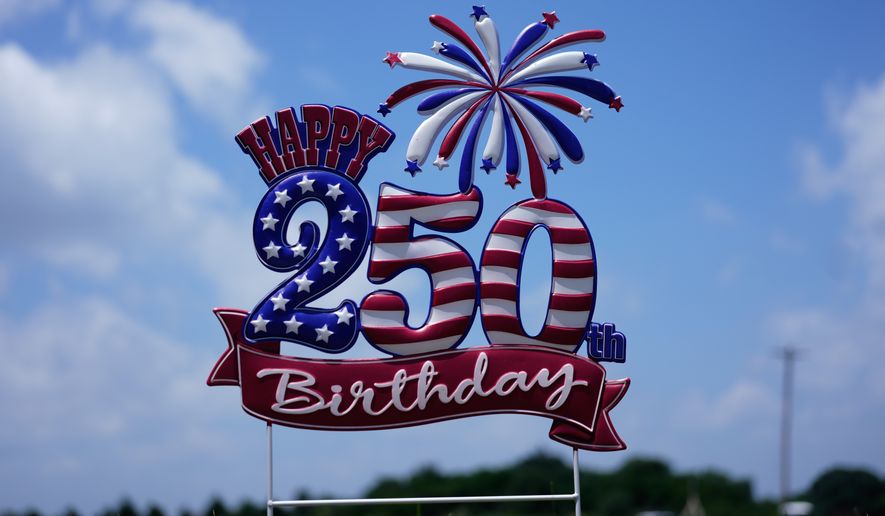

NEW YORK — The United States’ 250th birthday carries ambitions to galvanize Americans behind nationwide community-service drives and patriotic brand launches. Well-known U.S. nonprofits hope to inspire a record-setting level of volunteerism, while major companies such as Walmart and Coca-Cola are sponsoring tributes and selling limited-edition merchandise.
But the private sector’s unifying ambitions have been met with a mixed response, complicated by an uneasy national mood. Fewer Americans see their country as exceptional compared to 10 years ago, according to a recent survey from The Associated Press-NORC Center for Public Affairs Research, part of a broad decline in patriotic sentiment. Views of the American flag - a prominent feature of semiquincentennial celebrations - are divided by politics, age and race.
Rival events, planned by two different commissions, are adding to the conflicted feelings. Late last year President Donald Trump created Freedom 250, a nonprofit led by his allies, to organize alternative programming to America250, the official nonpartisan group formed in 2016 by Congress.
People were interested in these podcasts
“The American dream is alive again. That’s something that nobody thought they’d be saying when you went through that last four years of incompetence,” Trump said at his June 24 campaign-style rally kicking off Freedom 250’s Great American State Fair, which lost nearly all scheduled musical performers over concerns the event had grown too politically charged.
Philanthropy sees local impact as key to engagement
The tone contrasted with one of America250’s tentpoles: America Gives. The initiative aims to strengthen volunteering habits by encouraging Americans to serve with its nonprofit partners and log those hours in an online tracker.
Salvation Army USA National Commander Merle Heatwole lamented that a number of potential participants have assigned political agendas to the nonpartisan program, partnered on by his Christian aid nonprofit. Still, he celebrated that thousands of churches supported their “Good Neighbor Day” of volunteering in May.
“Some people have shied away because they’re not sure whether this is a nonpartisan effort, or whether it’s connected to the Trump administration versus the Democratic administrations,” Heatwole said. “That, I think, has hindered it slightly. But I think that overall, people are excited about having an opportunity to get involved.”
The America Gives tracker counted just over 38 million hours volunteered entering the holiday weekend. It’s unclear how many hours would set the single-year record. Americans recorded 4.99 billion service hours in a one-year span from 2022-2023, according to an AmeriCorps analysis of Census Bureau data.
America250 Chair Rosie Rios said there will be a big year-end increase because many partners wait until “the last second” to populate their hours. She emphasized that highlighting the value of service is their only agenda.
Most nonprofits aren’t leveraging semiquincentennial campaigns, one consultant found. Jayne Cravens, whose 30-year nonprofit career has included volunteer coordination, said nonprofits lack the infrastructure to provide meaningful service experiences. That’s especially so after the Trump administration gutted AmeriCorps, the federal agency for national service and volunteerism, in 2025. Nonprofits scrambled to replace lost workers and funding.
Audra Watson, who leads youth civic programs at the nonprofit C&S, is spearheading a three-year effort to increase civic engagement among 20 million people ages 14 to 24.
She finds most young people are getting engaged through appeals outside of the 250th. While the milestone has sparked “some excitement for some young people,” she said, those participants are “hand-raisers” already “deeply excited about history.”
The more they encourage young people to consider local impact, where she said they hold the most influence, the more she finds they depart from partisanship.
“For some young people, the 250th is their thing,” she said. “But for many, many more of them this is about really taking that energy and catalyzing that energy around issues of their community.”
Dueling logos muddle the market
Marketing consultants say brands have to tread carefully, given a divided nation and shrinking national pride.
Further jumbling 250th celebration advertising, marketing executives noted, have been the two competing logos. The America250 emblem depicts a bold red, white and blue continuous ribbon that spells out “250.” The Freedom 250 design features the words “Freedom 250” written in a classic serif font, placed inside a circular arrangement of 13 stars, a nod to the original U.S. flag
“Once you have two competing logos, it’s confusing,” said Allen Adamson, co-founder of marketing consultancy Metaforce.
Walmart, an America250 founding sponsor, is sponsoring a mobile recording studio that is collecting oral histories across the country. The Library of Congress will archive a selection of stories, the company said.
Coca‑Cola launched “Paint the Nation,” a large-scale public art initiative resulting in dozens of murals created with local artists. The company said each mural will reflect local culture and community pride, creating a “visual legacy that extends beyond the anniversary year.” Commemorative mini-cans are also being issued for all 50 states plus Puerto Rico and Washington, D.C.
Aaron Hilton of Suffolk, Virginia says he’s seen lots of paper plates, cups and T-shirts with the America 250 reference. He’s not interested, blaming his lack of enthusiasm on the Trump administration.
“I’ll end up getting the Coke because I do drink Coke, but otherwise I really don’t want to buy anything like that,” said Hilton, 36. “I’m not feeling really patriotic about this.”
Darrell Brown, 50, of Alexander, Arkansas, has already bought commemorative T-shirts and flags. Every year, he decorates his lawn with a 7-foot inflatable Uncle Sam. This year, he’s added more American flags than usual to commemorate the milestone.
Brown saye he’s been sticking to merchandise with America250 references. He finds it politically divisive to have two logos.
“I don’t believe this should be a political issue,” he said. “I think it should be just about celebrating the country, regardless if you’re a Democrat or Republican.”
Grassroots programming defined commemoration 50 years ago
Future generations might be pleasantly surprised to see all their communities accomplished under the milestone’s banner, according to M.J. Rymsza-Pawlowska, a cultural historian who wrote a book about the 1976 bicentennial.
She recalled that the Vietnam war and Watergate still felt fresh during those celebrations. President Richard Nixon initially replaced Lyndon B. Johnson’s bipartisan planning commission with one composed of political appointees interested in a top-down celebration of American supremacy.
But Nixon scrapped those plans in place of federal funding for grassroots programming, Rymsza-Pawlowska said, which grew into forms of civic engagement still popular today. Environmental pick-ups and get-out-the-vote work were common forms of bicentennial volunteerism.
Private funders still support such efforts, though not at the scale possible with government backing. State humanities councils launched a “By the People” campaign to fund community-driven programs exploring the nation’s culture and imagining its future. Her Washington, D.C. chapter created an oral history project that promises “an intimate and complex portrait of what it means to call the nation’s capital home” today.
“We don’t really know what the ultimate legacy of the 250th will be,” Rymsza-Pawlowska said. “A commemoration is just an opportunity to do a thing that you were already doing but have an occasion for it. And possibly get some money for it.”
___
Associated Press coverage of philanthropy and nonprofits receives support through the AP’s collaboration with The Conversation US, with funding from Lilly Endowment Inc. The AP is solely responsible for this content. For all of AP’s philanthropy coverage, visit https://apnews.com/hub/philanthropy.

Please read our comment policy before commenting.