



A version of this story appeared in the daily Threat Status newsletter from The Washington Times. Click here to receive Threat Status delivered directly to your inbox each weekday.
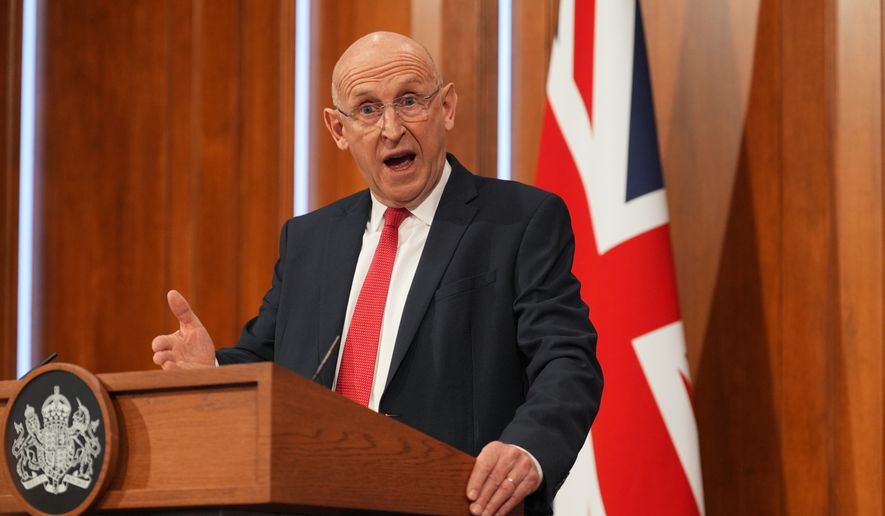
British Defense Secretary John Healey unexpectedly stepped down Thursday in a dispute over military spending in the latest blow to embattled Prime Minister Keir Starmer.
His departure casts harsh light on the dire state of the armed forces of America’s closest ally.
In a public letter to the prime minister, Mr. Healey wrote, “This new era for defense required further investment… you have been unable, and the Treasury has been unwilling, to commit the resources that the nation needs.”
Military funding — details of which Mr. Healey said he received on Monday — “falls well short of what is required,” he wrote.
He continued: “I am being forced to make decisions that would reduce the readiness of our Forces and increase the risk to personnel on operations, and could make the country less safe.”
At issue: The Defense Investment Plan, designed to set in place the funding for new capabilities called for in last year’s Strategic Defense Review, which set forth a 10-year vision for the armed forces.
The SDR was published in June 2025; the DIP was expected to follow later that year.
But as months passed, it became clear that a behind-closed-doors gutter fight was underway between Mr. Healey’s Ministry of Defense and the Treasury.
As British media and punditry grew increasingly frothy, Mr. Starmer vowed to release the plan before the next NATO Summit, which starts on July 7 in Ankara.
In a surprise intervention on Wednesday, the speaker of the House of Commons urged the government not to release the highly anticipated DIP on Friday.
Prior to Mr. Healey’s letter, reports suggested that while the Ministry of Defense needed $22.9 billion, the Treasury was offering $13.3.
Some clarity has now emerged. In his letter, Mr. Healey said that he sought defense spending of 3% of GDP by 2030, but the government plan called for 2.68% by that year.
Despite widespread rumors in recent days, there had been no indication that Mr. Healey, respected on both sides of the House, would fall on his sword.
How the drama will impact Mr. Starmer is unclear.
He led the Labour Party to a general election victory in 2024, but has squandered the electorate’s goodwill: Labour suffered major defeats in local elections this year. A May YouGov poll found 69% of Brits view Mr. Starmer unfavorably, while just 23% approve.
He faces a potential leadership challenge from Manchester Mayor Andy Burnham, who is popular among Labour’s rank-and-file, as well as some senior lawmakers.
Regardless of Labour’s leader, the next general election must take place by summer 2029.
And regardless of politics, the U.K. Armed Forces must contend with budget shortfalls.
The Ministry of Defense has struggled to win funds in a government where welfare spending, the National Health Service and achieving net zero emissions are leading priorities.
However, it is not just about budgets.
The MoD has bigger manpower than the Royal Navy, with 32,000 personnel, and the Royal Air Force, with 27,000.
Its 55,000 bureaucrats have overseen endless inefficiencies and procurement snafus.
Though London spends more on defense than Paris and Rome, both allies deploy more troops, more surface warships and more airframes.
Mr. Healey’s deputy, former Royal Marine Commando and Armed Forces Secretary Al Carns, warned in a tweet, “Our Armed Forces… deserve a Ministry of Defence that matches their seriousness with our own.”
On Monday, Mr. Carn’s former corps rebranded from “3rd Commando Brigade” to “UK Commando Force” after the all-arms brigade broke down into smaller, special forces units.
Critics called the shift inevitable: The Royal Navy lacks vessels to deliver large amphibious forces.
The public was shocked at the outset of the Iran conflict, when the Royal Navy was able to deploy just one destroyer to the theater – and it needed repairs upon arrival.
Currently, according to reports, Britain’s entire flotilla of nuclear attack submarines is undergoing maintenance at over-stretched facilities.
The army’s biggest new program, the Ajax armored fighting vehicle, was ordered in 2014 to enter service in 2019. It is still pending.
The future of the $8 billion platform is unclear: Troops using the vehicle consistently suffer health issues from noise and vibration.
The Royal Air Force and Royal Navy jointly deploy just 48 F35 stealth fighters, from an originally planned fleet of 138 – a number which may never materialize.
Meanwhile, Australia deploys 72 of the aircraft.
A major embarrassment may be incoming, with Japanese Prime Minister Sanae Takaichi set to summit with Mr. Starmer on Sunday before heading to Italy.
On the agenda will be the status of the Italy-Japan-UK sixth-generation stealth fighter project, first announced in 2022. London’s funding commitment remains unconfirmed.
One pundit suggested possible upsides to Mr. Healey’s departure.
“The resignation will ensure that this government — and subsequent ones — will find it harder to be complacent on defence spending,” wrote Ed Arnold, senior associate at the Royal United Services Institute think tank.
“The MoD needs a fundamental cultural transformation… this resignation will hopefully be a catalyst for wider departmental reform.”
But a co-author of last year’s SDR, Richard Barrons, noting that Mr. Starmer’s government “decided not to fund its own defense review,” was scathing.
“This makes this country unsafe, it diminishes its place in NATO,” he told the BBC. “Our enemies as well as our allies will have observed this catastrophe today.”
Contact the author


Please read our comment policy before commenting.