


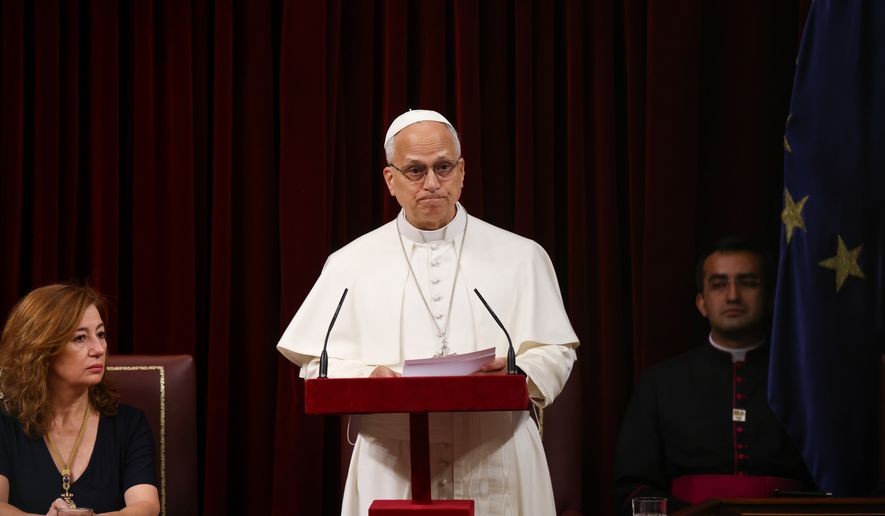

1. What happened when Pope Leo XIV visited Spain’s parliament?
Pope Leo XIV became the first pope ever to address Spanish lawmakers, delivering a speech to Las Cortes Generales in Madrid on Monday. Lawmakers responded with a 7-minute standing ovation and chants of “Viva el Papa!” The address covered migrants’ rights, international law, artificial intelligence in warfare and the need for moral renewal in public life.
2. Why is a papal address to Spanish parliament historically significant?
People were interested in these podcasts
The Catholic Church was a central pillar of Francisco Franco’s dictatorship and lost much of its political standing after Spain transitioned to democracy in the 1970s. Religious observance has declined sharply since, making a formal invitation for the pope to address parliament something that would have been considered unthinkable just a few years ago. Speeches by popes to foreign legislatures are rare globally — Pope Francis addressed the U.S. Congress in 2015, and Pope Benedict XVI spoke to Germany’s Bundestag in 2011.
3. What were the pope’s key messages to Spanish lawmakers?
Leo called for safe and legal pathways for migrants, warning that no one should be forced to leave their homeland due to conflict, poverty or climate change. He also expressed concern about rising European defense spending and demanded strict ethical oversight of AI-powered weapons systems, arguing that decisions about life and death should never be left to automated systems.
4. How does Leo’s visit connect to Spain’s current political situation?
The visit comes at a difficult moment for Prime Minister Pedro Sanchez, whose Socialist government has been weakened by corruption scandals and has failed to pass a national budget for three years. Despite the Catholic Church’s traditional alignment with Spain’s conservative opposition, Leo and Sánchez have found common ground on immigration and opposition to the conflict involving Iran. Leo appeared to address the country’s political polarization directly, cautioning that pluralism should not become “the constant disparagement of one’s adversary.”
5. What did the pope say about Spain’s colonial history?
Leo referenced the 16th-century School of Salamanca — a Spanish intellectual tradition that helped give rise to concepts of international law and human rights in response to Spain’s conquest of the Americas. While praising those thinkers, he acknowledged that both the church and society “did not always live up to” those moral insights, in an apparent reference to the Catholic Church’s role in the transatlantic slave trade and colonial conquest.
For more on this report, read “Pope’s historic speech to Spain’s parliament demands respect for migrants and gets 7-minute ovation” from The Associated Press, published on The Washington Times.
This article was constructed with the assistance of artificial intelligence and published by a member of The Washington Times' AI News Desk team. The contents of this report are based solely on The Washington Times' original reporting, wire services, and/or other sources cited within the report. For more information, please read our AI policy or contact Steve Fink, Director of Artificial Intelligence, at sfink@washingtontimes.com
The Washington Times AI Ethics Newsroom Committee can be reached at aispotlight@washingtontimes.com.

Please read our comment policy before commenting.