


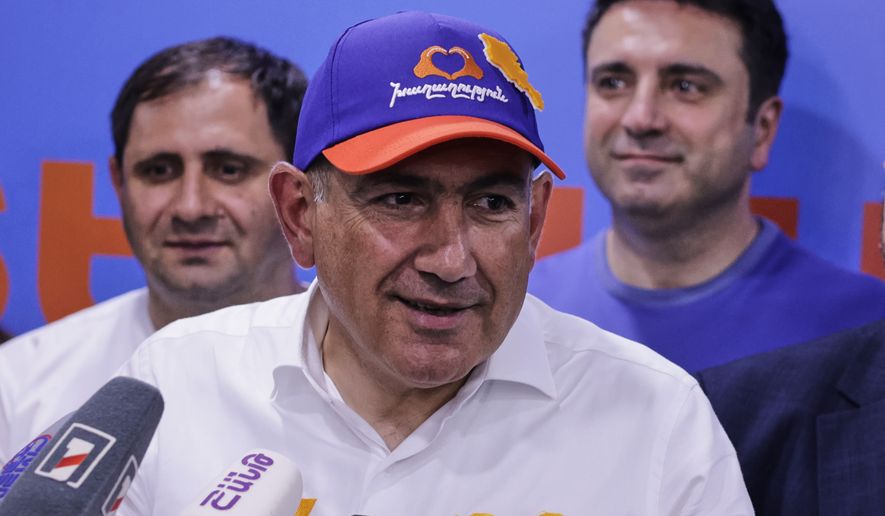

YEREVAN, Armenia — Armenian Prime Minister Nikol Pashinyan claimed victory Monday in a general election seen as a test of Russia’s influence in the South Caucasus country, as preliminary results showed his governing party in first with more than double the votes of the next contender.
Mr. Pashinyan was looking for a strong mandate for a new geopolitical course that includes distancing Armenia from Moscow and deepening cooperation with the West. “The European Union is our main partner in democratic reform implementation, and we will continue that path,” Mr. Pashinyan said as he cast his vote on Sunday.
Mr. Pashinyan’s Civil Contract party came in first with 49.82% of the vote, according to the latest preliminary results on Monday.
People were interested in these podcasts
His main opponent, Samvel Karapetyan, is a billionaire who made his fortune in Russia and is under house arrest, accused of advocating for the government’s overthrow. Mr. Karapetyan, whose Strong Armenia bloc was the runner-up with 23.28% of the vote, rejects that charge as politically motivated.
Armenian investigators said they also issued six arrest warrants for members of Strong Armenia the day before the election, accusing them of buying votes. The party seeks to develop close business ties with Moscow and has accused Mr. Pashinyan of attempting to start a war with the Kremlin.
While the Central Election Commission says it has counted ballots from all electoral precincts, full results are not expected until Sunday. This is to give parties time to lodge complaints about any perceived irregularities.
Richard Giragosian, who heads the Regional Studies Center think tank in Armenia’s capital, Yerevan, said that despite concerns that Russia was trying to sway the election, the vote had been “genuinely free and fair” and “stands as a referendum on the future of the country.”
“Much of the Russian efforts at interference fell flat and were ineffective,” Mr. Giragosian told the AP on Monday.
Russia has warned Armenia it would suffer economic consequences if it continues moves toward the EU. Moscow controls a significant portion of Armenia’s energy and infrastructure, a point that has been driven home by Russian President Vladimir Putin in his meetings with Mr. Pashinyan.
Russia recently banned the import of a number of Armenian products, including flowers, wine and fish. Moscow has cited violations of import rules, but the European Commission has called the measures “economic coercion.”
Mr. Putin and other Russian officials also have made thinly veiled threats comparing Armenia’s path to that already taken by Ukraine, which was invaded by Russia.
Armenia’s National Assembly must consist of at least 101 members elected for five-year terms. Parties must win at least 4% of the vote to enter, while blocs made up of three or more parties must hit 8%.
The Hayastan (Armenia) bloc led by former President Robert Kocharyan is also set to take seats, receiving 9.93% of the vote. The Prosperous or Blossoming Armenia party, led by pro-Russia businessman Gagik Tsarukyan, has hovered around the 4% threshold.
Turnout stood at 58.94%, according to the latest announcement by the election commission.
Preliminary results from the election commission suggested the governing party has won 61 seats in the National Assembly.
According to Mr. Giragosian, the analyst, this will allow Mr. Pashinyan’s party to rule on its own and pass most laws independently, but not to secure constitutional amendments without a referendum.
Opposition parties have strongly criticized the government for attempting to normalize relations with neighboring Azerbaijan. Mr. Pashinyan and Azerbaijani President Ilham Aliyev initialed a document on moving toward a peace deal at the White House alongside U.S. President Trump in August.
Armenia and Azerbaijan were locked in a decades-long conflict over Karabakh, a breakaway region that had been controlled for decades by ethnic Armenian forces. Azerbaijan took control of the entire Karabakh region during a rapid offensive in 2023.
Mr. Pashinyan announced on Monday that Armenia intends to move toward “institutionalizing” a peace deal, and ratifying an agreement with the White House that would create a major transit corridor through Armenian territory to be named after Mr. Trump.
“This is a truly transformative project, as Armenia is becoming a crossroads of the world,” Mr. Pashinyan said at a meeting of a parliamentary committee, referring to the country’s position bridging Europe’s hungry energy markets and Central Asia’s gas fields.

Please read our comment policy before commenting.