


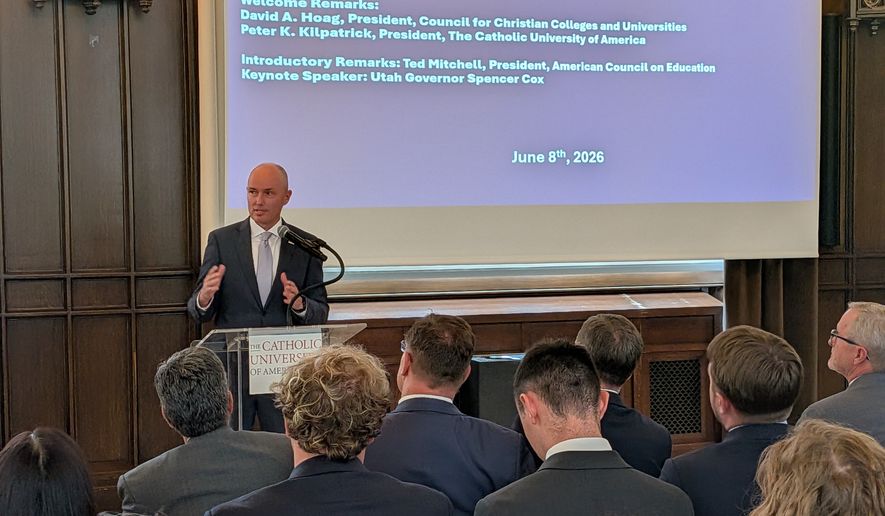

Religious colleges are holding themselves up as models of respectful political disagreement in the Trump era, as they met this week to promote their speech codes as moralizing influences on students.
“Faith-based communities have simmered in the secret sauce that America needs so much,” American Council on Education President Ted Mitchell told the ACE Commission on Faith-Based Colleges and Universities. About 150 leaders of Jewish and Christian campuses, including 33 university presidents, attended a meeting of the commission on Monday afternoon.
Utah Gov. Spencer Cox, a Republican and Mormon who has criticized President Trump’s sharp political rhetoric, said faith-based colleges teach students to be comfortable with differences.
He pointed to the Jan. 6, 2021, riot at the U.S. Capitol and the assassination of political activist Charlie Kirk as examples of why people look to religious schools to provide an oasis from divisive rhetoric.
“If we’re going to survive another 250 years, we’ve got to get this right,” Mr. Cox said during a lengthy keynote address that drew loud applause.
Other speakers included the presidents of Baylor, Yeshiva, Notre Dame and Brigham Young universities. They said their mission of loving God and neighbor teaches students to “disagree better.”
“We’re showing them models where they can go deeper into their values,” said Rabbi Ari Berman, president of Yeshiva University.
Some of the presentations on Monday called on faith-based colleges to rebuild trust in the value of a degree.
Clark Gilbert, an elder in the Church of Jesus Christ of Latter-Day Saints, cited a poll from Gallup and the nonprofit Lumina Foundation that found the share of adults expressing “a great deal” or “quite a lot” of confidence in universities dropped from 57% in 2015 to 42% in 2025.
Some college administrators attending the meeting at the Catholic University of America in Northeast Washington told The Washington Times that their religious guidelines for public debate increase students’ respect for other views.
“We encourage free speech and thinking, but we can put boundaries on it that public colleges can’t,” said Bryan Schroll, general counsel at Cedarville University, which bans LGBTQ student groups. His Ohio school requires students to be Christian and faculty to sign a Baptist profession of faith.
Andrew Bolger, chief of staff at the evangelical College of the Ozarks in Missouri, said his campus requires students to pursue the good and practice Christian hospitality in their words.
“All our students take a patriotic education class to learn the Bill of Rights, but they also have to abide by our core values,” Mr. Bolger said.
Founded in 1918, the D.C.-based American Council on Education represents roughly 1,600 campuses as the top coordinating body of U.S. higher education.
Free-speech advocates concerned
The Foundation for Individual Rights and Expression, a free-speech group that did not attend the meeting, said religious campuses often promote conformity rather than intellectual diversity.
“The best environment is one where all sorts of controversial ideas can be presented and contested,” said Laura Beltz, FIRE’s director of policy reform. “If a college makes clear only certain viewpoints can be shared, the opportunity to be a true ’marketplace of ideas’ is stymied.”
Ms. Beltz said the schools that established the council’s faith-based commission in 2024 have a legal right “to set their own rules for speech” based on religious values. But she urged them to adopt “speech-protective policies and actually enforce them” instead.
Other free speech experts who did not attend the meeting countered that the Constitution protects nearly all speech, not just expressions deemed inoffensive to religious ears.
“Universities must be careful that, by enforcing policies and facilitating settings for civil dialogue, they are not inadvertently suppressing other avenues for open inquiry,” added Kristen Shahverdian, director of higher education and free expression at the advocacy group PEN America.
FIRE has frequently clashed with conservative Christian campuses such as Hillsdale College for enforcing morality codes that deny a podium to left-wing groups. It has also blasted moderate and liberal religious colleges for inconsistently enforcing vague free-speech policies to suppress conservative student views.
The group flagged Catholic University three times for inconsistently enforcing its own free-speech commitments during the 2025-26 school year.
Administrators dismantled an Israeli-flagged memorial to Gaza terror victims, briefly suspended student access to Reddit over adult content concerns and blocked Rep. Randy Fine, Florida Republican, from speaking about antisemitism unless another orator balanced his hardline views on Muslims.
“You try to curate the conversation with people who will represent their views civilly and respect others,” Catholic University President Peter Kilpatrick told The Washington Times in an interview after the meeting. “Jesus called that loving your enemy.”
Contact the author


Please read our comment policy before commenting.