



A version of this story appeared in the daily Threat Status newsletter from The Washington Times. Click here to receive Threat Status delivered directly to your inbox each weekday.
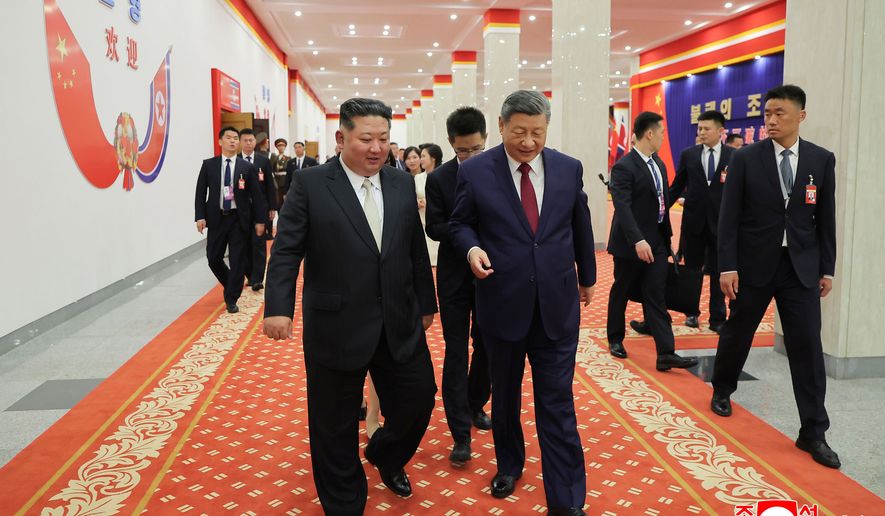
SEOUL, South Korea — Chinese President Xi Jinping wrapped up his two-day visit to neighboring North Korea Tuesday, after impressive ceremonial pomp but only vague official commentary on upgrades to bilateral ties.
Mr. Xi and his wife were greeted upon arrival in Pyongyang by state leader Kim Jong-un and his wife, and similarly seen off when they departed.
The Chinese couple were feted with a 21-gun salute, and greeted by thousands of cheering citizens, then formally wined and dined.
As is typical for a meeting of two heads of very opaque states, little hard information on discussions has leaked out. State media in both nations reported in generalities, such as descriptions of the visit as a “a new historical starting point.”
Ties were said to be expanded in diplomacy, law enforcement and defense. Diplomacy may refer to Taiwan, law enforcement to border crossings by North Korea escapees.
It is not clear how defense ties could expand: The two militaries do not conduct joint exercises, though China, which lacks a presence in the Sea of Japan, may seek to base warships in North Korean ports.
Mr. Xi’s visit to North Korea is part of a recent spate of global diplomacy. It follows summits held in Beijing with European leaders, and recent meets with U.S. President Trump and Russian President Vladimir Putin.
North Korea has significant strategic value for China. The Kimdom forms a geographically rugged, ultra-militarized buffer on China’s northeast flank against Japan, South Korea and the two democracies’ resident contingents of U.S. troops.
The 1950-53 Korean War, which Beijing entered when North Korea was on the verge of collapse, remains the bloodiest struggle China has fought since becoming a communist republic in 1949.
Despite that common history and a mutual defense treaty, bilateral relations have not always been amicable, with North Korea resentful of China’s influence.
Even so, Beijing, ever-wary of border instability, has consistently supported the isolated state, particularly after the collapse of the Soviet Union, which decimated North Korea’s economy.
Recent overseas visitors to Pyongyang, the state’s showpiece capital, say they are impressed by increased use of personal technologies, new architecture and rising prosperity indicators, but the heavily sanctioned economy remains largely insignificant in global terms.
Its core relevance internationally remains strategic: It has successfully defied the global community and U.N. Security Council sanctions to build a nuclear arsenal and the missiles to carry it.
Mr. Xi may have shifted course on that. On a 2019 visit to Pyongyang, he vowed to work for denuclearization. There was no apparent mention of denuclearization this time.
Though scarcity of information gave Pyongyangologists little to mull, a reference by Mr. Kim, to supporting China’s policy toward Taiwan captured eyes.
Experts also criticized the widespread analysis carried by international media that one of Mr. Xi’s key aims was to reassert the primacy of Chinese, rather than Russian influence, over North Korea.
Experienced analysts called that takeaway a “false optic.”
Split on unification approaches
China and North Korea have diverged on respective approaches to national reunification.
China was divided when Nationalist forces, defeated by Communists on the mainland in 1948-49, fled to the island of Taiwan, which has since become a prosperous democracy.
The Korean Peninsula was bisected by great powers at the end of World War II, then solidified into two separate states, with Washington and Moscow backing the South and North, respectively, in 1948. Enmity was exacerbated by the 1950-53 Korean War; division persists to this day.
North Korea this year changed its constitution to remove references to reunification.
Some consider that long-overdue official recognition of the impossibility of the North seizing or even merging with a freer, more populous, more prosperous South.
Pyongyang’s most notable military investment is its strategic nuclear force — of limited or no use in any reunification operation.
China’s unification position is the opposite. Beijing claims Taiwan — a claim it promotes vigorously across numerous channels worldwide.
While China possesses a significant nuclear deterrent, its most notable military build in recent years has been naval. Its navy now operates three aircraft carriers and an expanding range of amphibious assets.
Mr. Kim’s verbal support for Mr. Xi’s Taiwan stance caught the eye of Fyodor Tertitskiy.
“Kim said he reinforced the commitment to ’One China,’ and this looks quite ominous to me,” said the Russian, who watches North Korea from Seoul’s Korea University. “Nobody is doubting that North Korea supports China, but why reaffirm this?”
Mr. Kim’s statement pricks an ultra-sensitive strategic fault line between Seoul and Washington. Seoul is deeply wary of any Taiwan crisis, given that it hosts some 28,000 U.S. troops.
“South Korea does not want to be sucked into a struggle over Taiwan so looks for all possible excuses not to participate — this is perfectly understandable,” said Andrei Lankov, a North Korea expert at Seoul’s Kookmin University. “It is not merely an excuse: This could be a signal that if South Korea gets involved in a Taiwan crisis, China might encourage North Korea to inflict harm.”
U.S. bases on Korea’s west coast are perfectly positioned to monitor, or even interdict, Chinese movements in and over the Yellow Sea. During the second Trump administration, talk of “strategic flexibility” — the use of U.S. troops for regional operations — has risen in volume in the Pentagon.
Korean discomfort is twofold. One: North Korea could support China by causing trouble on the peninsula. Two: If U.S. troops act, South Korea could become a Chinese target.
China, Russia, North Korea
Around Mr. Xi’s trip, a common narrative in global media has been China’s alleged concern about North Korea’s recent tilt toward Russia.
In 2024, Mr. Putin and Mr. Kim — to global surprise — significantly upgraded bilateral ties. That agreement followed Pyongyang’s supply of munitions to Russia, and later enabled North Korean troops to engage in combat against Ukraine.
The Russian and North Korean economies are complimentary. Russia needs weapons, munitions and troops for its war with Ukraine. North Korea needs military technology, grain and oil.
The uptick in Moscow-Pyongyang ties led some to surmise that China’s influence over North Korea could be eclipsed by Russia’s.
Experts differ. They say that Mr. Kim likely knows that Moscow’s outreach to Pyongyang is transactional, and will weaken if the Ukraine War ends, leaving Pyongyang reliant upon Beijing.
While Russian backing for North Korea has certainly soared, isolated Moscow, bogged down in a four-year war, is deeply reliant upon Beijing.
“I don’t think Xi is worried about [Russian influence], these are false optics,” said Mr. Tertitskiy. “Xi could call Putin and can tell him, ’Stop this, because if you won’t, you will face consequences.’”
Nor can Pyongyang play Beijing and Moscow against each other, as it did when Cold War competition simmered between the two communist superpowers.
“It’s difficult to explain tensions between China and Russia when tensions are not that tense!” said Mr. Lankov. “They are not merely in good relations: Russia is remarkably dependent on China.”
He noted that in the 1970s, China and Russia were of similar economic sizes. In 2025, China’s economy, valued at $19.6 trillion, vastly overawes Russia’s, worth some $2.5 trillion.
Amid global sanctions, China, the world’s second-largest economy, has become Russia’s economic lifeline: It buys energy and supplies Moscow with industrial goods.
“Russia has no reason to quarrel with China over the marginal issue of North Korea,” Mr. Lankov said.
Contact the author


Please read our comment policy before commenting.