


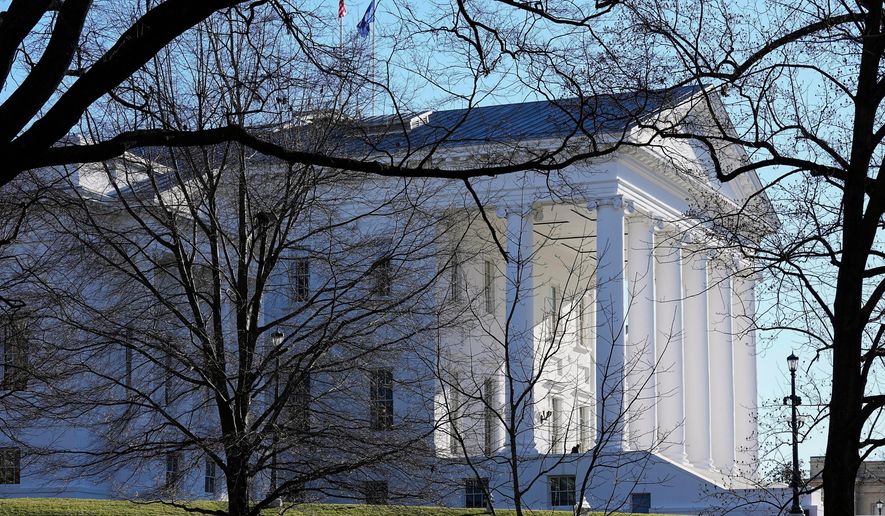

Virginia’s Supreme Court on Wednesday ruled that the commonwealth can hold its ballot referendum next month on a new Democrat-friendly congressional map, despite ongoing challenges to the proposal’s constitutionality.
The state’s high court said it will determine the constitutional merits of the redrawn map after the April 21 election if it passes.
“It is the process, not the outcome, of this effort that we ultimately have to address,” the ruling said. “Issuing an injunction to keep Virginians from the polls is not the proper way to make this decision.”
People were interested in these podcasts
Wednesday’s ruling follows a separate ruling from Lynchburg earlier this week in which a judge dismissed a lawsuit that sought to delay the start of early voting, which is scheduled to begin Friday.
Lynchburg Circuit Court Judge Patrick Yeatts said during the hearing this week that it’s not his court’s duty to halt an election. The magistrate also noted that constitutional challenges will have to be settled after the election is held.
“None of the substantive constitutional issues were rejected. They remain live and will have to be litigated,” said Tim Anderson, an attorney who represented the Lynchburg City Council in the lawsuit.
The Virginia Supreme Court has not said when it would take up the issue.
“Unfortunately, it’s an answer that doesn’t provide us the immediate relief we were looking for to stop this steal, but it does say this is the Supreme Court’s responsibility,” Lynchburg Vice Mayor Curt Diemer, a Republican, told Lynchburg’s WSET-TV following the Monday hearing.
A separate challenge in Tazewell County Circuit Court argued the redistricting referendum violates state law by holding early voting too soon. Virginia requires voters to receive 90-day notice of any referendums before they can cast their ballots.
That challenge will also be heard by the Virginia Supreme Court.
But the Attorney General Jay Jones’ office celebrated the ruling as a testament to the referendum’s legal standing.
“The Lynchburg Circuit Court’s decision reinforces our position since the beginning — this election was properly called and will proceed as scheduled,” the office of Mr. Jones, a Democrat, said in a statement. “The Office of the Attorney General stood up in court to protect Virginians’ right to vote.”
The Council filed the lawsuit, in part, to try to stall Virginia Democrats’ move to drastically flip congressional representation in the state.
After Gov. Abigail Spanberger took office and Democrats secured majorities in the state Legislature, lawmakers redrew the congressional map to erase the current 6-5 split that leans Republican for a likely 10-1 margin that favors Democrats.
The commonwealth’s redistricting push is part of a nationwide arms race in which both parties are gerrymandering as many seats as possible ahead of this fall’s midterm elections.
The Republican-led states of Missouri, North Carolina, Ohio and Texas all redrew their maps to boost their party’s ranks in Congress, while California followed suit with its own referendum last fall.
Efforts to do the same by Utah’s Republicans backfired, and a judicial ruling last month wound up netting Democrats an additional seat.
The prospect of a similar outcome in Maryland has scared the state’s Democratic supermajority away from redistricting, much to the chagrin of Gov. Wes Moore.

Please read our comment policy before commenting.