



OPINION:
When I was getting my Ph.D. in economics at Harvard back in the 1980s, no institution was more revered and respected than the National Bureau of Economic Research.
These days, the NBER seems to spend far too much of its time sponsoring badly flawed research designed to attack Trump administration policies.
The latest example is an “Alice in Wonderland” type working paper claiming President Trump’s secure border and stepped-up U.S. Immigration and Customs Enforcement policies have somehow caused U.S.-born workers to lose jobs.
People were interested in these podcasts
This is not economics. It is ideology with regression tables.
The paper’s headline claim is that areas with larger increases in ICE arrests showed lower work among “likely undocumented immigrants” and no positive spillover for U.S.-born workers. It even suggests that less-educated U.S.-born men in immigrant-heavy sectors were harmed by immigration enforcement.
Look under the statistical hood, and that conclusion clearly rests on a fragile tower of proxies, assumptions and methodological evasion, starting with the most basic problem: The study does not actually know who is illegal.
The Current Population Survey does not identify legal status, so the paper invents a category called “likely undocumented.” Its main definition is foreign-born, working-age adults with a high school education or less in selected sectors.
That sweeps in lawful permanent residents, refugees, asylum recipients, temporary legal workers, naturalized citizens with lower education levels and other legal immigrants. It is a blunt instrument masquerading as a microscope.
Nor does the paper measure the most important thing immigration enforcement is supposed to affect: the total number of illegal workers in the labor market.
There, the authors openly acknowledge that they do not estimate changes in the total number of immigrant workers. Instead, they study employment outcomes among people who remain in the United States and still show up in the survey.
That is like studying the effect of a bank robbery crackdown by interviewing only the robbers who were not arrested, not scared off and still willing to answer the phone.
The whole point of immigration enforcement is to remove illegal workers, deter illegal entry, induce voluntary departure and change employer behavior. Those are the channels through which American workers may gain bargaining power, job openings and higher wages over time.
This paper largely excludes those channels and then announces that they do not exist. That is not real research. It is a faux investigation built to miss the point.
The timing is equally flawed. The study uses a short window of data — essentially the first months of the Trump enforcement surge. Labor markets do not reallocate overnight.
Employers need time to recruit, raise wages, alter job requirements, mechanize, use temp agencies or shift from illegal labor pipelines to legal hiring channels. U.S.-born workers need time to respond to wage offers, relocate, train or switch occupations.
Then there is the fake cleanliness of the “treated” and “control” groups. The authors divide the country into areas with large increases in ICE arrests and areas with smaller increases.
Yet they also acknowledge that enforcement increased everywhere. That means the control group is not untreated; it is merely less treated. Nor are ICE arrests a clean proxy for enforcement pressure.
Arrests are only one measure. A low-arrest area may have workplace audits, employer compliance shifts, voluntary departures, high-profile warnings or local political resistance. A high-arrest area may simply have more jail transfers, more visible targets or stronger state and local cooperation.
What the paper really shows is much narrower: Among survey respondents who fit a rough “likely undocumented” profile, in selected industries, in selected areas, over a short window, reported work fell after ICE arrests rose.
That may be an immediate disruption effect. It may be survey composition bias. It may be a sectoral weakness. It may be all three.
What it isn’t is proof that securing the border costs Americans jobs.
Here is the commonsense economics NBER seems determined to ignore: When illegal labor floods a market, it suppresses wages, weakens bargaining power, distorts employer incentives and punishes law-abiding businesses that hire legal workers.
Restoring the rule of law may create short-term adjustment costs, but adjustment costs are not a policy failure. They are the price of undoing years of open-border labor market distortion.
If NBER wants to regain the respect it once commanded, then it needs to stop being a partisan laundromat and get back to honest, nonpartisan research — the kind that puts facts, workers and economic reality ahead of anti-Trump narrative-building.
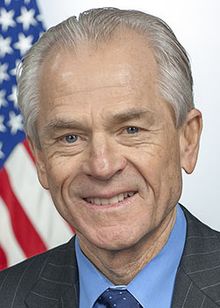
• Peter Navarro is the White House senior counselor for trade and manufacturing. www.peternavarro.com
Follow the author

Please read our comment policy before commenting.