



OPINION:
The early days of the COVID-19 pandemic forced an unprecedented, real-time experiment upon American prisons.
Faced with the nightmare scenario of an airborne virus ripping through congested, poorly ventilated cellblocks, correctional systems across the country had to preserve both inmate and officer safety.
Yet, as the dust settles on these emergency measures, two starkly different narratives have emerged. On the federal level, the Bureau of Prisons (BOP) utilized the CARES Act to execute a masterclass in data-driven, highly structured community transition.
People were interested in these podcasts
Meanwhile, down in North Carolina, a chaotic, litigation-driven rush to empty beds exposed the deep systemic failures of state-level panic.
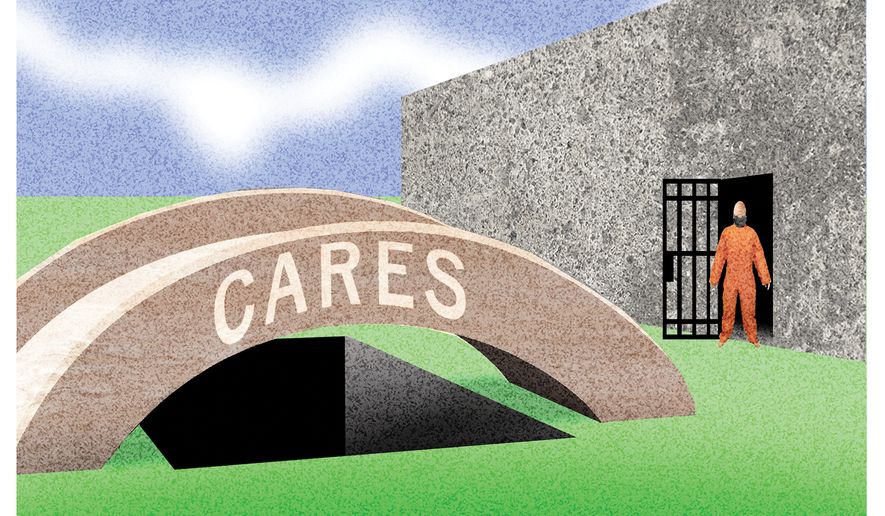
The contrast between these two approaches offers a vital lesson for the future of American criminal justice reform: Safe release requires a bridge, not a trapdoor.
The federal system has low-single-digit recidivism, at best. In North Carolina, from a sample group of 1,180 prisoners, 48% (566 people), were later arrested on charges of new offenses and 20% have been convicted.
To understand what a successful release framework looks like, one need look no further than the federal CARES Act implementation. Signed into law in March 2020 by President Trump, the act granted the BOP broad discretion to expand the use of home confinement.
The federal approach was defined by absolute procedural rigor. Inmates weren’t just handed a bus ticket; they were systematically vetted using the PATTERN risk-assessment tool. To qualify, individuals had to be classified as minimum or low security risks, maintain a spotless institutional misconduct record for at least a year, have a verified, stable home plan and fall into high-risk medical categories.
This was consistent with much of the work done to pass the First Step Act. Proper reentry is a critical public safety tool.
The results of this federal experiment were nothing short of extraordinary. By 2023, of the more than 13,200 individuals placed into CARES Act home confinement, an overwhelming 96% completed their terms without a single technical violation or new offense. More astonishingly, only 22 individuals (0.17%) were returned to secure custody for committing a new crime.
In 2024, the BOP compared CARES Act releases to general home confinement and found that people released under the CARES Act were less likely to recidivate than those on general home confinement (3.7% versus 5.0%). Plus, violent crime for CARES Act releases was under 1%.
Unlike the federal model, which was born of a deliberate legislative directive, North Carolina’s mass release was a shotgun marriage forced by a lawsuit. Following 11 months of fierce litigation, the state scrambled to settle and agreed to a consent order that mandated the accelerated transition of 3,500 individuals within a strict 180-day window.
Because North Carolina was operating under a ticking legal clock, it relied on blunt, reactive instruments. Chief among these were discretionary sentence credits, which accounted for roughly 61% of the state’s releases. Rather than transitioning individuals into structured, monitored community frameworks, these discretionary credits simply shaved weeks or months off maximum sentences to force immediate releases.
The fatal flaw of the North Carolina model was this structural severance. North Carolina prematurely pushed thousands of people out the door into communities unequipped to receive them. The state’s version of home confinement, the extended limits of confinement (ELC) initiative, was simply insufficient.
These administrative shortcuts ignored a fundamental truth of criminal justice: A non-violent offense (without consideration of a person’s full history) does not automatically translate into nonviolent offender or smart reentry.
Furthermore, by utilizing arbitrary quotas to satisfy a judicial settlement, North Carolina simply could not meet the deluge of reentry needs of this population.
The policy takeaway is clear. The federal CARES Act proved that targeted, well-monitored home confinement can save taxpayers tens of thousands of dollars per person annually without compromising public safety.
North Carolina, conversely, demonstrated the perils of neglecting critical public safety considerations in release planning and execution.
The BOP continues to be a national model of public safety and correctional innovation, with smart-on-crime leadership. Yet smart-on-crime policies cannot be achieved merely by opening the gates to satisfy a legal settlement. They require the federal blueprint, which is grounded in public safety — just like the First Step Act.
• John Koufos is a former criminal trial attorney and is now a consultant advising the private and public sectors on technology, healthcare and justice issues. Follow John on X @JGKoufos or at www.cottagefour.com

Please read our comment policy before commenting.