



OPINION:
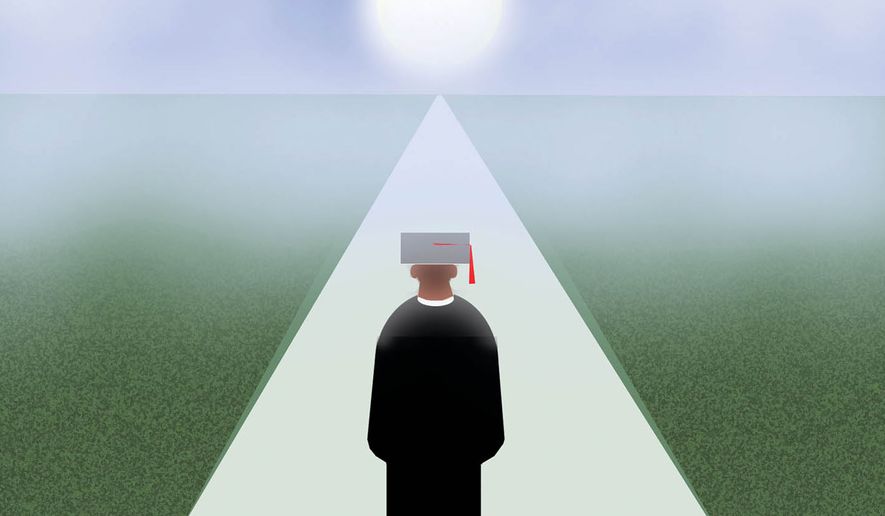
High school graduation season is upon us. Teenagers are transitioning to a new chapter in their lives, which is exciting but also can result in some understandable trepidation.
Even for the graduates who think they already have their futures well mapped out, life has a way of delivering unexpected surprises, some welcome and others harshly unappealing.
That’s why new graduates would do well to consider the sage advice from Sef Scott, who delivered an inspiring graduation speech to his classmates at Plano Senior High School in Texas back in 2018.
“I have autism and a social communication disorder,” he began. “Just by my being here, speaking to all of you — that alone is unexpected.”
His empowering message about embracing the unexpected was founded upon being undaunted about the future: “Don’t fear the unknown. Will it be unexpected? Yes, yes, it will. But that does not make it wrong.”
The young man’s insightful words have resonated deeply with me since I first heard them shortly after retiring from the CIA. At the CIA, we painstakingly tried to plan for every possible outcome, which was especially challenging because so much was seemingly out of our control.
My best mentors were the CIA officers who asked the right questions and could anticipate even the most unlikely of scenarios, which might torpedo our sacred mission. They stimulated productive discussion and debate, which elevated our state of readiness.
Senior managers were known to complement the most successfully planned and executed clandestine operations for “going off without a hitch.”
But the lesson was more nuanced. We almost always had to deal with unexpected and sometimes even unimaginable developments. By relying on our exhaustive planning and exceptional training like defensive driving, trauma first aid and surveillance detection, we could nevertheless achieve success.
That encouraged us to take calculated risks, like conducting a high-threat meeting with a source penetration of a terrorist group, from whom we obtained time-sensitive intelligence about threats to our homeland. Or deploying undercover behind enemy lines or exfiltrating a source from harm’s way.
Incorporating the most comprehensive planning into our clandestine CIA operations made embracing the unexpected less unsettling and more in line with Roman philosopher Lucius Antaeus Seneca’s maxim about how “luck is what happens when preparation meets opportunity.”
But what about when life’s challenges appear arbitrarily and entirely without warning?
No amount of preparation could have spared my family from the trauma when my late wife Kim was diagnosed with cancer when she was 37 years old and passed away four years later, leaving behind me and our sons, who were then 11 and 8 years old.
But my sons and I still embraced the unexpected, no matter how unbearably painful it was. We started by being honest and open with ourselves about our sorrow.
Days after Kim passed away, my sons began expressing their emotions through art therapy. A service dog offered my sons companionship and helped encourage them to share their feelings. Together, we spent time in reflection and discussion. We learned from our friends, family members and doctors. And we read books, which informed our understanding of grief and helped us process a way forward.
We deliberately devoted our time and energy where we believed we could make a difference while not allowing ourselves to be debilitated over what we were helpless to change. We did not languish over why Kim had been stricken with cancer. Instead, we found a path to philanthropy, which soothed our broken hearts.
That’s why, to this day, we honor Kim’s memory by supporting kids in the fight for their lives against pediatric cancer through the Jessie Rees Foundation. And we’re still learning.
Winston Churchill once remarked that “education is what remains after all else has faded from memory.” High school graduates should take a moment to reflect on the value of education, which includes what they have learned in and outside of the classroom heretofore and what they will learn down the road.
Learning after all is a lifelong journey, not a destination in and of itself.
As they step out into the world, graduates should remember they’re carrying with them the tools to further develop their critical thinking and build knowledge so they can effectively navigate what awaits them: life’s labyrinth of unforeseen twists and turns.
President John F. Kennedy said that “our progress as a nation can be no swifter than our progress in education.”
Sef Scott was right. That’s what embracing the unexpected is all about.
• Daniel N. Hoffman is a retired clandestine services officer and former chief of station with the Central Intelligence Agency. His combined 30 years of government service included high-level overseas and domestic positions at the CIA. He has been a Fox News contributor since May 2018. He can be reached at danielhoffman@yahoo.com. All statements of fact, opinion, or analysis expressed are those of the author and do not reflect the official positions or endorsement of the CIA or any other U.S. Government agency.
Follow the author

Please read our comment policy before commenting.