



OPINION:
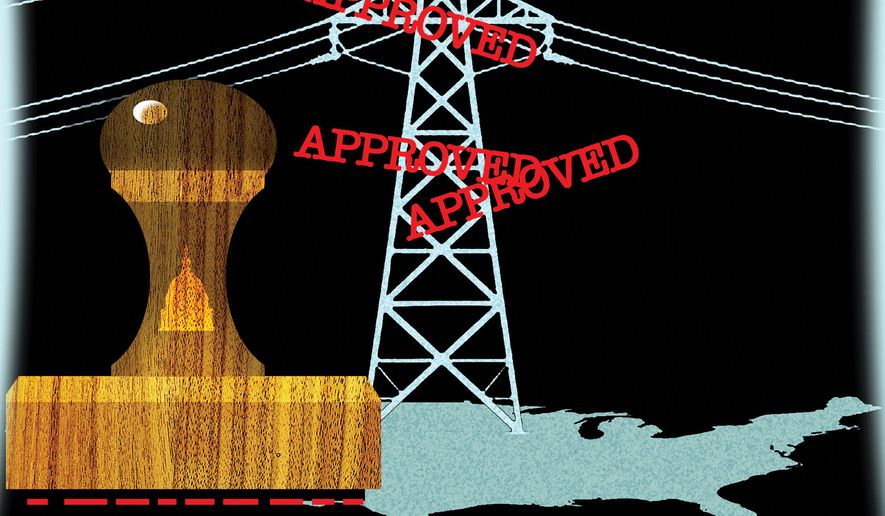
Members of Congress and their staffs, for the past six months or so, have been “working” on legislative reforms to some — but by no means all — of the laws that govern under what circumstances energy projects are allowed to proceed in the United States.
Given the irreducible fact that the prosperity of this nation is inextricably linked to its ability to find, produce and transport energy, that effort is laudable.
Unfortunately, it seems to have picked up a lot of ideological baggage as it has wandered through Congress.
Most fundamentally, the entire effort seems to be built on the theory that many energy projects are stopped or unnecessarily delayed by the permitting process. That may or may not be true, but the proposition does not have much evidence.
Certainly, there are the obvious, high-profile projects that have trouble (Dakota Access, Keystone XL), but the overwhelming number of projects get permitted in a timely, if not quick, fashion.
Perhaps not coincidentally, that fact has caused some folks on the left side of the spectrum to introduce into the discussion elements that have nothing to do with permitting. For example, some would like the legislation to address how best to socialize the costs of large electric transmission lines across regions and, more importantly, across ratepayers.
Some Democratic senators have proposed that for each permit issued to a natural gas or oil project, one for a similar-size wind or solar project should be issued. No clue what that kind of nonsense has to do with reforming the federal permitting process.
The other significant flaw with this effort is that in the enthusiastic embrace of its bipartisan nature, it has overlooked (intentionally or otherwise) many of the real problems with permitting, in large measure because fixing permitting will involve things that are likely to be difficult for one or both sides.
For example, way back in July 2011, the Federal Energy Regulatory Commission issued Order No. 1000. It was the commission’s attempt to encourage the building of electric transmission lines across regions. As you might imagine, something from Team Obama wound up making things worse, involving more lawyers and bureaucracies in a process that had previously been dominated by engineers.
Those who want to address climate change and make space in the automotive fleet for electric vehicles — the ideological brethren of those who instituted Order No. 1000 — tell us we should be building somewhere between 2,000 and 3,000 miles of interstate transmission each year. In the past few years, we have built about 100, mostly because of the complexity and difficulty of navigating Order No. 1000.
Nevertheless, no one — with the exception of a few brave utilities — is addressing the pathologies driven by this order.
Section 401 of the Clean Water Act is another example. That section requires states to certify that whatever action is being contemplated (in the energy space, that usually means construction associated with crossing a body of water) will not impair the state’s ability to meet its water quality standards.
The provision has been used to delay projects for years. Fixing it will require limiting the authority of the states on land use and water quality. No clue how this circle gets squared.
One last and perhaps most obvious example: If we are going to build electric transmission across regions, then some lines will likely cross the property of people (mostly in rural areas) who will almost certainly not benefit much from them except in the most universal definition of the word benefit.
To build that transmission, to impair that property, we will eventually need to compensate the landowners or guarantee them some share of the benefits.
Finally, any permit applicant for a pipeline, transmission line or production permit on federal lands has to wade through about a half-dozen federal agencies, including the Interior Department, the Commerce Department, the Environmental Protection Agency and FERC.
Not surprisingly, each of these agencies routinely points the finger at the other guys when people complain about delays.
If Congress really wanted to help permit applicants, then it would create a single agency for permitting energy projects. That would put the authority and the responsibility for timely, thorough permitting in one place.
We should all be grateful that Congress is at least trying to do something helpful on energy permitting. It would probably be best, though, if its members focused their energies on fixing the actual deficiencies and pathologies in the permitting regime for energy.
This should not be an effort to fix the electricity markets or introduce irrelevancies. It should be about reducing the government-imposed constraints placed on the building of needed infrastructure.
• Michael McKenna is a contributing editor at The Washington Times.
Follow the author


Please read our comment policy before commenting.