



NEWS AND ANALYSIS:
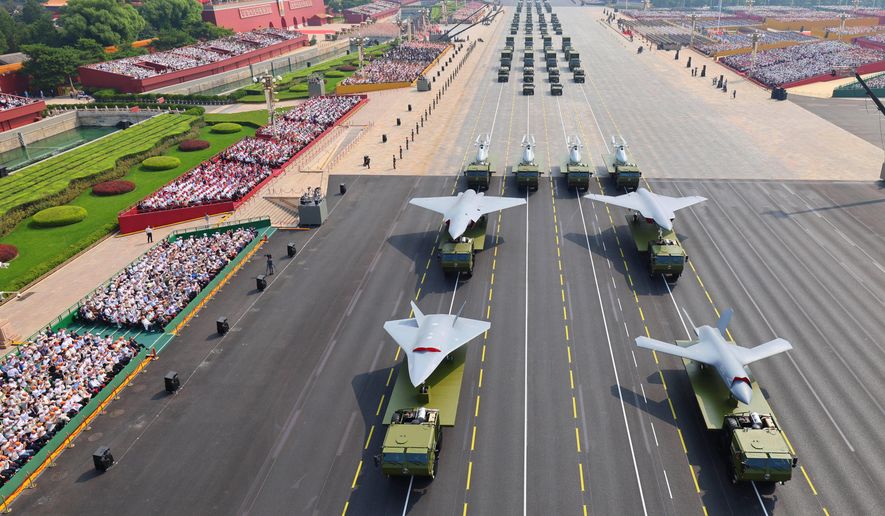
China’s military is developing artificial intelligence-powered drone warfare capabilities that will involve mobilizing millions of civilian drones and conducting decapitation drone strikes on enemy generals, according to a report by the People’s Liberation Army.
The PLA report provides a major window into how the PLA anticipates that wars will be fought in the future, with new weapons and technology China’s military believes will eventually dominate battlefields — including precision assassination strikes on military leaders and scientists.
“Unmanned warfare is set to become a primary mode of modern combat,” according to the report, “Influence of Unmanned Warfare on Political Work and Our Responses.”
People were interested in these podcasts
The PLA is shifting all its military forces toward waging advanced drone warfare but also wants to maintain Chinese Communist Party control over military operations and to achieve “cognitive dominance” over enemies, the 30-page report said.
The 2025 report by Col. Zhao Hui and Maj. Zhang Yicheng was translated by the Army’s China Landpower Studies Center and made public last month.
PLA drone warfare will be conducted according to “fundamental principles of Marxist war theory,” the report said, reflecting the CCP’s political control over the PLA.
The PLA study coincides with the disclosure of a July 2025 memorandum from U.S. Defense Secretary Pete Hegseth calling for “Unleashing U.S. Military Drone Dominance” in the American military and declaring drones to be the most significant battlefield innovation in a generation.
Drone warfare has been on display in the ongoing Russia-Ukraine war as Ukraine’s military developed and employed new and innovative ways to attack Russian forces autonomously.
According to the report, PLA drone warfare doctrine will seek to instill “self-sacrifice over self-preservation” in troops, including “willingly sacrificing personal interests, or even their lives, for victory.”
The PLA blueprint for the wartime use of the commercial drone sector includes mobilizing large-scale dual-use, civilian-military capabilities of unmanned systems.
Civilian aerial drones, electric vertical take-off and landing aircraft and autonomous vehicles “can be deployed to the battlefield with only minor modifications,” the report said.
China currently has more than 2,300 drone manufacturers with over 3.17 million units delivered, the report said.
To prepare for large-scale mobilization, the PLA will embed manufacturer technicians into combat units, form civilian volunteer teams for “unmanned reconnaissance, intelligence analysis, and public opinion guidance,” and call on tech firms to rapidly build new or counter-drone weapons.
Wartime tasks for drone attacks will include attempts to kill senior generals and scientists and sabotage strikes against sensitive facilities, the report said.
“Using unmanned systems to conduct targeted strikes against high-value figures — such as senior generals and scientists — or to disrupt and sabotage critical, sensitive facilities offers low costs, high success rates, and minimal collateral damage; consequently, this method is highly likely to become a primary means for adversaries to carry out infiltration and sabotage operations,” the report said.
Such attacks were framed in the report as a threat to China, but the reference reveals that PLA planners view leadership decapitation as a future mission for its drones.
Joshua Arostegui, research director at the China Landpower Studies Center at Army War College, said the report confirms that the greatest friction point of drone warfare for the PLA remains institutional control rather than hardware.
“The CCP’s foundational requirement for absolute political supremacy over military operations actively collides with the realities of machine-speed warfare,” he stated in an assessment of the report.
For Western military planners, the issue reveals a vulnerability for the PLA — maintaining CCP control over AI-powered drones will likely slow down kill chains, he said.
“In a high-intensity, multidomain conflict, U.S. and allied forces willing to delegate greater tactical autonomy to forward systems may possess a decisive speed advantage over PLA formations bottlenecked by mandatory political oversight and ethical reviews,” Mr. Arostegui said.
On the use of civilian AI and drones in PLA combat operations, Mr. Arostegui said: “Western forces will face increasingly complex legal and operational challenges regarding targeting, sanctions and distinguishing combatants from noncombatants in the unmanned battlespace.”
Rubio, Bessent voice doubts on AI talks with China
Secretary of State Marco Rubio said President Trump is expected to raise the issue of adopting guardrails on artificial intelligence during talks with Chinese President Xi Jinping but said little progress has been made ahead of the meeting in China next week.
Mr. Rubio told reporters on Tuesday in Paris that since the matter was raised during the Washington summit between the two leaders in September, “technical level” talks have been held on the topic.
Mr. Trump and Mr. Xi are slated to meet on the sidelines of the Asia-Pacific Economic Cooperation meeting set for Nov. 18 in Shenzhen, China.
“I’m sure it’ll be an issue among all the leaders that are at APEC, not just the U.S. and the Chinese on a bilateral basis,” Mr. Rubio said of the AI guardrails.
But the secretary suggested that so far discussions have been limited. “Obviously, we’ve heard their perspective, they’ve heard ours, but that’s still a work in progress,” he said.
Separately, Treasury Secretary Scott Bessent said in a speech Tuesday that Washington and Beijing should have no illusions about bridging differences on AI guardrails.
AI talks in Shenzhen will seek a mechanism for sharing risks and to “prevent a misunderstanding between our two systems,” Mr. Bessent said in New York.
Another goal is to exchange best practices in assessing and testing advanced AI models before release and keeping humans in the loop, he said.
“As SI advances, so will the need to engage in new areas of risk management — and to demonstrate how two nations can reconcile the demands of competition with the responsibilities of leadership,” Mr. Bessent said, using the administration’s favored acronym for AI — super intelligence.
“As we do so, we should harbor no illusions about the differences between the United States and China. As I stated earlier, our interests will not always coincide. And our approach to every challenge, likewise, will not always converge,” he said.
Mr. Bessent, who will travel to Shenzhen with Mr. Trump, made no mention of the unfolding Nvidia scandal involving CEO Jensen Huang and his affair with an alleged Chinese intelligence agent, Alice Huang.
However, Mr. Rubio was asked if China’s apparent diversion of advanced Nvidia AI chips through a company linked to Ms. Huang has him concerned about trust issues with China on AI.
Megaspeed, a company Ms. Huang has worked for, purchased more than $4.5 billion in Nvidia chips and the FBI is investigating whether some embargoed chips were diverted to China, The New York Times reported.
Mr. Rubio sidestepped the question, saying “the Chinese system is always going to act in the interest of the Chinese system.”
The U.S., he said, will always pursue “what’s good for America” whether the issue is AI guardrails or overall bilateral relations with China.
“And that will often put us in conflict or in disagreement with other countries, including China,” Mr. Rubio said.
Hegseth wants military schools to study Milley calls to China
Defense Secretary Pete Hegseth this week traveled to the Naval War College and announced major reforms for military service schools, including studying the contemporary constitutional “crisis” of retired Army Gen. Mark Milley, the former chairman of the Joint Chiefs of Staff.
Gen. Milley came under criticism from Congress and the Trump administration for making unusual calls to the Chinese military before and after the 2020 presidential election.
Mr. Hegseth said the military will continue to study traditional military affairs, including political scientist Samuel Huntington’s seminal 1957 book “The Soldier and the State” that calls for professionalized, politically neutral military forces under civilian control.
“But our syllabi systematically ignore the modern crises unfolding before our eyes,” he said.
“When a chairman of the Joint Chiefs of Staff engages in actions during a presidential transition that raised profound constitutional questions regarding civilian control of the military, that is not a topic to be swept under the rug,” he said.
“Just because some of you know Mark Milley, doesn’t mean we should not study his failures,” Mr. Hegseth said. “It is arguably the most significant civil military crisis since President Truman relieved General Douglas MacArthur in 1951. Our war colleges should study it, debate it and reinforce the foundational constitutional principle that the military is strictly subordinate to elected civilian authority.”
The Milley affair began with two calls to People’s Liberation Army Gen. Li Zuocheng by Gen. Milley in the tense days surrounding the disputed election of 2020. The first was meant to explain that the United States had no intention of attacking China.
A second call included a promise by the chairman to the Chinese general that he would inform the Chinese military of any impending attack in advance — a highly unusual claim that would violate operational security for military contingencies.
The calls were made on Oct. 30, 2020, and Jan. 8, 2021, based on what Pentagon officials said at the time was alarming intelligence that the Chinese mistakenly believed U.S. forces were preparing to attack China.
Gen. Milley defended the calls as justified and proper in pursuing strategic stability. He testified to Congress in September 2021 that there was “a significant degree of intelligence” reporting the Chinese military was on alert for a U.S. attack in October 2020 in the run-up to the November U.S. presidential election.
The claim, however, was dismissed as untrue by senior Trump administration officials at the time, including Secretary of State Mike Pompeo, White House National Security Adviser Robert O’Brien and Director of National Intelligence John Ratcliffe.
Gen. Milley was issued a preemptive pardon by outgoing President Joseph R. Biden and the second Trump administration removed his security clearance and guard detail after coming into office.
President Trump said on social media at the time that “If the story of ’Dumbass’ Gen. Mark Milley … is true, then I assume he would be tried for TREASON in that he would have been dealing with his Chinese counterpart behind the president’s back and telling China that he would be giving them notification ’of an attack.’ Can’t do that!” Mr. Trump stated.
Contact the author

Please read our comment policy before commenting.