


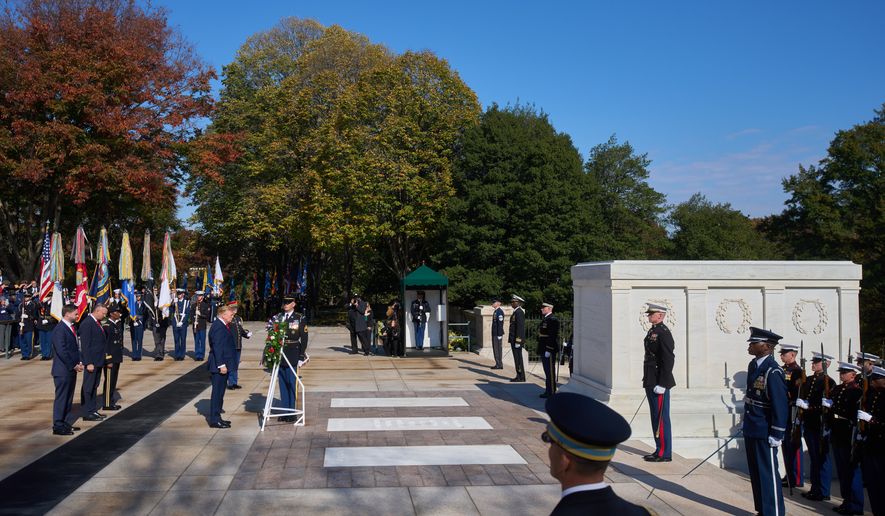

The warning a Tomb of the Unknown Soldier sentinel called out to Defense Secretary Pete Hegseth’s group on Veterans Day reflects a standard of decorum every visitor to Arlington National Cemetery is expected to meet, no matter their rank.
“All visitors will maintain an atmosphere of silence and respect at all times,” the soldier shouted Wednesday after laughter broke out among the group following the annual Veterans Day ceremony, according to video published by CNN.
The group included Mr. Hegseth’s chief of staff, Ricky Buria; deputy chief of staff Patrick Weaver; senior adviser and deputy assistant Tami Radabaugh; and his wife, Jennifer Hegseth, CNN and USA Today reported. It was not clear which members of the group were laughing.
People were interested in these podcasts
The sentinel stopped his patrol to face the group as it departed, the video shows. Members of the group turned to look back and kept walking. CNN noted that any ordinary visitor who laughed at the memorial would get the same warning.
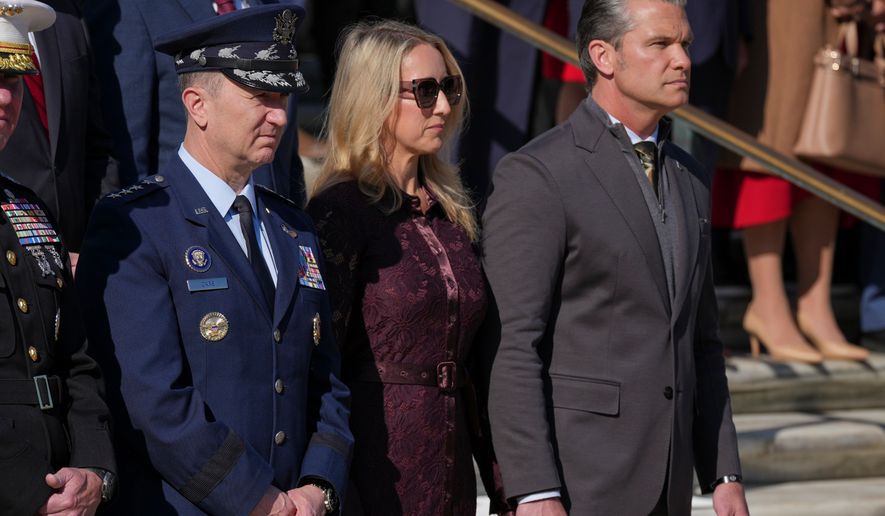
Here is what the Tomb of the Unknown Soldier is, why it is treated as sacred ground, who guards it and the rules visitors must follow.
What is the Tomb of the Unknown Soldier?
The Tomb of the Unknown Soldier is Arlington National Cemetery’s most iconic memorial, set on a hill overlooking Washington, D.C. Since 1921, it has held the remains of an unidentified American service member from World War I. Unknowns from World War II and the Korean War were added in 1958.
The white marble sarcophagus, placed in 1932, shows three figures on its east face representing Peace, Victory and Valor. The west side bears the inscription: “Here rests in honored glory an American soldier known but to God.”
Why is the tomb so sacred?
The Unknown represents every American service member who died in war and was never identified. When New York Rep. Hamilton Fish Jr., a World War I veteran, proposed the tomb in December 1920, his legislation described a warrior who “represents no section, creed, or race” and “typifies, moreover, the soul of America and the supreme sacrifice of her heroic dead,” according to Arlington National Cemetery.
The selection was deliberately anonymous. In October 1921, four unidentified bodies were exhumed from American cemeteries in France. At the city hall of Chalons-sur-Marne, Army Sgt. Edward F. Younger chose one by placing a spray of white roses on its casket.
The Unknown crossed the Atlantic aboard the USS Olympia and lay in state in the Capitol Rotunda, where about 90,000 people paid their respects on Nov. 10, 1921. The next day, President Warren G. Harding placed the Medal of Honor on the casket at the burial ceremony, while Americans nationwide observed two minutes of silence.
Who is buried there now?
Three Unknowns rest at the tomb: one each from World War I, World War II and the Korean War.
A fourth crypt once held a Vietnam War Unknown, interred on Memorial Day 1984 with President Ronald Reagan presiding. In 1998, at his family’s request, the Defense Department exhumed the remains, and DNA testing identified them as Air Force 1st Lt. Michael Joseph Blassie, a pilot shot down in 1972. He was reburied at Jefferson Barracks National Cemetery in St. Louis. The Vietnam crypt remains empty and was rededicated in 1999 to honor all missing U.S. service members from that war, according to Arlington.
Who guards the Tomb of the Unknown Soldier?
Soldiers of the 3rd U.S. Infantry Regiment, known as “The Old Guard,” have guarded the tomb since 1948. The Old Guard is the Army’s oldest active-duty infantry unit, serving since 1784, and its official ceremonial unit.
The tomb has been guarded every minute of every day since July 1, 1937, according to the Society of the Honor Guard, Tomb of the Unknown Soldier. Soldiers first stood watch only during daylight hours, starting in 1926. The society says the guard was created partly because, in the early 1920s, some visitors treated the flat original tomb as a picnic spot.
The guards, called sentinels, are volunteers. Arlington describes them as “the elite of the elite” of The Old Guard. Requirements include:
- A spotless service record and top physical fitness
- Men must stand between 5 feet, 10 inches and 6 feet, 4 inches tall; women between 5 feet, 8 inches and 6 feet, 2 inches
- An interview and a two-week tryout, during which candidates must learn seven pages of cemetery history word for word
- Memorizing where nearly 300 veterans are buried
- A 100-question badge exam pulled from 300 memorized items, with a passing score above 95%
Those who pass earn the silver Tomb Guard Identification Badge, which becomes permanent after nine months of honorable service at the tomb. More than 600 soldiers have earned it since the late 1950s, according to Arlington.
Why does the Tomb Guard take 21 steps?
Every movement on the mat carries meaning. Arlington says the sentinel takes 21 steps along the black mat, pauses facing east for 21 seconds, pauses facing north for another 21 seconds, then walks the 21 steps back. The number honors the 21-gun salute, the highest military honor.
The sentinel then shifts the rifle to the shoulder closest to visitors, signaling that the guard stands between the tomb and any threat.
The changing of the guard happens every hour from Oct. 1 through March 31 and every half-hour from April 1 through Sept. 30. Before each ceremony, the relief commander asks spectators to stand and remain silent.
What are the rules for visiting the tomb?
Federal regulations describe Arlington and other Army national military cemeteries as “a national shrine to the honored dead of the Armed Forces” and require all visitors to “observe proper standards of decorum and decency.”
The rules prohibit “disrespectful or disorderly conduct.” They also bar recreational activities such as running, sports and picnics, as well as demonstrations and playing musical instruments, loudspeakers or audio devices without a headset.
The regulations do not use the word “silence.” At the tomb itself, though, quiet is the expectation: before each changing of the guard, the relief commander asks spectators to stand and remain silent, and sentinels enforce that standard in real time. According to the Society of the Honor Guard, most challenges sentinels face today come from tourists “speaking too loudly or attempting to get a better picture” by stepping into the guarded area.
Wednesday’s warning showed that the standard applies to everyone, including the official who oversees the Pentagon.
This article was constructed with the assistance of artificial intelligence and published by a member of The Washington Times' AI News Desk team. The contents of this report are based solely on The Washington Times' original reporting, wire services, and/or other sources cited within the report. For more information, please read our AI policy or contact Steve Fink, Director of Artificial Intelligence, at sfink@washingtontimes.com
The Washington Times AI Ethics Newsroom Committee can be reached at aispotlight@washingtontimes.com.

Please read our comment policy before commenting.