


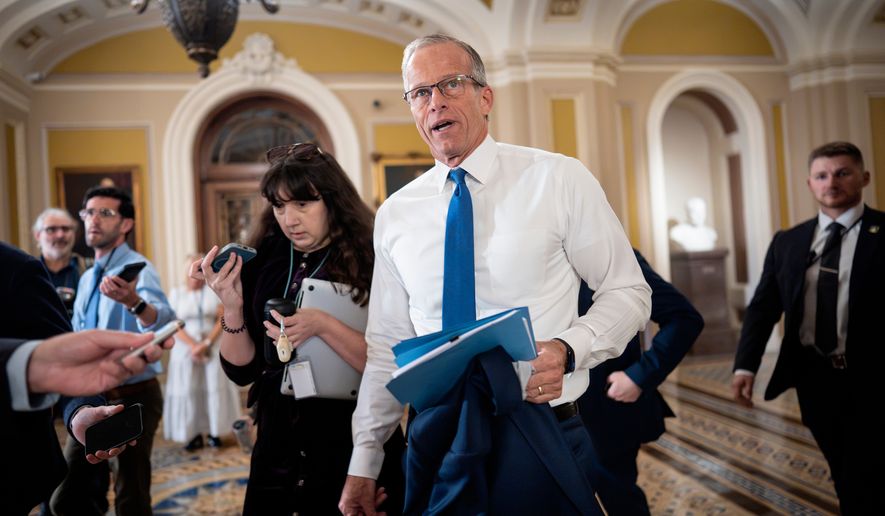

Senate Republicans adopted a symbolic resolution this week vowing “to do everything humanly possible” to pass another filibuster-proof reconciliation bill before their majority ends, but they are struggling to get on the same page.
A majority of GOP senators and President Trump see the exercise as necessary to, at a minimum, provide a defense funding boost before Democrats take control of Congress. But at least a few Republicans are not yet on board.
“It depends what is in this, whether it’s narrowly focused or whether it’s broad,” said Maine Sen. Susan Collins, one of the Republicans who lost her reelection race last week.
People were interested in these podcasts
Although the budget reconciliation process removes the threat of a Democratic filibuster, GOP leaders can afford no more than three defections to pass a party-line package on a simple-majority vote.
Kentucky GOP Sen. Rand Paul has already said he is opposed to the effort, calling it “tone deaf” for Republicans to fund the Iran war after their sweeping electoral defeat in large part over that issue.
He is also worried about the national debt and sees no need to add to the roughly $1 trillion annual defense budget, saying the U.S. spends more on its military than the next 10 countries combined.
Sen. Lisa Murkowski, Alaska Republican, who has repeatedly said she is not a fan of reconciliation, also remains a wild card. All she would say about it Thursday was they’re having “good meetings.”
Mr. Trump called on Senate leaders to “immediately move” a reconciliation bill with $350 billion in defense funding.
That amount was first outlined in his fiscal 2027 budget request. The Trump administration is trying to piece together a total defense budget of $1.5 trillion.
“The Radical Democrat Majority in the next Congress has already made it clear that their Number One Agenda is to BLOCK and RESIST this historic investment in our National Security,” the president said on social media.
Democrats have balked at the $1.5 trillion and, in particular, at providing any funding related to the Iran war.
That only added to the pressure on Republicans to deliver $350 billion in mandatory funding through the filibuster-proof budget reconciliation process.
Senate Majority Leader John Thune, South Dakota Republican, has said discussions are ongoing within his conference and has made no explicit commitments about what he can deliver.
Defense Secretary Pete Hegseth and other top Pentagon officials have been telling Republicans that securing the full $350 billion is “absolutely essential,” Senate Budget Chairman Ron Johnson said.
“The way they’re talking about this, this isn’t really optional,” the Wisconsin Republican said.
Sen. Mike Rounds supports the request but said the administration should not put all of its eggs in the reconciliation basket.
“If that does not come to fruition – and that is a very challenging thing to get done – you still have to have additional resources for the Department of Defense that may require a 60-vote margin in the future,” the South Dakota Republican said.
Identifying offsets could become crucial to securing enough Republican votes for a reconciliation package.
Sen. Rick Scott, Florida Republican, said he supports the $350 billion defense boost, but “it absolutely has to be paid for.”
If it comes together, this would be the third reconciliation bill Republicans take up this Congress.
The first, the One Big Beautiful Bill Act, was centered around sweeping tax cuts. While it included some spending cuts to government health care and food assistance programs, it was not fully offset.
Republicans did not include any pay-fors in their second reconciliation package funding immigration enforcement agencies for the next three years.
Offsetting the third would be a heavy lift, especially if Republicans decided to include more than defense funding, as several senators are pushing.
“I can’t imagine doing reconciliation without defunding Planned Parenthood and without something to bring down the cost of health care,” Missouri GOP Sen. Josh Hawley said.
Some Republicans also want to include pieces of the SAVE America Act requiring proof of citizenship to register to vote and photo IDs for casting ballots in federal elections.
“If they put stuff like that in there, they won’t have the votes. Zero chance,” retiring North Carolina GOP Sen. Thom Tillis said.
Republicans must move quickly. Mr. Johnson wants the Senate to adopt a budget resolution teeing up the reconciliation process before Thanksgiving.
Contact the author


Please read our comment policy before commenting.