



Calling races on election night may be becoming routine for prediction markets. Convincing Washington they belong in the financial system may be a much tougher bet.
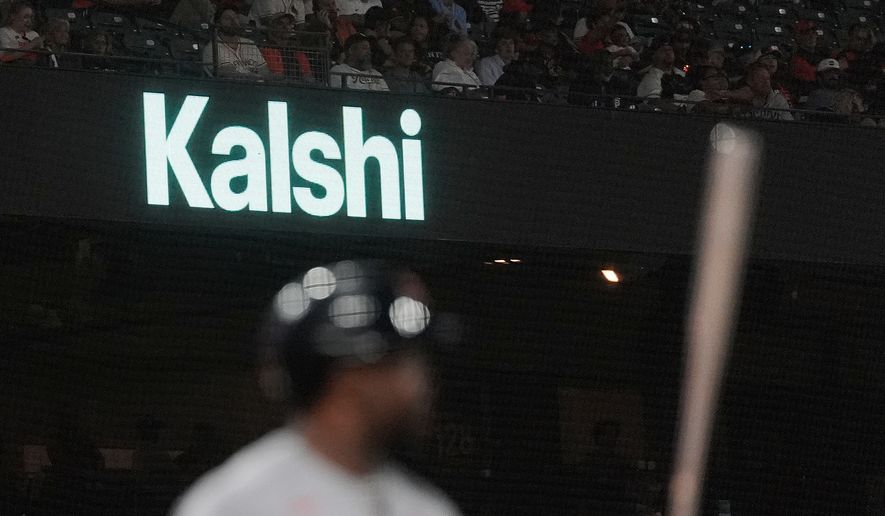
Kalshi, the nation’s largest federally regulated prediction market, emerged from the 2026 elections eager to take a victory lap. The company says its markets correctly forecast the winner in 98% of races. Polymarket, another industry heavyweight, made similar claims.
Kalshi’s leadership even sees a future where these exchanges stand shoulder to shoulder with the New York Stock Exchange or the Chicago Mercantile Exchange as standard tools for hedging risk.
People were interested in these podcasts
“The way I think about it is we can become the ultimate market to really price everything,” Kalshi CEO Tarek Mansour said at a Washington event last week. “Kalshi means everything in Arabic, and we’re finally getting close with that.”
Kalshi is now valued at roughly $40 billion and Polymarket is worth about $21 billion, underscoring their rapid evolution from a niche corner of finance to a global powerhouse.
However, it’s now up to lawmakers, regulators and judges to decide whether prediction markets like Kalshi, which has embraced federal oversight, belong regulated alongside Wall Street exchanges or in the same category as sports betting and casinos.
Congress weighs in
The gambling-or-trading debate spilled onto Capitol Hill.
Sen. Ted Cruz of Texas, a potential 2028 Republican presidential contender, is preparing legislation that would prevent federally regulated prediction markets from offering gambling-related contracts, including sports betting, unless they receive approval from state or tribal authorities.
“I think prediction markets, for sports betting, are a thinly veiled way to get around state laws regulating gambling,” Mr. Cruz told The Washington Times. “I think it ought to be up to the states to decide whether and how to regulate sports gambling, rather than a federal back door that circumvents state regulation.”

Prediction markets are regulated by the Commodity Futures Trading Commission, the same federal watchdog that polices derivatives trading. As the industry booms, the agency faces growing criticism from skeptics who say it has been too passive, particularly as platforms push deeper into sports betting-style markets.
Mr. Cruz is hardly alone in trying to tighten the federal reins.
Another likely White House aspirant, Rep. Ro Khanna, California Democrat, said sports prediction markets are “sports betting disguised as financial trading.”
“They flout state and tribal gambling laws, siphon state tax revenues, fuel addiction, and expose young Americans to public health risks while evading state consumer safeguards,” he said on X. “Congress must ban them.”
Other lawmakers have floated similar proposals, as well as measures that would bar elected officials from trading on prediction markets or prohibit contracts tied to elections, military actions and legislative outcomes.
Democrats also seized on the industry’s ties to President Trump’s orbit.
“The President’s family has become even more entangled with the success of this industry,” Sen. Elizabeth Warren of Massachusetts and Jeff Merkley of Oregon said in a Nov. 9 letter to White House Counsel Will Scharf. “Earlier this year, Donald Trump Jr. became an advisor to Polymarket shortly before his venture capital firm made a $300 million investment in the company. Trump Jr. likewise received an equity stake in Kalshi worth $300,000 in January 2025 and also joined the company as an advisor.”
Casino lobby
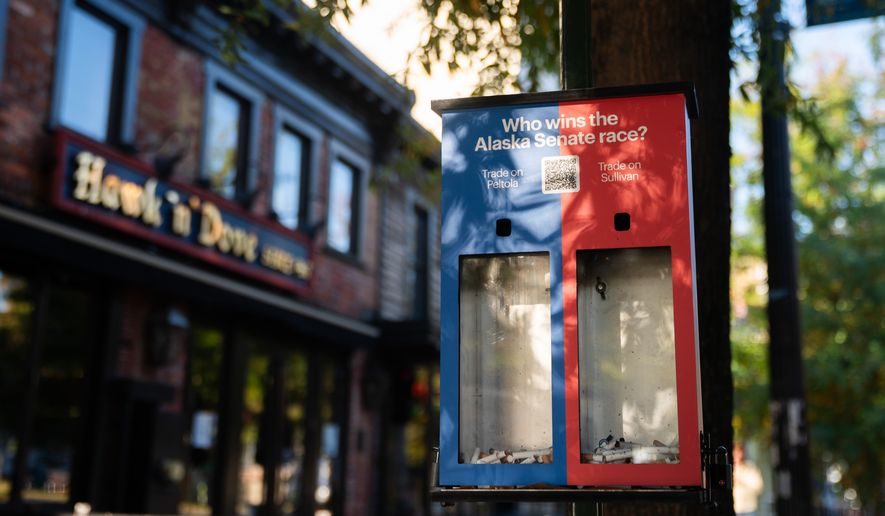
While prediction markets let you bet on yes-or-no outcomes for real-world events such as elections, sports, economic data or even the weather, the wagers are called event contracts — not bets.
The American Gaming Association, the casino industry’s chief lobbying group, accuses Kalshi of “blatantly mocking congressional intent by claiming CFTC regulation to offer sports bets outside the legal, state and tribal frameworks”
“Action is being taken at all levels of government, including in courtrooms across the country where Kalshi is losing big time and facing serious criminal and civil actions,” said AGA spokesperson Anne Riley.
Mr. Mansour, Kalshi’s 30-year-old CEO, said a lot of opposition to prediction markets is driven largely by legacy players, namely casino operators worried about new competition.
“They’re monopolies, and monopolies do not like added price discovery and price transparency,” Mr. Mansour said.
Ms. Riley pushed back. “In saying they want to compete with legal gaming operators, they are conceding that their product is in fact gambling,” she said. “Yet they are defying state and tribal law and not paying state gaming taxes, even though total sports gambling volume on Kalshi alone this year is roughly $320 billion.”
She said 47 state attorneys general, more than 140 tribal nations and other tribal groups, as well as an overwhelming majority of Americans, say their sports bets are gambling and should be regulated as such.
Others warn that a ban would do little more than send sports-event contracts offshore, beyond the reach of U.S. regulators.
Legal wrangling
States and prediction-market operators remain locked in a dispute over whether the Commodity Exchange Act gives the CFTC the final word over sports-related event contracts traded on federally licensed exchanges.
The Supreme Court will decide in January whether it will take up the issue after lower federal courts issued rulings that handed both the prediction markets and states victories.
If the justices pass, a decision might not come until sometime in 2028.
Kalshi co-founder Luana Lopes Lara said on “Market Matters with Marley Kayden” that she originally thought the conversation with states would have played out more amicably.
“For example, we are happy to pay taxes on the state level if that’s a conversation. We are happy to add consumer protections,” she said. “We thought it was going to be more on that angle than the angle that it’s going, but you know, with innovation there’s going to be a lot of pushback from a lot of different stakeholders, especially [those who] are kind of used to a different framework.
“I think you just have to go through the court system and go from there,” she said. “We’re very confident in our position.”
Regulatory shift
The CFTC, a quasi-independent agency whose five commissioners are appointed by the president and confirmed by the Senate, underwent a dramatic transformation in its relationship with the industry.
It approved Kalshi as a designated contract market in 2020, but then blocked the company’s election contracts three years later, setting off a legal battle that ended in a federal court victory for Kalshi in September 2024.
That ruling proved to be a turning point. Kalshi, Polymarket and other federally regulated operators expanded into sports-related contracts, triggering a fresh wave of legal and political challenges from states that argued the products amounted to unauthorized gambling.
By 2026, the CFTC had largely shifted from skeptic to defender. The agency backed Kalshi’s position against states in federal court and launched a rulemaking process designed to create permanent standards for prediction markets.
And yet, the agency has not been a rubber stamp.
The CFTC warned Kalshi last week that it could face potential enforcement charges for allegedly failing to notify regulators about dozens of proposed products under development, Politico reported.
Kalshi disputed the allegation, saying the issue involved a procedural error affecting only a handful of contracts, many of which never went live.
What’s next?
Sam Lazarus, a geoeconomic analyst at the Council on Foreign Relations, said the industry must work closely with regulators and the incoming Congress to build confidence in the markets and overcome persistent misunderstandings about how they work and what role they should play.
“The biggest open question, despite the progress that’s been made, is that of regulation,” Mr. Lazarus said during a recent panel discussion last week at the B20 Summit in Washington. “The next four years are going to be a critical time to determine whether 2026, one of the first major prediction-market elections, also ends up being one of the last for some time.”
At the summit, the private-sector counterpart to the G20, Kalshi flexed its muscle, sponsoring events across Washington’s luxurious Wharf district and renting an upscale Lebanese restaurant where executives, analysts and industry insiders debated the future of the industry, including Kalshi’s new partnership with S&P Dow Jones Indices, the company behind the S&P 500.
They promoted the deal as further evidence that prediction markets are moving closer to the financial mainstream and attracting the attention of established Wall Street players.
Behind them, a screen flashed some of the yes-or-no questions that drive business on the platform. Will President Trump pardon a high-profile defendant? Will Ghislaine Maxwell be released from federal custody? Will a new Supreme Court justice be confirmed?
Missing from the rotation was perhaps the biggest question facing the industry itself: Will the Supreme Court, the next Congress and even the next president prove to be friend or foe to prediction markets?

Please read our comment policy before commenting.