


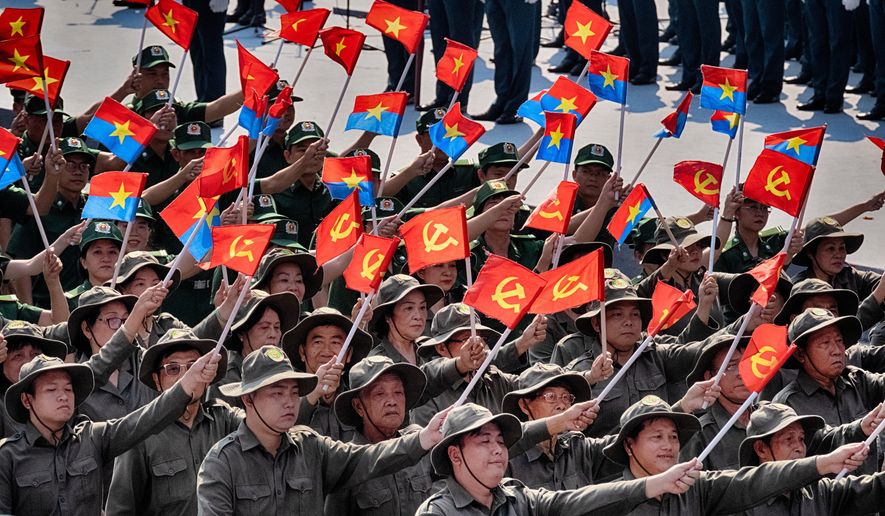

Vietnamese researchers are in Washington this week to conduct U.S.-funded studies on Hanoi’s war dead and will receive special treatment from the National Archives and Records Administration — treatment that critics say has not been reciprocated in Vietnam or extended in the U.S. to American researchers seeking access to the same archives for clues on missing U.S. service members.
The visit to NARA starting Monday is part of a search for Hanoi’s dead from the Vietnam War, according to U.S. and Vietnamese officials.
The visiting Vietnamese will be granted preferred access to U.S. records that until recently were denied to American officials looking for information on prisoners of war and missing in action (POW/MIA) in Vietnam, according to people familiar with the issue.
People were interested in these podcasts
Critics also say the communist government-backed delegation is being granted extended hours at the archives — treatment not afforded to American POW/MIA researchers who have sued the archives in the past for failing to provide documents on lost U.S. troops.
The Vietnamese delegation is expected to include a senior Vietnamese government official and researchers from Vietnam’s Office 515, an official MIA unit.
The group will also include a state-run television journalist.
They will work with experts from the Pentagon’s POW/MIA office and Texas Tech University at the archives facility in College Park under U.S. funding from a congressionally mandated program called the Vietnam Wartime Accounting Initiative.
Taxpayer-funded perks
The special treatment includes extended working hours through Thursday, greater access to archives specialists that is not provided to other researchers, and extra time in an archives room for studying documents and imagery.
Airfare and local accommodations for the visiting Vietnamese also are being paid by American taxpayers, perks not afforded to U.S. researchers who travel to Vietnam and who in the past have been forced by the Vietnamese government to pay tens of thousands of dollars for POW/MIA documents.
NARA spokeswoman Grace McCaffrey said the Vietnamese visit will mark more than four decades of cooperation between Washington and Hanoi on missing personnel.
During that time Vietnam helped the Defense POW/MIA Accounting Agency, which recently gained access to some Vietnamese archival materials, she said.
Included in the new information from Vietnam were 13 U.S. identification cards linked to 12 people unaccounted for in the war. The cards were turned over to Defense Secretary Pete Hegseth during his visit to the Philippines last month.
However, a person close to the issue said those materials were not obtained from Vietnam’s Defense Ministry or Ministry of Public Security archives, which remain off-limits.
The cards were found in the Vietnam Office for Seeking Missing Persons, an archive that Pentagon researchers were only recently allowed to access.
The Pentagon, working through the Vietnam Wartime Accounting Initiative, requested NARA’s help in facilitating the Vietnamese visit, Ms. McCaffrey said, noting it will provide “limited extended access to research rooms, if necessary.”
The research is the result of assistance provided by Vietnam to the United States, she said.
The Washington Times has learned, however, the archives is extending its operating hours to remain open for the Vietnamese until 7 p.m. and that archives specialists will remain on call for the team.
Others who conduct research at the same archives are required to end work at 5 p.m. daily, and at 4 p.m. for classified materials research, which the visit likely will include.
Limited access in Vietnam
Sean Everette, a DPAA spokesman, said a recent Vietnamese law provided greater access to archival holdings and DPAA researchers were able to access a location called “Archives III” in September.
Those archives contain limited materials related to wartime missing.
“While our researchers have access to this archive, they have determined that these national collections do not hold the specific documentation we need to support case progression for our unaccounted-for service members,” Mr. Everette said.
DPAA researchers were granted “relatively easy access” to Vietnamese archives at provincial archives, museums and military tradition houses in past years and are continuing targeted research at those levels, he said.
The Vietnamese government denied access to defense and security archives for years and most requests for specific information often were denied.
Mr. Everett said “ostensibly” all POW/MIA information is now at the Vietnam Office for Seeking Missing Persons archives at the Defense Ministry headquarters.
DPAA plans to send an archival research team to Hanoi in early 2027 for five weeks of research in the archives, he said. He noted that the Vietnam Office for Seeking Missing Persons has shown a strong commitment to supporting Pentagon research efforts by facilitating unprecedented access to its holdings and collaborating closely on the follow-on research mission.
That access was denied from 1993 until September.
The United States had a total of 2,646 U.S. personnel missing in Vietnam and as of August 2025, 1,067 remains have been repatriated.
Unsolved cases of missing service members continue to raise questions about whether Americans were left behind and held captive after the end of the war in 1975.
POW/MIA researchers say the Pentagon has worked with the Vietnam Office for Seeking Missing Persons for over 30 years and that Americans were not allowed access to requested archives.
Vietnam also made the questionable claim that it did not know the recently turned over missing ID cards were in its archives.
A spokesman for the Vietnamese Embassy did not respond to email requests for comment.
Stephen Maxner, the Texas Tech employee working with the Vietnamese at the archives did not respond to email and telephone requests for comment.
Families still waiting
Bob Moore, who was part of a lawsuit against NARA seeking the disclosure of classified POW/MIA records, said he has been delayed from getting archive records about his brother, Harry Moore, a Korean War aviator who went missing and was declared dead until the Pentagon years later told him there is information Harry had survived an aircraft downing.
“I’m 100 years old and I don’t have time for the U.S. government to keep these records secret for years more,” Mr. Moore said.
Mr. Moore was part of a group of POW/MIA family members and researchers who sued the archives in 2020 for failing to provide documents related to missing Americans.
The lawsuit against NARA lasted from 2020 to 2026 in seeking the declassification of classified POW/MIA documents. The plaintiffs ceased their efforts earlier this year after NARA revealed that documents going back to the 1950s remained classified, potentially requiring years more review.
At least two elderly plaintiffs — the widow of a POW/MIA and a highly decorated former U.S. POW in Vietnam — died awaiting documents sought under the lawsuit.
Instead, the archives demanded that researchers file new Freedom of Information Act requests that generally take years to fulfill.
Susan Milliner, whose brother-in-law is missing Army Warrant Officer William P. Milliner since 1971 in Vietnam, said she appreciates the ID card exchanges and helping Hanoi get answers from the archives.
“But why won’t the U.S government give the same priority to helping American POW/MIA families and researchers get records from the archives on our missing heroes? Why?” she asked.
Doubts about Hanoi’s cooperation
Mark Sauter, president of the POW Investigative Project, one of the groups that sued NARA in the past for failing to provide records on Korean and Cold War missing Americans, said the release of the new identification cards shows Vietnam has not cooperated.
Vietnam held the cards for over 50 years proving Hanoi has not been fully cooperating in good faith, as U.S. officials have asserted, he said. The new information also raises questions about how much more information Hanoi is still hiding, Mr. Sauter said.
“It’s great American families get ID cards of their missing heroes, but it raises an inescapable issue: Contrary to decades of U.S. government claims, Hanoi has never been ’fully cooperating in good faith’ on the POW issue,” he said.
“After more than a half-century of lies, how long will the U.S. government keep paying Vietnam for POW/MIA information they should have given us decades ago, instead of demanding all the information now?”
U.S. researchers should get at least as much cooperation from Hanoi as the government is providing to its researchers, he said.
Airman ID card raises new questions
Among the 13 documents turned over in October was the identification card of Air Force Lt. Col. Henry Serex, an electronic warfare officer who went missing after his EB-66 jet was shot down over Quang Tri Province in Vietnam in 1972.
Twenty years later, in 1992, U.S. satellite imagery allegedly showed a secret escape and evasion code provided by the Air Force then-Maj. Serex near a prison in northeastern Vietnam.
The imagery contained the word “SEREX” and escape code “72TA88” and led to U.S. investigations that were inconclusive, according to the POW Investigative Project, which tracked the case.
Pentagon investigators said Serex did not survive the shootdown.
The discovery of his ID card, however, along with the satellite imagery, raises new questions about whether Hanoi ended up with him or his body at some point and has never returned or accounted for him.
Col. Serex’s daughter, Jennifer Serex-Helwig, thanked the private group Mission: POW MIA for helping obtain the ID cards.
But she questioned what comes next in a post on social media.
“To get the news that my dad’s ID card survived this & then was found & then kept by the Vietnamese somewhere for over 54 years, then what about my dad?” Ms. Serex-Helwig said on Facebook. “Just brings up more questions about the ’SEREX 72TA88’ satellite imagery.”
Mr. Sauter said: “Why does Hanoi get concierge treatment at the National Archives, paid for by the U.S. taxpayer, while American POW/MIA families and researchers are still fighting, on their own dime, to get NARA to release POW/MIA documents dating back to the 1950s?”
Hanoi’s war dead campaign
The visit to the archives is part of a recent Vietnamese program to account for between 200,000 and 300,000 troops from the war, most of whom remain unlocated. Hanoi sought U.S. assistance in 2018 to search for the missing.
The Pentagon last year provided $1.3 million to three organizations under the initiative, including Texas Tech, Mission: POW MIA and the U.S.-ASEAN Business Council Institute. An additional $700,000 has been provided to the imitative from U.S. companies including Meta, which runs Facebook.
Propaganda concerns
The inclusion of state media in this week’s visit is raising concerns among some American officials that the Vietnamese may be set to conduct a propaganda show that will trumpet document and intelligence discoveries at the archives that the Hanoi government will then use to assert were hidden as part of a U.S. government cover-up.
Vietnam remains governed by a communist government that jettisoned a rigid centralized economy in the 1980s for a mixed quasi-capitalist, socialist system. The result has been an economic boom for the country.
Defense analysts suspect the favorable treatment for the Vietnamese delegation may be linked to a pending U.S. arms deal with Vietnam. A Pentagon spokesman declined to comment when asked if the U.S. is working on an arms deal with Vietnam.
Dave Huffman, the head of Mission: POW MIA, said his group has set in motion a greater exchange of POW/MIA artifacts including the most recent release by Hanoi of the ID cards. Many of the U.S. items were spotted first in museums in Vietnam and later turned over.
Vietnam veterans have provided artifacts they collected from the war on Vietnamese soldiers, which are being provided in exchanges.
“We want Vietnam to give us what they’ve got, and we want to try to give them as much as what we can get and help families on both sides of this,” Mr. Huffman said.
On Vietnam holding on to material for decades, Mr. Huffman said he does not know if the information was kept hidden or if “nobody asked for it.”
Mr. Sauter, the POW investigator, said numerous requests were made on missing American troops for decades with little response or assistance from the Vietnamese.
Mission: POW MIA will not be part of the Archives research with the Vietnamese but Mr. Huffman said he hopes the access the Vietnamese are getting will be matched in Vietnam.
“Whatever the Vietnamese get here with assistance from the U.S. whether that’s private organizations or the U.S. government, I want to see that reciprocated in Vietnam when our private organizations or our government officials go over there,” he said.
Strategic ties with Hanoi
Successive U.S. presidential administrations have courted Vietnam in seeking to counter expanding Chinese influence. Vietnam is looking for closer U.S. ties amid mounting tensions with Beijing over disputed islands in the South China Sea and China’s increasing effort to assert regional hegemony.
Joint cooperation on missing service members from the Vietnam War is a key element in improving bilateral relations of the once wartime enemies, despite what critics say has been limited cooperation from Hanoi.
Other U.S. efforts include helping to pay for the removal of unexploded ordnance from the war and assisting in dealing with the health effects from Agent Orange, a U.S. military defoliant used in the war.
For Vietnam, the upcoming visit is part of a program launched in March by the government called the “500 Days and Nights” campaign to locate 7,000 dead and identify another 11,000.
Many of the Vietnamese soldiers who died in the war fought between 1955 to 1975 were buried in local cemeteries but are marked unknown, according to U.S. and Vietnamese officials.
A DNA laboratory, also funded by the U.S. government and private companies, is being set up in Vietnam to help identify the dead soldiers.
The Vietnamese government unit in charge of the search, Office 515, acted last summer after local authorities discovered a mass grave site in Ho Chi Minh City, formerly Saigon, that had been turned into a park.
Office 515 is expected to seek information in the U.S. on 52 battles from the war including information on the Viet Cong — the communist guerrilla forces Hanoi considers part of its army.
Vietnamese investigators, however, are not searching for lost and missing South Vietnamese soldiers, only those who fought for the communist side, what the government calls “martyrs.”
The official Vietnamese military organ, People’s Army, in July denounced what it stated were calls on social media and from others described as holding “hostile ideologies” to investigate fallen South Vietnamese. The outlet said the South Vietnamese were traitors and members of a “puppet army.”
“This conceptual manipulation is a very sophisticated and dangerous form of political conspiracy,” the military newspaper stated.
The uncovering of the mass grave in the park led to digging up over 800 bodies and was major news in Vietnam.
The discovery set in motion the greater effort by Hanoi to locate other remains, including efforts to increase cooperation with the U.S.
Vietnam’s ambassador to the United States, Nguyen Quoc Dung, told a conference on Oct. 21 organized by the Stimson Center that the war dead campaign seeks to find 7,000 martyrs who battled South Vietnamese and U.S. forces during the war.
According to Mr. Dung, the mission is urgent based on changing former battlefield terrain, fading traces of information and aging veterans and witnesses. The goal is to combine Vietnam’s records, documents and witness accounts with U.S. wartime archives, forensic expertise and DNA technology, he said.
Mr. Dung announced that Vietnamese experts would work with Texas Tech on the archives research, with plans to review up to 3 million pages of documents.
The ambassador said during the conference that Vietnam has “cooperated fully and in good faith” with the U.S. in seeking information on missing troops from the war.
Cost of cooperation
However, Vietnam has been charging the Pentagon as much as $10,000 for a single document related to missing Americans from the war, according to a report last year by a POW advocacy group.
Despite spending more than $86 million since 2016, just 25 cases of missing soldiers were resolved, and Vietnam appears to be using recovery efforts to extort money from the United States, the National League of Families of American Prisoners and Missing in Southeast Asia stated in the report.
“Vietnam has transformed the POW/MIA accounting mission into a revenue-generating enterprise rather than a humanitarian obligation,” the report published last year stated.
Mr. Dung said work by Vietnam with U.S. groups to review archival records will help in identifying additional mass graves. The U.S. also is sharing military operational data and providing DNA identification technology.
Contact the author


Please read our comment policy before commenting.