


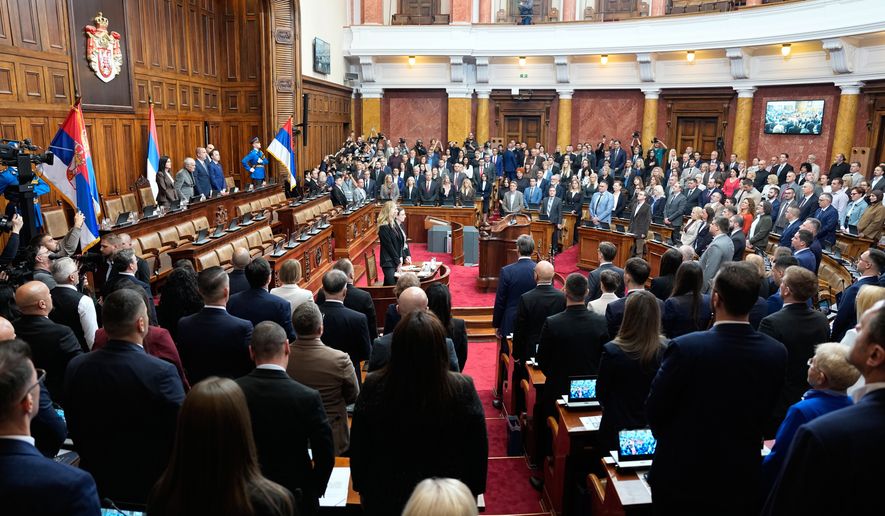

BELGRADE, Serbia — Serbia’s new parliament met on Tuesday for the first time since the stunning election victory last month by a grassroots student-led movement that ousted then-President Aleksandar Vucic and his party.
The National Assembly’s inaugural session marks the first step toward the formation of Serbia’s new government. It’s also the first time ever in the Balkan country that a newly-formed protest movement makes up the parliamentary majority.
The lawmakers are first set to choose a parliamentary speaker, his or her deputies and various parliamentary bodies. The vote is expected on Wednesday after Tuesday’s session passed with other procedural matters and a debate.
People were interested in these podcasts
A new government then must be voted into office within 90 days.
The Students’ List movement holds 140 parliamentary seats in the 250-member parliament, compared with 103 belonging to Vucic’s right-wing Serbian Progressive Party. Vucic himself is now one of the opposition lawmakers after serving as defense minister, prime minister and president over the past 14 years. The remaining parliamentary seats belong to the parties of Serbia’s ethnic minorities.
Vucic, in a lengthy speech, told lawmakers that his party “won’t carry out any obstruction” of the parliamentary work. But he also said that his party soon will stage protests. He did not elaborate.
Vucic has accused the students of “revolutionary terror” in daily appearances on loyal media and social networks following a surge in postelection arrests that included officials, police officers and a private bank owner who allegedly attempted to siphon off money.
Hundreds of people gathered outside the parliament building in central Belgrade to see off the student-backed lawmakers, who are mostly teachers, professors and other experts with respected careers but little or no political experience. A woman in the crowd spilt yoghurt on the head of a female lawmaker from Vucic’s party as she was arriving.
Serbian media have reported that the new lawmakers spent days practicing and preparing for the session, where they will face well-versed and experienced opposition lawmakers notorious for aggressive verbal attacks on opponents.
The Students’ List group on Oct. 25 defeated Vucic’s right-wing SNS in the early parliamentary vote that came after two years of anti-corruption protests in the Balkan country. The SNS party’s caretaker government remains in office until a new Cabinet is confirmed.
Serbia also must hold an early presidential election by the end of the year. The date for the vote has yet to be determined. It was triggered by Vucic’s resignation in September as president to pursue a failed attempt to become the new prime minister.
The protests erupted first in November 2024 in response to a train station tragedy, which involved the collapse of a concrete canopy in Serbia’s north that killed 16 people. Many in Serbia blamed the collapse on flawed renovation work and rampant graft.
Students have promised to restore democracy and the rule of law, and to terminate deeply rooted corruption, cronyism and alleged organized crime links that they say thrived under Vucic.
Observers have predicted that the Students’ List group will face resistance within the system, and strong opposition in parliament. The students have said they won’t allow the session to turn into a “reality show.”
The parliamentary meeting’s live coverage on the state-run RTS television station was widely watched. Some bars in Belgrade and elsewhere in Serbia advertised special prices for people to watch it.
Serbia is a candidate nation for European Union membership, but the effort has stalled under Vucic because of democratic backsliding and close ties with Russia. EU officials have offered to help the future Serbian government through the promised reforms.

Please read our comment policy before commenting.