


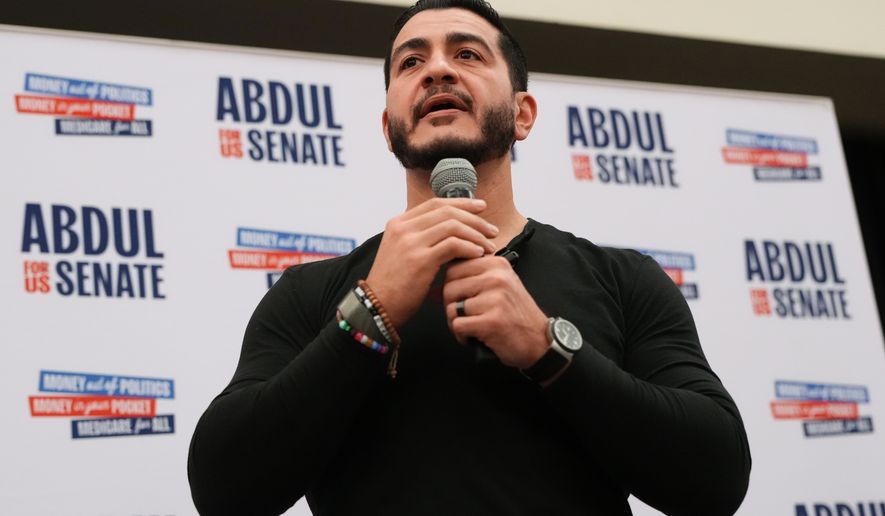

YPSILANTI, Mich. — Less than 24 hours after Rep. Haley Stevens rocked Michigan’s Senate race by endorsing Republican Mike Rogers, Abdul El-Sayed was back on the campaign trail Monday, imploring supporters to ignore the political drama and vote.
Launching the first of four stops on the final full day of campaigning, Mr. El-Sayed framed the election as a test of whether ordinary people can build a coalition strong enough to challenge the political and economic establishment.
“This movement is about you,” Mr. El-Sayed told the crowd. “It is about whether or not we are willing to put ourselves into our democracy. It is about whether or not we are willing to reach across the divide they think we will not reach. It is about being willing to build together what we cannot have alone.”
People were interested in these podcasts
Mr. El-Sayed said the race is bigger than President Trump, casting it as a choice between a system rigged for corporations and billionaires and a grassroots movement focused on lowering costs and expanding opportunity.
“Donald Trump is not himself the disease of our politics. Donald Trump is the worst symptom of the disease of our politics,” he said. “The disease is the system that allows big corporations and billionaires and special interests to buy and sell politicians in ways that lead them rigging the system against us.”
He was joined by Sen. Elizabeth Warren of Massachusetts and Rep. Debbie Dingell, with Rapper Common scheduled to join him later in Detroit for the campaign’s closing event.
The backdrop to Monday’s event was the endorsement of Mr. Rogers by Ms. Stevens, a Democrat who lost to Mr. El-Sayed in the Democratic primary for Senate.
Her defection marked the collapse of a fragile post-primary relationship and handed Mr. Rogers a potential opening in the campaign’s closing day.
For months, Mr. Rogers worked to win over Jewish Democrats and Black voters who are uncomfortable with Mr. El-Sayed, particularly supporters of Ms. Stevens after the hard-fought primary contest.
Mr. Rogers criticized Mr. El-Sayed’s anti-Israel stance, accused him of sympathizing with terrorists and highlighted his family’s alleged ties to the Muslim Brotherhood, which spawned terrorist groups such as Hamas.
By Monday, digital “Country Over Party” billboards featuring Ms. Stevens and Mr. Rogers had sprung up along I-94.
Mr. El-Sayed tried to avoid talking about the endorsement. He said his message to voters nervous about it was, “Go vote.”
“There is only one thing we can do to control the outcome,” he told reporters, saying he pays little attention to the daily churn of polls and campaign intrigue. “I don’t think much about my former opponent.”
Still, Democrats were struggling to process Ms. Stevens’ decision, which came after more than 2 million early votes had already been cast and with most polls showing Mr. El-Sayed holding a lead.
The endorsement also renewed questions about whether Mr. El-Sayed’s left-wing populist message and confrontational political style can assemble a winning coalition in a battleground state where Democrats have traditionally relied on a broader ideological tent.
Some of Mr. El-Sayed’s supporters said Ms. Stevens had actually helped him.
Denise Bailey, a 42-year-old mail carrier, said the endorsement energized Democrats who were already planning to vote for Mr. El-Sayed.
“I feel like energy was flagging, and then this has been like everybody has been like, ’Oh, hell no!’”
Ms. Bailey was part of a packed crowd at Eastern Michigan University, where supporters gathered Sunday morning for one of Mr. El-Sayed’s closing campaign events.
His allies also sought to portray the endorsement as a political misfire.
Amir Makled, a lawyer running for the University of Michigan Board of Regents, said the campaign followed the news by posting its biggest fundraising day yet, bringing in more than $2 million.
“I think that Haley’s true colors came out, and, you know, the opposite effect has happened,” Mr. Makled said. “I think that was a moment that unified the party.”
Ms. Warren, meanwhile, told the crowd that the focus should be on Mr. Trump’s failure to lower costs, insisting that Mr. El-Sayed is the change agent both Washington and Michigan need.
“We need fighters and Abdul is the fighter,” Ms. Warren said. “We need fighters, not rubber stamps.”

Please read our comment policy before commenting.