



OPINION:
It is the first week of November, and Election Day is once again nearly upon us.
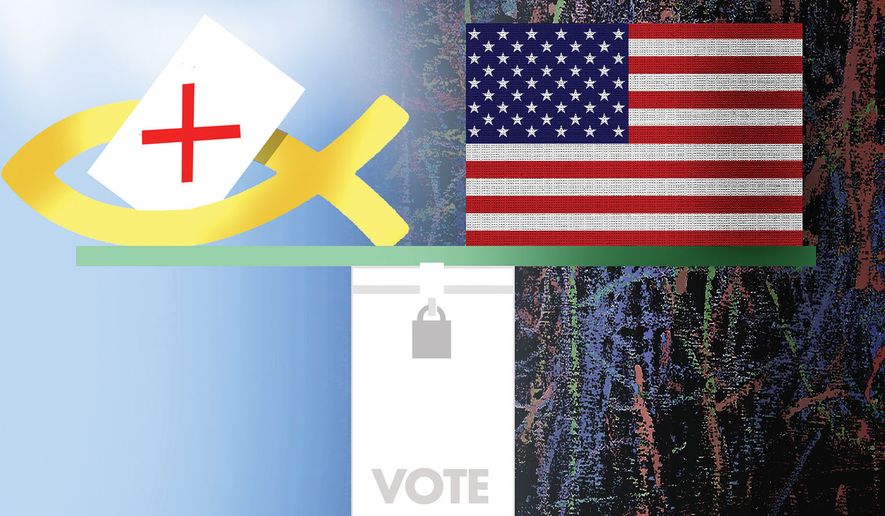
With so many critical issues at play for our country, the ubiquitous question remains: Will the largest potential voting bloc in American politics bother to vote, and perhaps even more important, do they even believe they should? Will America’s Bible-believing Christians go to the polls Tuesday, or will they stay home because they think politics has no place in their church and that their church has no place in politics?
The most recent Gallup polls indicate that 30% to 35% of American adults identify as “born-again evangelicals.” This figure translates to approximately 100 million people nationwide. If you add practicing Catholics, that figure increases by another 20 million.
People were interested in these podcasts
Therefore, a conservative estimate of the number of Americans who align themselves with the Bible’s clear teachings on matters such as the sanctity of human life, the definition of marriage, sexual identity, individual freedom, moral culpability, private property rights and community responsibility totals at least 120 million men and women nationwide.
Do these people vote? The unfortunate answer is that millions do not. In fact, the data shows that 40% or more of our country’s Christians will not show up on Election Day to simply check a box as to whether Planned Parenthood should be allowed to kill babies, whether children should be sexually indoctrinated in our public schools, or whether women should have their own bathrooms, showers, locker rooms and sports.
Why is this?
The unfortunate answer is that many Christians have bought the lie of separation of church and state, and thus believe that politics has no place in their faith and that the faithful should stay out of politics.
Is there any legal, historical or biblical basis for such ecclesiastical disengagement? The simple answer is no.
Thomas Jefferson’s letter to the Danbury Baptists, for example, makes it unmistakably clear that his hypothetical “wall” of separation exists to keep the government out of the church’s business, not the other way around. There is zero evidence here that our nation’s third president was telling Christians that they were legally obligated to confine their faith to the four walls of the church building.
In fact, he said the opposite, reassuring these Connecticut pastors that the government had no say in what the church did in the public square.
America’s founding era is replete with references proving this point. On the Christian responsibility to engage politically, John Jay wrote, “It is the duty, as well as the privilege and interest, of our Christian nation to select and prefer Christians for their rulers.” John Adams added that without Christian engagement, the American republic would fail: “Our Constitution was made only for a moral and religious people. It is wholly inadequate to the government of any other.”
The Bible is equally clear, if not more so. Here are just a few verses that could fill volumes on the matter: “When the righteous are in authority, the people rejoice; but when the wicked bear rule, the people mourn.” (Proverbs 29:2) “Seek the welfare of the city where I have sent you into exile, and pray to the LORD on its behalf, for in its welfare you will find your welfare.” (Jeremiah 29:7) “I urge that supplications, prayers, intercessions, and thanksgivings be made for all people, for kings and all who are in high positions.” (1 Timothy 2:1-2) Jesus explicitly commanded his followers to be salt and light (Matthew 5:13–16) and, thereby, to engage in the society around them — not to withdraw from it.
No one is arguing that politics has any salvific merit or that civic engagement should replace the Great Commission. No one is saying that voting is the sum of all Christian responsibility. Confession, prayer, evangelism and personal holiness rank higher, but who among us can argue that voting is not one simple way to use the freedom that God has given us to love our neighbors as ourselves?
Should Christians vote? The answer is yes, and we should be ashamed of ourselves if we do not. Anthony Esolen of Touchstone magazine says it best: “We [vote] to keep the madness at some distance, and buy what time we can to recover. … We vote for breathing space. [We are] recommending not retreat but real and energetic assault on all fronts. … [We vote to] recover the goodness of ordinary life, so that others, wearied by political war without end, will see with their eyes what we believe in our hearts and profess with our lives, that there is no other name but Christ whereby we may be saved.”
• Everett Piper (dreverettpiper.com, @dreverettpiper), a columnist for The Washington Times, is a former university president and radio host. He is the author of “Not a Day Care: The Devastating Consequences of Abandoning Truth” (Regnery). He can be reached at epiper@dreverettpiper.com.
Follow the author

Please read our comment policy before commenting.