


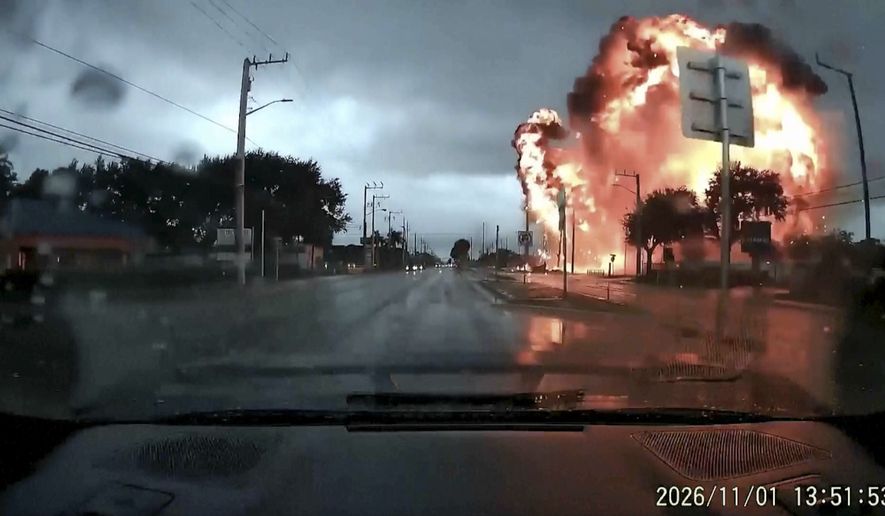

The private jet that nosedived onto a Florida roadway and killed all nine people aboard may have broken up before impact, according to federal investigators.
The National Transportation Safety Board, an independent federal agency that investigates transportation accidents, sent a “go-team” of rapid-response technical specialists to examine Sunday’s crash of the Learjet 60 in Lake Worth Beach, Florida, the agency said.
Documentation of the incident has begun, NTSB investigator in charge Timothy Monville said at a Monday press conference.
People were interested in these podcasts
Investigators have gathered evidence that there was “some breakup” before the aircraft crashed, NTSB member Tom Chapman said at a Monday press conference.
Parts of the aircraft may be found away from the actual impact site, he added.
“We have a lot of work to do on scene,” he said. “This will be a several-day process, and the biggest obstacle that we’re going to have is recovering the major wreckage from the impacted crater on the roadway.”
The NTSB is leading the investigation, with support from the Federal Aviation Administration.
Transportation Secretary Sean Duffy and the FAA said all nine people aboard were killed. Authorities have not identified the victims or said what caused the crash.
The nine people on board included two flight crew and seven passengers.
Identities will be confirmed by local authorities, Mr. Chapman said.
One man on the ground was in a vehicle that was leaving the immediately adjacent impacted area, and he sustained a leg injury, authorities said.
The aircraft was operated by Aurora Aviation, doing business as Upper Jets, a private charter firm based in Fort Lauderdale, according to federal officials.
At about 10:37 a.m., the private business jet departed from Austin-Bergstrom International Airport in Texas, bound for North Eleuthera Airport in the Bahamas.
It went down at approximately 12:50 p.m. on Sunday, crashing into a roadway area on Military Trail between Cresthaven Boulevard and 10th Avenue North near Greenacres.
Before crashing, at about 12:47 p.m., a pilot reported to air traffic control that they had “light, clear ice that is manageable and moderate turbulence” at 35,000 feet, before requesting a climb to 37,000 feet.
The ice is “certainly a factor” in the investigation, Mr. Chapman said Monday.
The crew reported the outside temperature was -53° Fahrenheit.
“Weather conditions are a major focus of the investigation,” he said. “You all saw what the weather was like here at the surface. What we have to determine is what the weather conditions were like at altitude.”
The pilot later declared a Mayday emergency, descending 10,000 feet per minute, then an “overspeed condition” and a descent of “20,000 feet per minute.”
Flight tracking data showed the jet fell more than 26,000 feet in about a minute. The last altitude Flightradar24 received was 8,750 feet at 12:49:22 p.m. local time. The service reported the jet’s descent rate exceeded 32,000 feet per minute, equal to a downward speed of about 360 mph.
Then the signal dropped.
The jet nosedived into the road, creating a fiery crater.
“Our mission is to understand not just what happened, but why it happened, and to recommend changes to prevent it from happening again,” Mr. Chapman said. “We will not be determining the probable cause of the crash, but we’re here on scene, nor will we speculate about the cause.”
Early indications show that a cockpit voice recorder was installed on this aircraft, but federal investigators do not know that the recorder was still on board at the time of Sunday’s flight.
Contact the author


Please read our comment policy before commenting.