



OPINION:
Earlier this year, at a pre-Davos conference at the United Nations in Geneva, I listened to European leaders fret about their continent’s future.
They lamented that about 79% of artificial intelligence startup funding in 2025 went to American companies and said Europe will miss the revolution.
As a U.S. Marine and former member of Congress who now serves on a bank board and invests in private companies, I heard something deeper: The United States is winning the AI race, and we can lose it only by beating ourselves or letting China steal our lead.
People were interested in these podcasts
A generation ago, the world grappled with the commercialization of the internet. In 2000, venture capital poured $100 billion into startups and then crashed. Yet many of today’s 10 most valuable companies rose with the internet: Alphabet, Amazon, Nvidia, Broadcom, Meta and a reinvented Apple and Microsoft.
America won the race to the internet, and that victory helped drive our gross domestic product from $10.3 trillion in 2000 to $30.8 trillion in 2025. Inflation-adjusted GDP per person rose 40%, from about $50,000 to $70,000.
In 1990, fewer than 1% of Americans used the internet; now 96% do. U.S. internet traffic has grown from about 30,000 terabytes per month in 2000 to more than 500 million terabytes per month in 2025, with a compound annual growth rate of nearly 48% over 25 years. American dominance of that technology underpins American primacy.
Now the world competes in a new internet-enabled race: AI. Conceived in the 1950s, AI advanced in fits and starts before accelerating over the past two decades. Bloomberg began pricing bonds algorithmically in 2008, Tesla put Autopilot on the road in 2015, and J.P. Morgan began reviewing loan contracts with machine learning in 2017.
Washington saw it coming. In 2018, Congress created the National Security Commission on Artificial Intelligence, chaired by former Google CEO Eric Schmidt. I worked with congressional colleagues to enact the commission’s recommendations in the 2021 National Defense Authorization Act, ensuring that America, not China, would win the AI race.
In late 2022, large language models such as ChatGPT — soon followed by Claude — pushed AI into the public square.
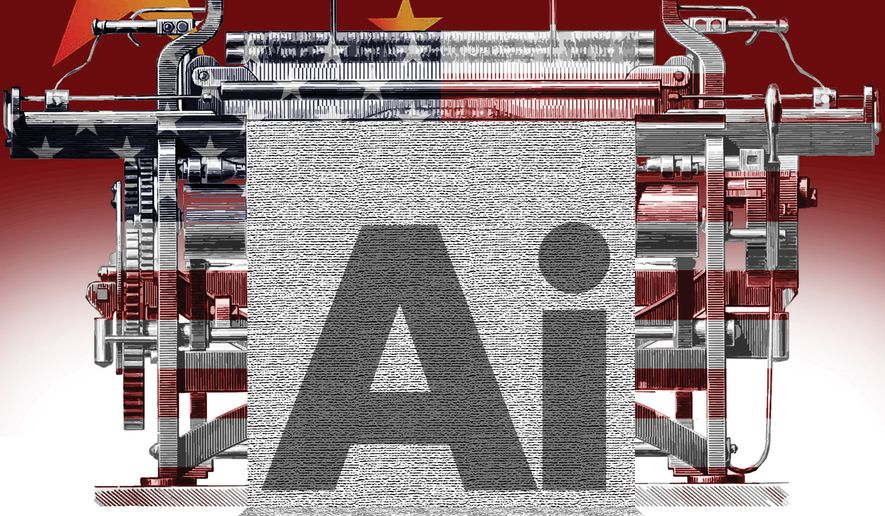
New technologies breed fear. Two centuries ago, weaving a yard of cloth by hand took about 40 minutes of labor. Mechanized looms eventually cut that to less than a minute. Fearing for their livelihoods, the Luddites smashed and burned the new machines. Thank your bedsheets that the Luddites lost.
Right now, America leads in AI investment, committing more than 23 times as much private capital as China. Yet two threats could squander America’s lead: one within, one without.
At home, critics worry about AI’s demands for power and water. We can address these concerns: new power generation, water-conserving cooling systems and permitting reform. Meeting these challenges directly beats surrendering the field.
Washington can also wound American champions. Anthropic, which completed a landmark public listing this month at a valuation of approximately $1.5 trillion, warned in its initial public offering prospectus that government attitudes toward the company could hurt its customer and partner relationships.
This year, the Pentagon designated the company a supply chain risk and for several weeks the Commerce Department blocked foreign access to two of its most advanced models. We must marshal our champions, not kneecap them.
Meanwhile, China seeks to pirate our software and steal our hardware. U.S. agencies say Chinese AI firms have systematically mined American models, and federal prosecutors have charged Chinese schemes to smuggle Nvidia chips.
Export controls mean little without the agents and funding to enforce them.
Technology’s ultimate value lies in application. The internet permeates American life at home and at work, and so will AI. China understands this; the Chinese Communist Party aims to have AI across 90% of its economy by 2030.
Washington should continue to make sure that we win the AI revolution — by facilitating power construction, enforcing export controls and avoiding regulation that hands the race to Beijing. Do that, and AI will power the next American century.
Future generations will thank us, just as we thank those who refused to smash the looms.
• Van Taylor, a businessman based in Plano, Texas, served in the U.S. House, the Texas Senate and the Texas House and is a retired U.S. Marine officer who led Marines in Iraq.

Please read our comment policy before commenting.