



OPINION:
The sudden grounding of U.S. domestic air traffic for more than four hours on Nov. 13 shocked most Americans.
It should not have. In many ways, it was business as usual.
Government, by its very nature, is reactive, not proactive. Disruptions such as the ground stop generate bad publicity, congressional hearings, political grandstanding and calls for additional spending. Bureaucratic heads sporting new black eyes sometimes roll, but little substantive change materializes after the crisis du jour passes and the spotlights dim.
People were interested in these podcasts
The main legacy of virtually all government crises, as documented by Robert Higgs in his seminal book “Crisis and Leviathan: Critical Episodes in the Growth of American Government,” is relentless expansion in both the size and scope of government.
Transportation Secretary Sean Duffy warns that we “will have more” such flight disruptions unless Congress appropriates another $50 billion to upgrade legacy air traffic control systems. Pleading for more money is almost always the bureaucracy’s response to evidence of system or policy failure.
However, the problems at the Federal Aviation Administration — and the air traffic control system — go much deeper than an inadequate budget.
Most serious is the fact that there is little incentive for our so-called public servants to systematically upgrade infrastructure. The political benefits come from announcing new spending programs. After that, the actual hard work of designing and building — which may take years or decades — gets little attention, even when it fails.
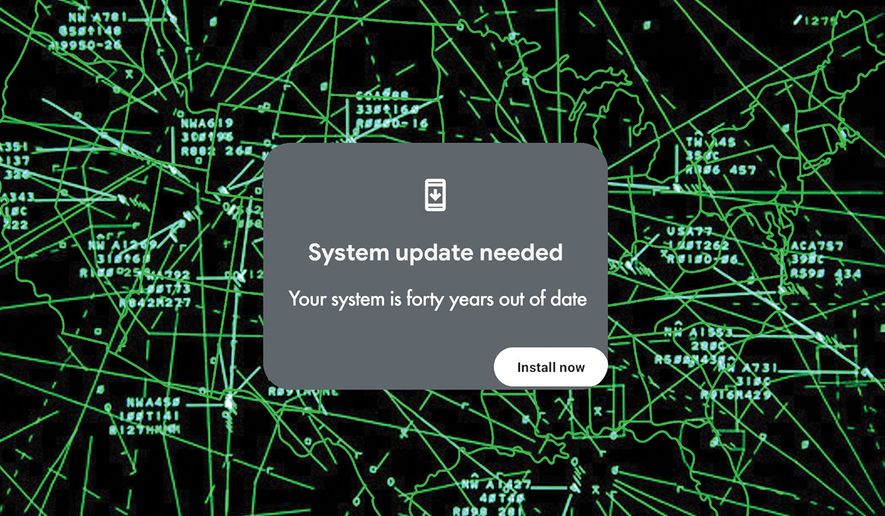
A nearly 40-year veteran of the U.S. air traffic control system told my research associate, “They are now in a predicament.” The entire “NextGen” plan to update the air traffic control system, he says, was based on incremental improvements.
“I always questioned whether that was even possible. You run into existing systems that are so old that ’you can’t get there from here.’ That is part of why they have failures; they add whiz-bang stuff, that may be relatively useless, to old systems and sooner or later one or the other pukes.”
The Federal Aviation Administration is not alone in its inability to modernize. The computer technology the IRS uses to process tax returns is decades old, dating to the 1960s. Repeated attempts to modernize the IRS’s data processing systems have come to naught.
According to the Government Accountability Office, “the IRS is just one of many agencies, governmentwide, grappling with aging or old IT systems. Of the government’s $100 billion in annual IT spending, 80% goes to operating and maintaining existing systems. The older the systems are, the more the upkeep costs — and older systems are more vulnerable to hackers.”
Fortunately, no one was injured or killed when the ongoing patchwork upgrading of the air traffic control system caused the recent ground stop. Yet the disruption is further evidence, if any were needed, that government is institutionally incapable of cost-effective policy administration — and throwing more money at the problem is unlikely to bring about fundamental improvement.
As others have emphasized, Mr. Duffy’s $50 billion budget request will finance only a one-time “fix,” likely to be rendered obsolete by new technology.
A more promising step would be to spin off the FAA’s air traffic control operations into a private nonprofit entity, as many other countries already have.
As the veteran air traffic insider told us, “Australia did what Duffy is trying to do in four years in the mid- to late 1990s for less than $500 million [about $1.1 billion in current dollars]. New Zealand did something on a lesser scale … but similar in nature in the same time frame. It can be done.”
• William F. Shughart II, distinguished research adviser and senior fellow of the Independent Institute in Oakland, California, is the J. Fish Smith Professor in Public Choice at Utah State University’s Huntsman School of Business.

Please read our comment policy before commenting.