


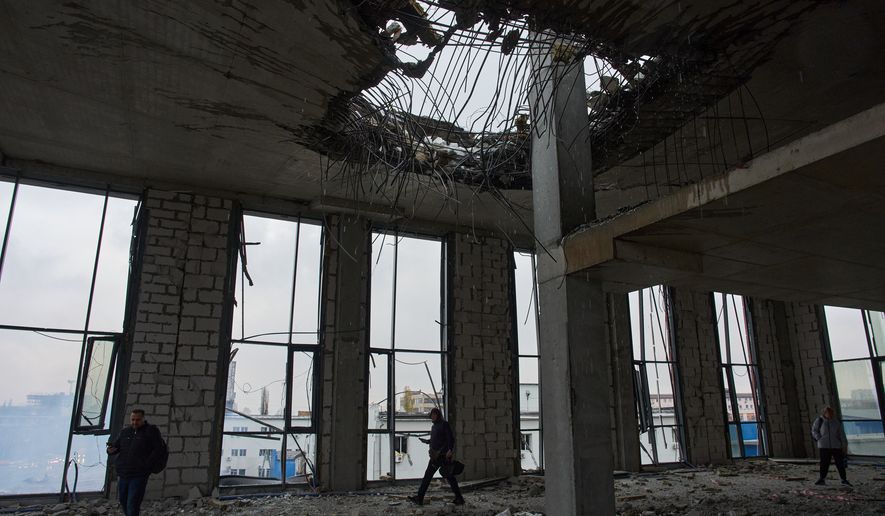

PARIS — As Russian ballistic missiles rained down on Kyiv overnight Thursday, wounding seven people and damaging a shopping center, dozens of U.S.-made interceptors that could help Ukraine defend itself against such attacks were still awaiting a signature in Washington.
Ukrainian President Volodymyr Zelenskyy on Tuesday said Defense Secretary Pete Hegseth had yet to authorize the transfer of 48 Patriot missiles to his country, confirming earlier reporting by the Financial Times that the Pentagon was holding up deliveries of some 60 interceptors allocated to Ukraine, with some being financed by its Western allies.
“Unfortunately, Hegseth has not signed it yet, so it depends entirely on him,” Mr. Zelenskyy said during a joint press conference with Hungarian Prime Minister Peter Magyar.
People were interested in these podcasts
On Wednesday evening, the Ukrainian president announced that Kyiv’s allies committed more than $700 million in additional funding for American weapons, specifically for interceptors capable of downing ballistic missiles.
“Unfortunately, we don’t have any good news from the United States yet on accelerating deliveries,” he said.
The dispute has exposed a vulnerability in the arrangement struck last year between Washington and its NATO allies to sustain military assistance to Ukraine.
While European governments have largely taken over the financial burden of supplying Kyiv with American weapons, the availability of those arms and the political authority to release them remain in Washington’s hands.
The Iran war, which has depleted American missile inventories and heightened competition for air defense equipment, has further complicated Ukraine’s efforts to secure supplies ahead of its fifth winter under Russian bombardment.
Billions in European funding
Launched in the summer of 2025, the Prioritized Ukraine Requirements List, or PURL, was designed to reconcile President Trump’s reluctance to commit additional American taxpayer dollars to Ukraine with European governments’ desire to sustain the country’s defense.
Under the NATO-coordinated initiative, allies finance packages of American military equipment tailored to Ukraine’s most pressing battlefield requirements, including ammunition and sophisticated air defense systems that European manufacturers can’t readily supply in sufficient quantities.
According to Ukraine’s Defense Ministry, about 95% of the Patriot interceptors the country receives are supplied through the initiative.
A quarterly report to Congress published this month by the U.S. government’s inspector general overseeing assistance to Ukraine found that 27 NATO allies and partners pledged or contributed $6.8 billion to PURL by the end of September.
Of the $4.89 billion already transferred to the U.S. Treasury, $2.58 billion had been allocated to replenish American military inventories following transfers of equipment to Ukraine. An additional $2.32 billion was earmarked for procuring military equipment and services for Kyiv.
Norway, the Netherlands and Germany were the three largest contributors, collectively committing more than $3.4 billion.
At a meeting of Ukraine’s military backers in Brussels last week, Germany and Norway each announced an additional $300 million contribution to the initiative.
NATO Secretary-General Mark Rutte said allied commitments through PURL and separate American Foreign Military Sales arrangements surpassed $10 billion.
Growing frustration with Washington
The delays have prompted public criticism from some of America’s European allies.
Finnish Defense Minister Antti Hakkanen told Euronews this month that European countries already provided the money for desperately needed interceptors while blaming a lack of political willingness in Washington for holding up deliveries.
“We have the funding; now we need the stocks to be delivered to Ukraine,” Mr. Hakkanen said.
He acknowledged he didn’t know precisely what was preventing the transfers.
The dispute comes amid growing tensions between Washington and Kyiv over Ukrainian strikes on Russian oil infrastructure.
The bombing has complicated the Trump administration’s efforts to contain global energy prices and broker an agreement between the warring countries.
In October, the Financial Times reported, citing European officials, that Washington threatened to suspend the PURL mechanism and intelligence sharing unless Ukraine curtailed its attacks on Russian oil refineries.
Secretary of State Marco Rubio subsequently acknowledged that some interceptors purchased through the initiative might not have reached Ukraine, but denied that the delays were politically motivated.
“There’s nothing being deliberately denied to Ukraine,” Mr. Rubio told reporters during a visit to India.
NATO’s supreme allied commander in Europe, U.S. Air Force Gen. Alexus Grynkewich, also maintained in October that deliveries under finalized, European-funded PURL packages were not delayed.
Norwegian Defense Minister Tore Sandvik told his country’s Parliament on Tuesday that packages financed by Norway this year were delivered as intended.
It remains unclear whether all the outstanding Patriot shipments identified by Ukrainian officials are part of finalized PURL packages or involve separate transfers from allied inventories requiring American approval.
The battle for American missiles
The Pentagon is confronting supply constraints as it seeks to replenish its own arsenals while meeting commitments to allies in Europe and the Middle East and preparing for a possible confrontation with China.
In a Nov. 10 assessment, Mark F. Cancian and Chris H. Park, researchers at the Washington-based Center for Strategic and International Studies, estimated that the U.S. expended two-thirds of its prewar inventory of Patriot interceptors defending against Iranian ballistic missiles.
“Rebuilding inventories will require a multiyear commitment extending beyond the current crisis,” the researchers wrote.
A separate report published last week by the U.S. Government Accountability Office identified persistent munition shortages and urged the Pentagon to develop a plan to restore its inventories.
American manufacturers are expanding production, but the additional capacity will take years to materialize.
Lockheed Martin, which delivered a record 620 PAC-3 Missile Segment Enhancement interceptors last year, reached an agreement with the U.S. government in January to increase annual production capacity to 2,000 missiles by the end of 2030.
On Oct. 30, the State Department approved a possible $2.1 billion sale of 500 Patriot interceptors to Ukraine, financed by Canada, Germany, Norway and European-backed funding rather than American taxpayers.
Deliveries, however, are reportedly not expected to begin until the early 2030s.
Mr. Zelenskyy said last month that Ukraine was receiving an average of 12 Patriot missiles per month from the U.S. this year while facing 150 Russian ballistic missiles over the same period.
Pressure on Capitol Hill
The slow pace of American weapons deliveries has drawn bipartisan criticism in Congress.
Earlier this month, a group of lawmakers, including Republican Sens. John Cornyn of Texas and Chuck Grassley and Joni Ernst, both of Iowa, demanded that Mr. Hegseth explain delays in executing a separate $400 million military assistance package appropriated by Congress for fiscal 2026.
According to the lawmakers, the Pentagon waited until the final weeks of the fiscal year to commit most of the funds. Deliveries are expected to stretch into fiscal 2029, and the package reportedly excludes Patriot interceptors.
The lawmakers have given the administration until Monday to provide a written explanation.
Last week, Ukraine’s government approved an arrangement letting Kyiv draw on the European Union’s $98 billion support loan to finance additional purchases of American weapons through NATO.
At the same time, Ukraine is working with European defense manufacturers to develop a domestic alternative to the Patriot under a program dubbed Freyja.
Mr. Zelenskyy on Wednesday said integration of the system’s components had begun, with initial prototypes and testing expected this winter.
Kyiv has also been seeking permission to manufacture Patriot interceptors on Ukrainian soil. Despite assurances from the White House and encouraging responses from American manufacturers, Mr. Zelenskyy said Tuesday, the necessary licenses have yet to materialize.
Until then, Ukraine’s ability to defend its cities and battered electricity grid against Russian ballistic missiles will remain heavily dependent on decisions made thousands of miles away in Washington, even as European capitals are increasingly footing the bill.

Please read our comment policy before commenting.