


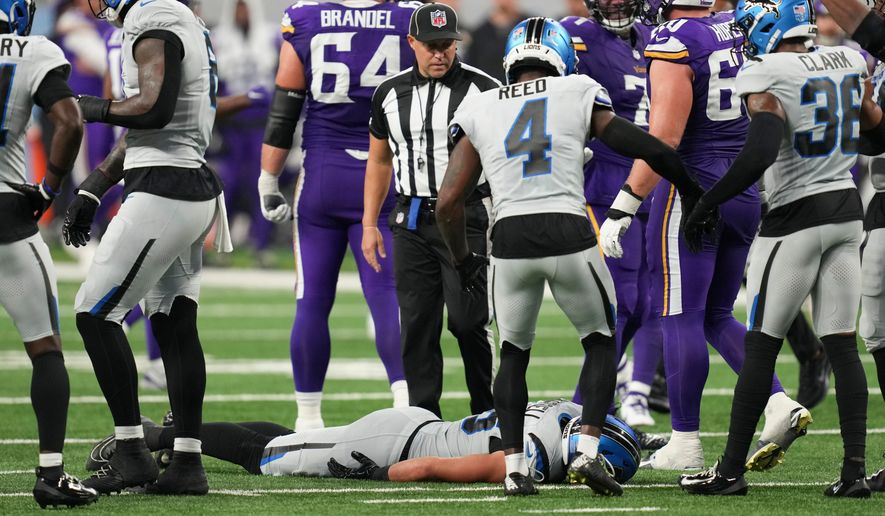

It’s the worst sight on a football field, one that has never been eliminated from the sport.
A player lying motionless — prone or supine on the turf — as teammates, coaches, opponents and fans wonder if he’ll walk again or if a potential neck injury could end his playing career.
The NFL landscape was reminded of this unfortunate reality of football on Sunday, when Detroit Lions linebacker Jack Campbell suffered a neck injury in the fourth quarter of a win over the Minnesota Vikings. He remained on the field for several minutes until first responders placed him on a backboard, carted him off the field and took him to a nearby hospital.
People were interested in these podcasts
Updates have been scarce.
The Lions have still not said whether the 26-year-old has any feeling in his extremities, or if he’ll be able to walk or play football again. The team noted Monday that “preliminary indications are positive.” Coach Dan Campbell asked for continued prayers.
Despite the NFL’s continued efforts to reduce injuries — with a focus on concussions — neck injuries remain a nightmarish threat. A rare risk, but one that nevertheless remains.
A 2023 study in the BMC Musculoskeletal Disorders journal counted 464 neck injuries among NFL players from 2016 through 2021, a rate of 23.5 per 10,000 plays. But 4.5% of those neck issues became career-ending.
The report determined that defensive players were more likely to suffer neck injuries than offensive players, with a handful of common causes.
Head-to-head contact, head-down tackle attempts and heads hitting the ground were most likely to cause neck problems, according to the study.
The NFL has taken a multi-pronged approach to squashing the threat of these injuries. The first is a trickle-up approach to change how players initiate contact, starting with Pee-Wee players. Defenders going for tackles with their eyes toward the turf are at a greater risk for injury.
“That’s a behavior that can be taught,” Dr. Nicholas Theodore, who recently ended his eight-year term as the chairman of the NFL’s Head, Neck and Spine Committee, told The Washington Times. “We teach at the youngest level now with tackling to keep the head up. When you’re not using your head as a weapon or a battering ram, you’re in a much safer position.”
Officials and coaches are still working to drill that head-first approach out of players at the NFL and NCAA levels. Initiating contact with a helmet is a penalty in the NFL, though it isn’t always caught by referees and draws criticism from fans who long for the hard-hitting days of John Lynch and Ronnie Lott.
New York Giants running back Cam Skattebo shares the head-first approach of those Hall of Famers. But he was flagged and fined $7,000 after initiating contact with his helmet during a run against the Houston Texans.
“But I will say, man, the NFL loves to post me when I do stuff like that — but then also wants to take stuff from me,” Skattebo told reporters. “I’m going to run the ball like I want to run the ball. And if I’m going to continue to get flagged for it or fined for it, man, I guess I’m going to play for free.”
Skattebo notwithstanding, the NFL has reported promising results in a trend toward fewer head and neck injuries over the last 30 years.
“We can call it a hardline stance, but it is data-driven,” Dr. Theodore said. “We know for a fact that if you’re coming at a high rate of speed and you’re using your head as a weapon, things don’t usually end well.”
The rate of what he called “catastrophic” injuries has dipped precipitously, according to data compiled by the National Center for Catastrophic Sport Injury Research. The bone-crunching hits of NFL Films highlight reels are less common, even as the game has grown in popularity.
A shift in coaching and player behavior is partially responsible, alongside rule changes. In addition to flags for players who use their helmets dangerously, the NFL has adjusted aspects of the game like the kickoff.
The game-starting play was often cited as the most dangerous in the sport due to the high-speed collisions from blockers and coverage players.
“That’s a recipe for disaster,” Dr. Theodore said.
To allow for more returns while decreasing injuries, the league introduced the “dynamic kickoff” in 2024. The new setup places the coverage team just five yards away from blockers. They’re also prohibited from running until the returner catches the football.
“The speeds have slowed down given the different formation, and they’re substantially slower,” Jeff Miller, the NFL’s executive vice president of player health and safety, said last year. “Therefore the blocks and tackles are happening at slower speeds.”
The NFL has openly expressed optimism about its ability to reduce the risk of concussions. The new rules have been accompanied by new equipment — such as the softshell Guardian Cap attachment and the Q Collar, which is designed to increase blood flow in the skull to protect the brain.
But there have been no breakthroughs in equipment to protect necks and spines, specifically. The NFL’s focus instead remains with rule changes, coaching adjustments and ensuring rapid response when injuries do happen.
There were approximately 10 minutes between when Campbell was injured on Sunday and when he was lifted into an ambulance and taken to the hospital.
“The whole ecosystem of awareness and care, I think, is part of the whole process. …” Dr. Theodore said. “But the nature of the sport is that you’ve got elite athletes moving at a high rate of speed and even with the best equipment, the best rules, the best enforcement, the best training; collisions are going to occur.”
Numbers and rule changes on paper are one thing. But the human toll remains. Fans often overlook it after seeing the initial gut-wrenching replay.
The game goes on.
It won’t for Campbell, not for the foreseeable future. The Lions haven’t said whether he’ll make a return to the football field. Dr. Theodore, who has not treated Campbell directly, noted that every patient and every injury is unique, as is the recovery.
Campbell is supposed to be in the prime of his career. Last season, he was named to the All-Pro and Pro Bowl teams for the first time. The Lions rewarded him with a four-year contract extension.
Now, it’s unclear what his future holds.
“Jack’s deal was definitely scary,” Lions quarterback Jared Goff said. “It just brings you back to reality for a moment that he’s a husband and a father. Scary. We’re praying for him and hope he’s going to be all right. If anyone is tough enough to get through something like that, it’s going to be him.”
Contact the author


Please read our comment policy before commenting.