


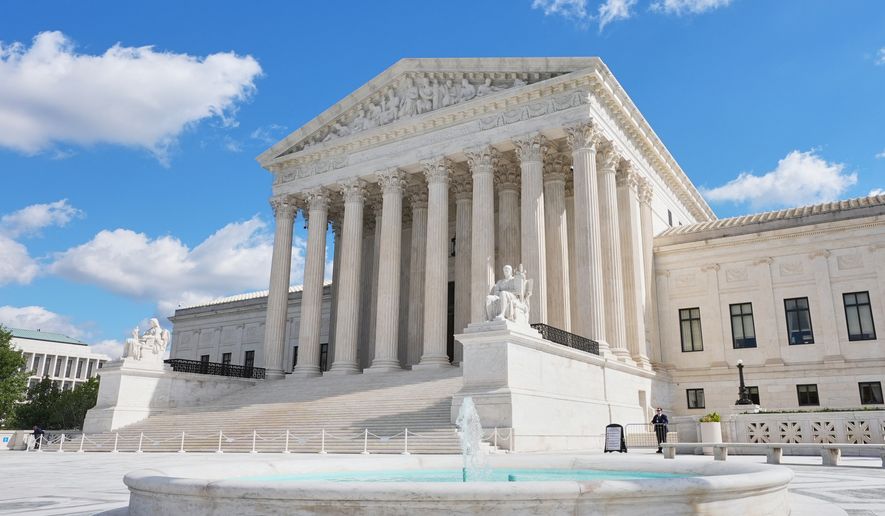

The Supreme Court waded back into the realm of religious liberty Tuesday as the justices heard a case testing whether states can ban religiously faithful Catholic schools from a universal preschool program because they can exclude families that don’t adhere to the church’s teachings on homosexuality.
At issue was Colorado’s universal preschool program, which lets parents choose private schools with the state picking up the tab — but prohibits discrimination, including against transgender students or children of same-sex couples.
Several Catholic parishes challenged the law, saying it would bar them from taking part in the program, costing parishioners thousands of dollars in tuition the state should be paying.
People were interested in these podcasts
Both sides in the case were hunting big prey, seeing the case as part of a confrontation between religious groups’ rights and LGBT rights, plus Supreme Court precedents that have gone both ways.
“This is a clash of rights and strong beliefs and strong interests,” said Justice Brett M. Kavanaugh, a Trump appointee to the court.
The court’s GOP appointees seemed favorable to the Catholic schools.
“There are 2,000 schools, only 34 Catholic schools [in Colorado]. There are plenty of opportunities to respect the rights of religious believers and respect the rights of LGBT parents to find among the 2,000 schools an appropriate fit for their children,” Justice Kavanaugh said. “It seems like this would be a solution in search of a problem.”
But the court’s three Democratic appointees saw the case from the side of the government, saying the schools were asking for a special carve-out in order to keep discriminating.
“It’s not like this is another way to get at Catholic people, it’s ‘We believe in anti-discrimination,’” said Justice Elena Kagan, an Obama appointee. “We’re not going to provide a special accommodation, which is what you are asking for.”
Principal Deputy Solicitor General Sarah Harris, arguing alongside the Catholic parish, disagreed.
“I don’t think it’s a special favor to people to respect a First Amendment right,” she said.
Justice Sonia Sotomayor, though, worried about where to draw the line.
“If it’s a sincere religious exercise to exclude Blacks, this principle would permit the exclusion of those children,” the Obama pick said.
The case is the latest in a string of public benefit-religion clashes to reach the high court.
In 2017, the justices blocked a Missouri law that paid for playground equipment, but excluded churches from applying. Three years later, they ruled against Montana’s tax credits for private schools, which excluded religious ones.
Then in 2022, they ruled against a program in Maine that paid private schools to take students and alleviate overcrowding in public schools, but refused to pay when curricula were deemed too religious.
Chief Justice John G. Roberts Jr. said each of those previous cases involved an express antipathy toward religion. He said Colorado doesn’t include that with its preschool program.
Still, he said the effects are “pretty much the same” — hindering the free exercise of religion.
He laid out the looming clash of precedents.
On one side in Sherbert, a 1963 case that said states cannot refuse to pay unemployment because someone’s religious beliefs prevent their working on a Sabbath.
On the other side is Employment Division v. Smith, a 1990 case that upheld denial of unemployment to two men who were fired over use of peyote as part of the religious practices of the Native American Church.
“It seems you’re quite interested to bury Sherbert,” the chief justice told Colorado’s lawyer. “Nothing in our precedent has backed away from Sherbert.”
On the other hand, he said, the religious groups also seemed eager “to bury Smith.”
Colorado said its program lets schools teach whatever they want — and that includes their religious faiths.
The only requirement, said Helen Norton, who argued for the state, was that schools not discriminate.
She said there was no evidence that Colorado was trying to block religious schools, and the rule wasn’t a pretext to prevent them from joining.
That was surprising to some of the justices who wondered that the state wouldn’t have seen the clash coming.
Justice Amy Coney Barrett pointed out that Colorado has been to the high court repeatedly, with cases challenging anti-discrimination policies used against a cake shop and a website designer.
“It’s hard to see how this wasn’t seen coming,” she said.
Justice Kavanaugh said it seemed like the state “provoked” the issue by refusing the Catholic preschools’ requests.
Ms. Norton said families must have all the options that fit their schedules.
“Families are harmed when they’re turned away by a publicly funded school that makes their lives work,” she said.
Justice Kavanaugh countered that the state does allow same-sex preschools, which he said could limit a family’s choice.
The case is St. Mary Catholic Parish v. Roy.
Lisa Roy is the head of Colorado’s Department of Early Childhood.
A decision is expected by the end of the court’s term next summer.
Contact the author

Please read our comment policy before commenting.